TL;DR: Earning a customer's time and money early reduces the risk of building a product no one needs. Treat a design partner relationship as a paid pilot, not a free feedback session. Hand-pick candidates manually. Pitch the pilot as outsourced custom development for a shared goal. Do not overcomplicate the legal agreement. The founder must personally run onboarding to eliminate early friction.
How to secure a design partner:
Identify your exact ideal customer profile.
Hand-pick candidates manually.
Pitch the relationship as a paid pilot.
Agree on a simple scope and exit path.
Onboard the client closely yourself.
The Cost of Free Feedback
Many B2B founders avoid charging because they have nothing built yet. They treat early targets as unpaid feedback sources. They ask hypothetical questions like "What do you think of this?" and call the polite answers validation.
Free feedback only tells you someone is willing to talk. Payment tells you the problem is real.
A committed design partner gives you irreplaceable industry context. Setting up a design partner startup pilot early reduces your risk. It keeps you from building a product the market does not actually need. You are not asking them to fund your idea. You are offering custom development for a problem they already feel. Willingness to pay is the demand signal.
What to Offer a Design Partner
Founders often struggle with what to offer in exchange for a partner's time. Instead of equity or lifetime free access, offer a clear exchange:
Discounted custom build: Solve their specific problem at a fraction of the cost of an in-house team.
Founder access: Give them direct access to your core team for immediate fixes.
Priority roadmap influence: Build the features they need first.
Direct onboarding: Ensure they get value immediately without navigating self-serve docs.
Clear exit path: Let them leave if the pilot does not work.
Find Candidates Manually
Do not use scalable growth marketing or ads to find your first design partners. Early partners must be hand-picked.
Go where they already are. Look for companies with a severe pain point. They must also have the budget to pay for a pilot. Building for a specific, desperate customer is safer than building for a broad audience. For more general frameworks on early customer acquisition, you can browse resources like the Y Combinator Library.
Pitch the Paid Pilot
Reframe the relationship from a high-stakes legal commitment to a low-risk pilot. Both sides share the same goal.
Use proof of demand to strengthen your ask. A vision without traction looks naive. Signed letters of intent, lined-up demos, or small pilot revenue proves real progress.
Frame your offer simply. You act as an outsourced engineering team working on their specific problem. You charge a fraction of the normal cost. Frame the offer around their immediate pain point. This accelerates buy-in. For more perspectives on navigating these early sales conversations, consider exploring publications like the First Round Review.
Keep the Agreement Simple
Founders frequently stall pilots by obsessing over procedural diligence. They worry about corporate setup and legal rights. Structure matters far less than actual proof that you have a working relationship.
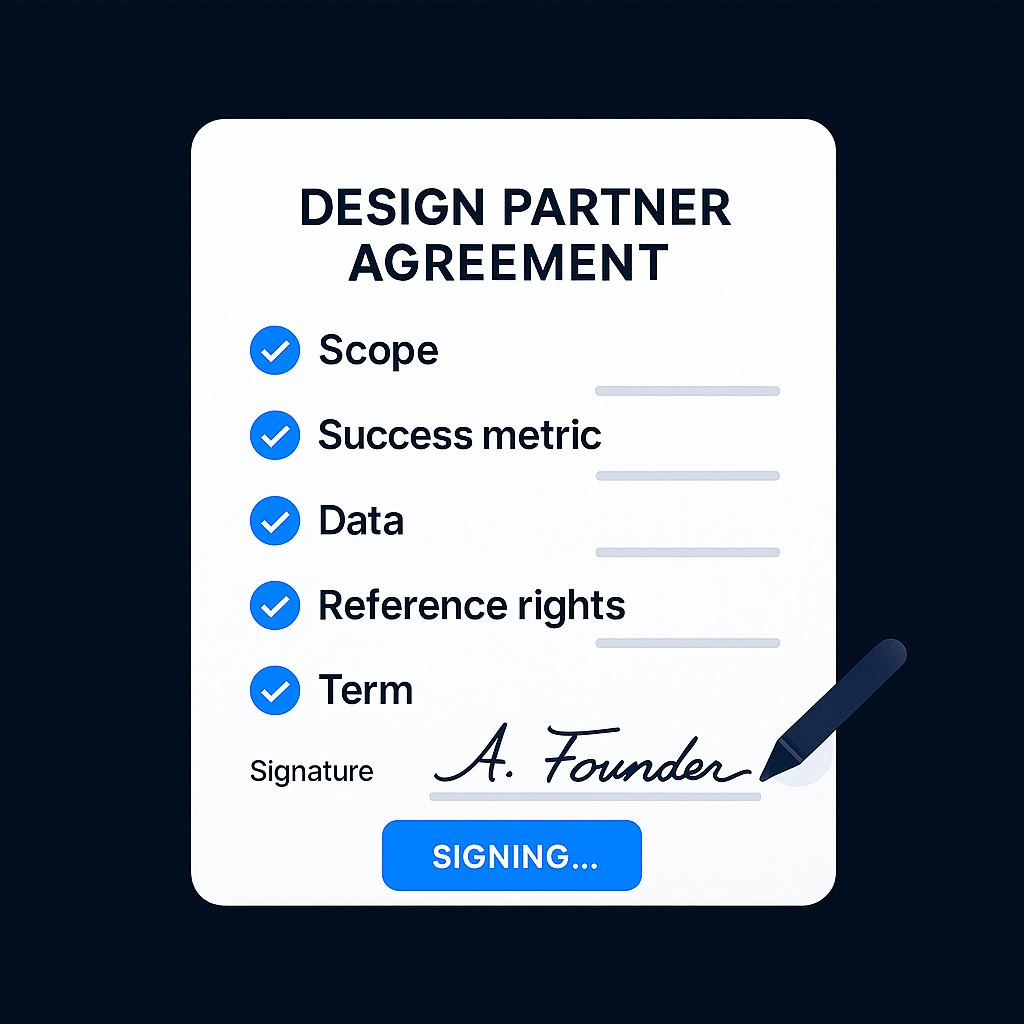
Keep the design partner agreement straightforward. Define the scope, expectations, feedback cadence, confidentiality, payment, and an exit path. Do not manufacture legal consequences for failure. It is just a pilot paid by someone else. You both try to achieve the same goal. Use a design partner template to align on these points quickly.
Execute Closely
Treating early customers like a passive beta list is a mistake. You can read more about this distinction in our guide on running a design partner program vs beta. They are co-creating with you.
Manuals or video recordings rarely work early on. The founder must personally handle onboarding and support the client team directly. Early friction is the easiest conversion killer for an unproven product. Doing unscalable work secures your first enterprise accounts. General resources from investors like Andreessen Horowitz often highlight the importance of hands-on founder involvement.
Practical Framework: Design Partner Discovery Questions
To ensure your pilot yields real market validation, use this framework to evaluate your customer interviews.
Bad Question (Invites Polite Lies) | Better Question (Reveals Past Behavior) | Why It Works |
|---|---|---|
"What do you think of this feature?" | "How did your team solve this specific issue last month?" | Grounds the answer in reality, not hypotheticals. |
"Would you pay $500 for this?" | "How much did you spend trying to fix this last quarter?" | Reveals actual budget authority and pain severity. |
"Does this workflow make sense?" | "Can you show me the exact workaround you are using today?" | Exposes hidden friction and internal processes. |
FAQ
Is it okay to ask a design partner to pay when we have nothing yet?
It is the clearest way to prove real demand. Think of this as acting as an outsourced engineering team. You provide custom development for a fraction of the cost. That is a big favor if it is a problem they do not have the resources to tackle on their own.
How much legal structure do we need if the pilot fails?
Treat a design partner arrangement as a pilot rather than a high-stakes commitment. Avoid adding unnecessary legal consequences or failure penalties to a pilot that does not work out.
How do you find startup design partners?
Find them manually. Do not rely on scalable marketing or ads. Go directly to where your ideal customers are. Hand-pick companies that feel the pain acutely. Invite them into a paid pilot.