TL;DR: Product validation proves people like your idea. Business model validation proves they will pay for it repeatedly through a sustainable channel. Do not hide behind complex unit economics spreadsheets early on. Validate your business model by asking for money, checking retention patterns, framing your pricing against the right alternative, and getting real proof of demand.
It is common to meet founders who believe their product is completely validated. Users love the concept. The early feedback is glowing. The friendly pilots are going well. But there is a catch: they have not actually asked anyone for money. They picked a monthly subscription without checking if the customer uses the tool more than once a year. They have not tested acquisition on cold traffic.
They have validated the product, but they have not validated the business model.
When you learn how to validate business model assumptions, you focus on a few key things. You test willingness to pay, the pricing frame, the retention pattern, and channel economics. It is the final de-risking step you take to validate your business idea before building out operations. It saves you from raising capital based on a naive vision.
The Spreadsheet Trap
Founders often overcomplicate business-model validation by treating it like a search for the perfect formula. They spend weeks modeling customer acquisition cost (CAC), lifetime value, and payback periods in a spreadsheet. Meanwhile, they haven't actually asked a single user for a credit card.
You cannot validate a business model by hiding behind a spreadsheet. You cannot validate it with a perfectly structured 20-slide vision deck. Ask for money. Validate the actual willingness to pay. Structure matters less than storytelling. Storytelling matters much less than real proof that you have a business going on. Revenue, signed letters of intent (LOIs), or lined-up demos are what matter.
The Core Framework for Validation
To test your B2B economics, focus on validating three linked assumptions:
Pricing tolerance and perceived competition: Who does the buyer compare you to, and what monetary value do you create?
Retention pattern: Does the customer's actual usage support a recurring B2B SaaS pricing model?
Channel viability: Can you acquire demand from a segment that is easy to reach and willing to buy?
Business Model Validation Checklist
Before you scale, confirm you have evidence for each of these steps:
Willingness to pay: You asked for money and customers said yes.
Usage frequency: You tracked how often they use it, and it matches your pricing model.
Perceived alternative: You know exactly what they compare your product to.
Cold acquisition: You successfully acquired a customer who did not already know you.
Monetary value: You can prove the time or money your product saves them.
Pricing Frame Worksheet
Pricing can change, but willingness to pay must be proven. The right price depends on the buyer's perceived comparison set, not just competitor averages. Use this worksheet to find your anchor.
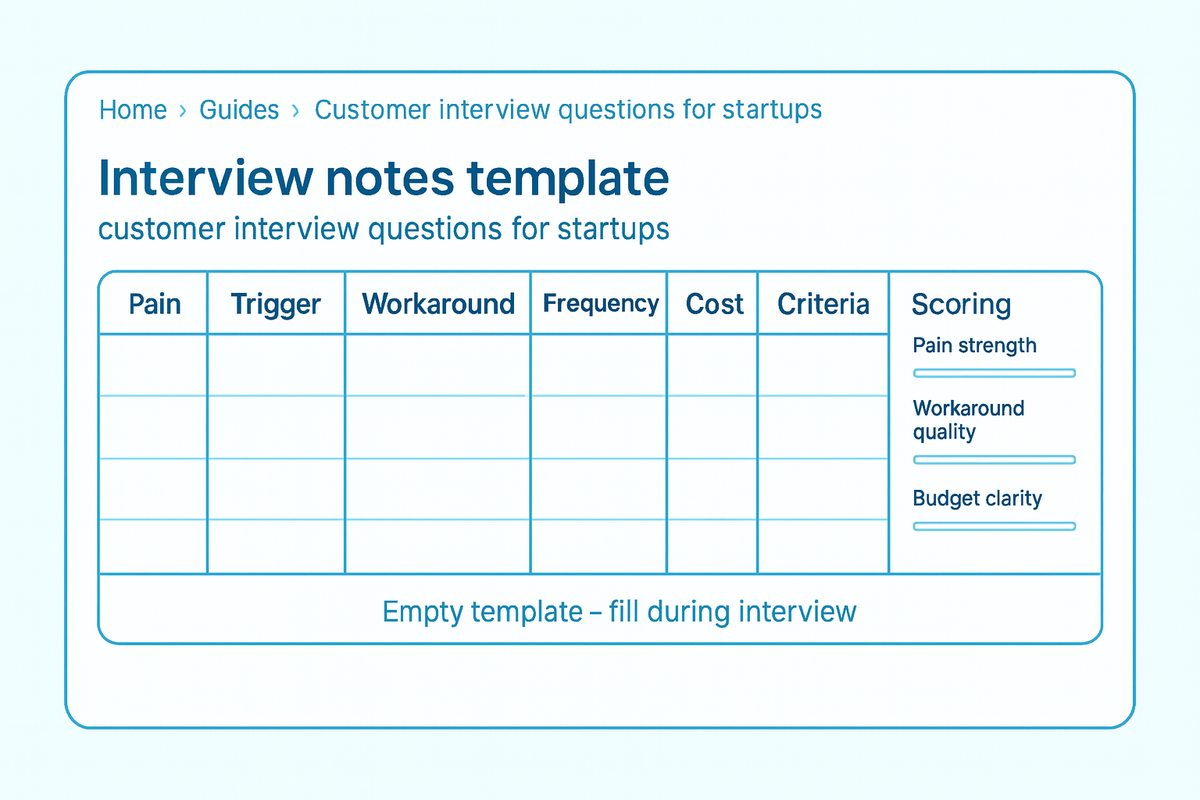
Validation Check | Your Current Hypothesis | Concrete Evidence Needed |
|---|---|---|
Usage Frequency | Is the tool used daily, monthly, or annually? | Active usage data, retained usage over 30 days |
Perceived Alternative | What is the buyer using now? | Customer interviews naming the old tool or process |
Monetary Value | How much time/money does this save? | ROI calculation with a customer, CAC test result |
Demand Proof | Are they willing to pay? | Paid pilot, signed LOI, cold demo booked, revenue |
Example: Framing the Category to Validate Pricing
If a buyer compares your product to a $20 software app, you have one pricing ceiling. If they compare you to a $140 human coaching session, you have an entirely different ceiling.
Consider an illustrative fitness software product that struggled to sell at $20/month. Buyers anchored it against cheap app subscriptions. Instead of lowering the price, the business reframed the category. They positioned the software as an alternative to a $140/hour personal coach. By changing the perceived alternative, they validated their pricing and sold at a premium of $45/month.
Change the Market Before the Product
Market and ideal customer profile (ICP) choice can change the model more than product features.
For instance, if you build an ESG compliance tool, the enterprise segment might look obvious. Large corporations are forced by law to comply. But enterprise sales cycles take 12 months, and competition is fierce. Simple market research might reveal that consultants and green SMBs do voluntary ESG reporting for branding benefits. Targeting this smaller, less saturated segment allows for a much simpler sales motion. You validate your business model faster with real cash flow rather than theoretical enterprise pipelines.
Test on Cold Traffic
A friendly pilot can prove that a workflow matters. But it does not prove you can acquire customers sustainably. Channel validation often requires testing on cold or semi-cold traffic. This is especially true for B2B contexts where acquisition and retention are the biggest unknowns. If you can attract users and get them to pay without a warm introduction, you are starting to validate the channel economics of the business.
For more on structuring these early tests, The Mom Test and Steve Blank's customer development framework offer deep dives on initial go-to-market motions and talking to users. Additionally, Y Combinator's library on finding product-market fit provides foundational advice on asking for money during early tests.
FAQ
How do you validate a business model?
Start by validating willingness to pay and retention. Find out how often your customer uses the product. Check what alternative they compare it to. Finally, test if you can acquire these customers through a repeatable channel.
Where do I start when validating my business model?
Start with the retention pattern and real buyer behavior. Figure out how often your customer will actually use the product. From there, move to testing their willingness to pay and ensuring your channel economics make sense.
What if I don't have any direct competitors?
Saying "we don't have competitors" is a well-known red flag. It usually means you have not found the alternative yet. If you don't know the perceived alternative, you don't understand the market. The alternative might be manual labor, an expensive consultant, a messy spreadsheet, or doing nothing.
Is a subscription model always best for a SaaS product?
No. A subscription only makes sense if the usage pattern supports repeat value. If your customer only needs the solution once a year, forcing a monthly subscription is a mistake. Align the pricing model to the natural usage behavior.
How much proof do I need before raising money?
Vision without traction sounds like naive storytelling. The most successful pitches have one thing: proof of demand. Revenue is best, followed by signed LOIs, and then booked demos.