Lean startup validation is the process of testing a business idea with real customers before building the product. It is designed for early-stage founders who need to verify market demand. A 14-day sprint produces concrete evidence, like customer commitments and willingness to pay, replacing assumptions with data.
TL;DR:
Validation is the single biggest determinant of your startup's success.
If you don't know your competitors, you don't know your market. If you don't know your market, you are building for yourself.
Stop polishing your idea in secret. Use this 14-day sprint to replace your own beliefs with hard evidence from real customers.
Define your metrics for success before you talk to anyone.
Ask for money early. Willingness to pay is the only true measure of value.
Building in the Dark
There is a specific kind of founder who loves to say, "We don't really have competitors." They say it with pride, as if they've invented a completely new category.
To anyone who has built companies before, this is a massive red flag. The issue isn't that you lack focus on the competition. The issue is that if you don't know your competitors, you don't know the market. If you don't know the market, you don't know the customer. You are building for yourself, using your own unchecked beliefs as a roadmap.
Other founders fall into a different trap. They avoid talking about money because they "haven't proven the concept yet." This is backwards. Refusing to ask for money means you never learn if you are producing real value. Money itself doesn't matter at this stage, but willingness to pay absolutely does.
Even when you find a real pain point, it doesn't automatically equal a business. Operational pains often fail as recurring software because they are episodic (nobody renews), already bundled for free into a tool the customer owns, or felt by an employee who has zero budget.
Validation is the core determinant of whether a startup works. A structured 14-day sprint forces you out of your head and into reality, helping you execute your lean startup methodology in the real world before you write a single line of code.
The 14-Day Lean Startup Validation Framework
This sprint gives you a time-boxed, concrete way to execute market validation. The goal is to move from hypothesis to direct customer feedback in two weeks.
Week 1: Hypothesis and Targeting
Day 1: Define the ICP. Exactly who are you helping? Write down the specific profile.
Day 2: Map the Pain and Solution. What is the exact pain, and how do you solve it?
Day 3: Set Your Kill Metrics. Define the exact metric that proves or disproves the idea. Without a predefined threshold, you are just collecting anecdotes.
Day 4: Identify Distribution. Where do these people hang out? Pick one channel.
Day 5: Start Manual Sourcing. Go to where your target customers already are. Invite them manually. Do not build a scalable acquisition process yet.
Week 2: Evidence and Feedback
Day 6: Schedule Interviews. Follow up and lock in times for direct conversations.
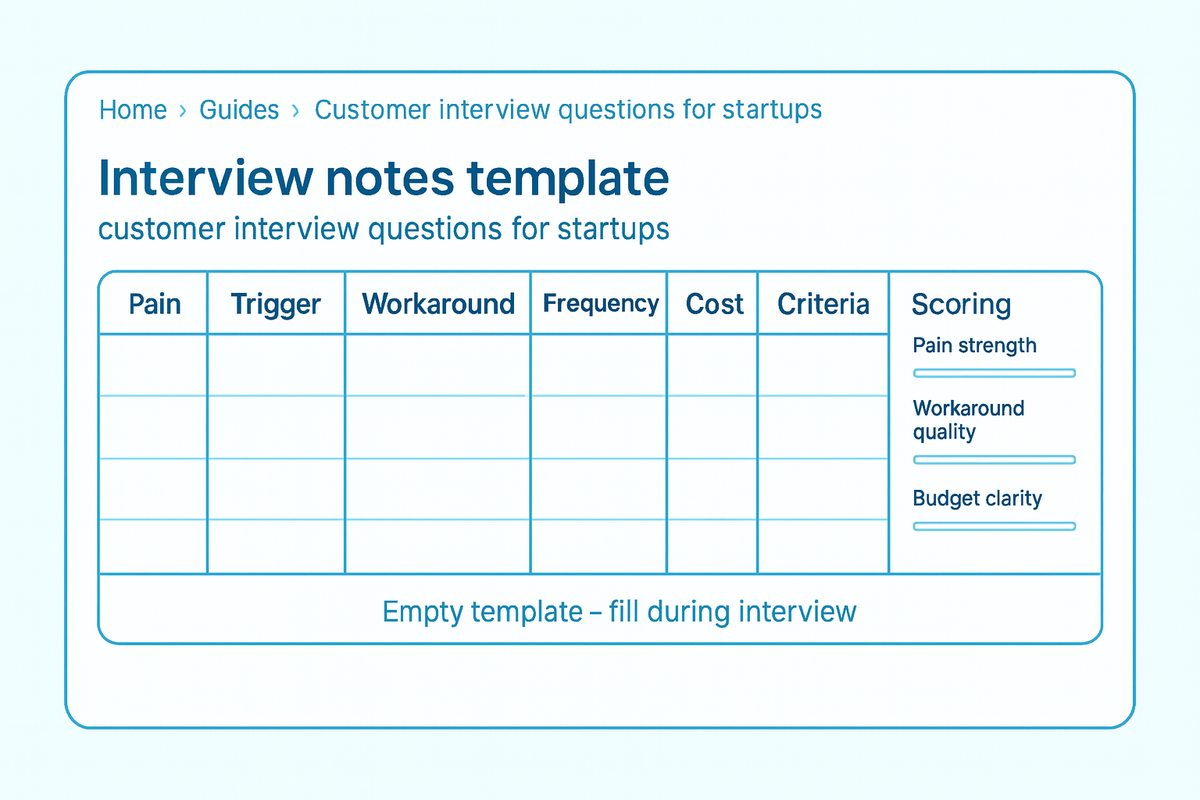
Day 7: Conduct Batch 1 of Interviews. Get on the phone. Do not pitch. Study their past behavior and what it costs them when things break.
Day 8: Conduct Batch 2 of Interviews. Continue the conversations. Update your mental model of the customer.
Day 9: Analyze the Pain. Review your notes. Is this pain frequent and severe enough to matter?
Day 10: Formulate the Offer. Turn your proposed solution into a clear, priced offer.
Day 11: Ask the Money Question. Introduce the priced offer to your most engaged interviewees. Ask for a commitment (like an LOI or pre-sale).
Day 12: Collect Responses. If they say it's a great idea but won't pay, you haven't validated the pain.
Day 13: Review the Metrics. Look at your initial kill metrics. Did you hit the threshold?
Day 14: Decide. Choose whether to build, adjust the ICP, or kill the idea.
Where Founders Get Validation Wrong
The most common mistake is framework-shopping. Founders fight over the perfect pitch deck structure or the best theoretical model, but structure matters far less than actual proof of demand.
When founders misunderstand what needs validating, they typically fail in two ways:
First, they validate the product but skip the market. The vast majority of a startup's success is dictated by the chosen market and ICP. Is it growing? Is there strong competition? These questions impact your business more than your product ever will. Market research isn't just a corporate exercise; it's survival. Read more on why markets win.
Second, founders confirm a pain exists without measuring how often it occurs and what it costs. For example, building a tool for non-standard document formats sounds great, but people rarely use anything other than standard, easily OCR-able files. If you are building for edge cases, you must measure the frequency and the severity of the pain. The mere existence of a pain is not a market.
The Validation Decision Rule
Use this simple decision matrix before you move from validation to building:
Condition | Action |
|---|---|
Pain is confirmed, but willingness to pay is low | Change ICP. The problem isn't severe enough, or you are talking to the wrong person (no budget). |
Willingness to pay is high, but the market is shrinking | Caution. You might get early traction, but long-term growth will be a brutal fight. |
Pain is severe, but only happens once a year | Do not build yet. Episodic pain rarely supports a recurring SaaS subscription. |
Users try it, but rely on an existing bundled tool | Re-test. "Good enough and free" usually beats "perfect and paid." |
Pain is frequent, costly, and users will pre-pay | Build. You have found a real signal. |
FAQ
After two weeks of talking to people, how do I know the feedback is real and not just politeness?
Most sprints fail on interview technique. If you ask customers, "What do you think about this?" or "How do you like it?", you force them to tell polite lies. Do not study their perception of you. Study their past behavior. Ask how they tried to solve the problem last time, and dig into why they behaved that way. You should walk out of every interview with a clearer mental model of the customer. The Mom Test is the gold standard for this.
What if I run tests in a new channel and get zero traction? Does that mean the idea is dead?
Watch out for the false negative. Often, a founder's strategic bottleneck is channel expertise, not the hypothesis itself. If you run your test through a channel you've never operated, you mostly just learn that you don't know the channel. You might wrongly conclude that the product doesn't work. For early tests, use a channel someone on your team already understands.
Can a 14-day sprint prove product-market fit?
No. A validation sprint only produces early evidence of demand and willingness to pay. Product-market fit comes later, when you see sustained retention and it becomes noticeably easier to attract new customers. While there are frameworks for measuring this (like those discussed by Lenny Rachitsky), the 14-day sprint is strictly about de-risking the initial build.