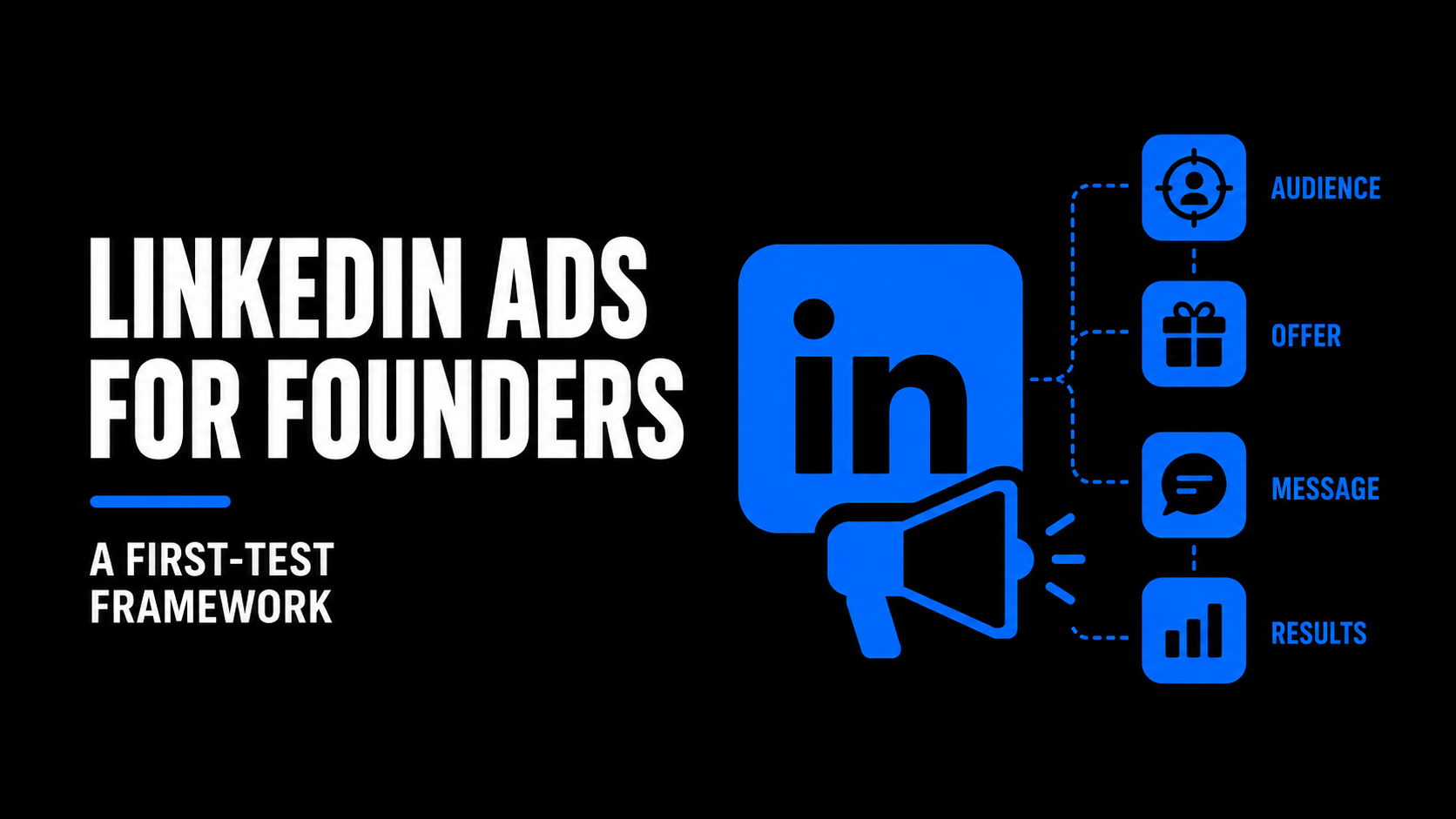
LinkedIn ads can be useful for B2B founders, but only when the first test is designed to answer a specific business question. The mistake is treating early paid social spend like a growth channel before you know the audience, offer, message, and conversion path. This framework helps you run a small, controlled LinkedIn ads test that produces evidence instead of noise.
TL;DR: Test the learning goal before the channel
Use LinkedIn ads when you have a clear ICP hypothesis, a specific offer, a conversion event you can track, and a decision rule for what happens after the test. Avoid spending just to see whether LinkedIn works.
Start with one learning question: audience, offer, message, or landing-page fit.
Keep the test narrow enough that a weak result tells you what to fix next.
Treat budget as the price of evidence, not proof that you have a scalable channel.
Use this as a first-test operating checklist, not a complete paid acquisition system.
Core Definitions
Audience hypothesis. A clear statement of who you believe should care, usually based on role, company type, pain, trigger, or buying situation.
Conversion event. The measurable action that tells you whether the campaign created useful intent.
Message match. The degree to which your ad promise, landing-page headline, proof, and call to action describe the same problem and outcome.
The first-test framework
Use this framework before launching LinkedIn ads.
1. Run a readiness check
Do not launch until you can answer these questions in plain language:
Who exactly are we trying to reach?
What painful or urgent problem are we putting in front of them?
What action are we asking them to take?
What will we do if the test produces weak clicks, weak conversions, or weak sales conversations?
If you cannot answer those questions, run more customer discovery before paid spend. Before launch, choose the campaign objective that matches what you need to learn, and confirm the current in-product setup even if you have saved references such as LinkedIn campaign objectives.
2. Pick one learning goal
Learning goal | Best first-test question | Avoid measuring |
|---|---|---|
Audience | Does this ICP engage with this pain? | Revenue from one small test |
Offer | Does this ask create intent? | Clicks without follow-through |
Message | Which pain angle earns attention? | Generic CTR alone |
Landing page | Does the page continue the ad promise? | Form fills without quality review |
For deeper audience planning, use a separate targeting pass after this framework: LinkedIn ads targeting for founders. If you need stimulus for angles, review B2B LinkedIn ad examples and translate the structure, not the surface copy.
3. Write the audience hypothesis
Use this format:
We believe [role] at [company type] is dealing with [pain or trigger], and will respond to [offer] because [reason].
Good founder tests are specific enough to be wrong. "B2B SaaS leaders" is usually too broad. "VPs of Customer Success at Series A SaaS companies trying to reduce implementation delays" is more testable.
4. Choose the offer
Pick the lowest-friction offer that still reveals useful intent.
Use a practical guide, teardown, calculator, or benchmark-style resource when the market is problem-aware but not ready to talk.
Use a demo, consultation, or pilot invitation when you already have strong evidence that the audience feels urgency.
Use a waitlist only when the product category and promise are immediately understandable.
Before launch, list the questions a buyer would need answered after clicking. A useful companion is LinkedIn ads questions for B2B founders, because weak campaigns often fail from unanswered objections, not just poor targeting.
5. Set budget guardrails
Budget should be tied to the cost of learning. Build a cap before the campaign starts:
Minimum useful spend: enough to get directional signal on one audience and one offer.
Maximum test spend: the amount you are willing to lose in exchange for a decision.
Stop condition: the result that tells you to pause, revise, or move the test elsewhere.
Use a simple budget model before opening an ad account. For a more detailed worksheet, use the LinkedIn ads budget calculator.
6. Install tracking before traffic
A founder test without tracking usually turns into opinion. At minimum, define the conversion event, install the required tag or tracking setup, and confirm that form submissions, demo requests, or key page actions are captured before launch. If you keep platform documentation nearby, verify the current setup path rather than relying only on a saved LinkedIn conversion tracking overview link.
Use the conversion tracking for LinkedIn ads template to map the event, source, landing page, and follow-up owner before the campaign starts.
7. Check landing-page fit
Your landing page should answer the same promise as the ad. Avoid sending a narrow pain ad to a generic homepage.
The same audience is named or clearly implied.
The same problem from the ad appears near the top of the page.
There is one primary action.
There is enough proof, specificity, or product context to make the next step reasonable.
Competing navigation paths do not distract from the test goal.
If the ad and page feel like two different conversations, fix message match first. Use ad landing page message match as the pre-launch review.
8. Define stop, continue, and revise rules
Signal | What it may mean | Next move |
|---|---|---|
Low impressions | Audience may be too narrow, or bid and budget may be constrained. | Revisit targeting and delivery. |
Impressions but weak clicks | Message or creative may not be relevant. | Rewrite the pain angle. |
Clicks but weak conversions | Offer or landing page may be misaligned. | Fix offer and page match. |
Conversions but poor fit | Audience may be wrong or qualification may be vague. | Tighten ICP and follow-up. |
Qualified conversations | There may be evidence worth extending. | Increase test discipline before scaling. |
9. Watch for common waste patterns
Testing three audiences, four creatives, and two offers with a budget too small to learn from any one path.
Optimizing for clicks when the real question is qualified intent.
Copying competitor ad formats without knowing their objective, funnel, or budget.
Sending every ad to the homepage.
Launching before sales follow-up is ready.
Calling LinkedIn expensive without knowing which hypothesis failed.
10. Use the compact decision checklist
Launch only when each line has a clear answer:
One ICP hypothesis is written.
One offer is selected.
One conversion event is defined.
Tracking is installed and tested.
Landing page matches the ad promise.
Budget cap is agreed before launch.
Stop, revise, and continue rules are written.
Sales follow-up owner is assigned.
Hypothetical planning math: if you cap a first test at $1,500 and estimate $25 per click, that buys about 60 visits. If your landing page converts 5% of those visits, you would expect about 3 conversions. That is not enough to prove scale, but it may be enough to inspect lead quality, sales objections, message resonance, and whether the next test deserves a tighter budget.
Will this framework help you get to first customers?
LinkedIn ads can help founders put a defined B2B audience in front of a specific offer. But early ads rarely solve the hardest problem by themselves: knowing which buyer, pain, offer, and message deserve more company time.
The right first test treats paid social as controlled evidence. You are buying exposure to a hypothesis, then watching whether the right people take the right next step. That is very different from declaring LinkedIn a growth engine after one campaign or dismissing it because one broad test underperformed.
The founder mistake to avoid is spending before deciding what the spend is supposed to teach. A useful LinkedIn ads startup framework starts with learning design, not campaign mechanics.
FAQ
Should a pre-seed or seed-stage founder run LinkedIn ads?
Only if the founder already has a narrow ICP hypothesis, a clear offer, and a practical way to follow up. If you are still unsure who feels the pain most acutely, customer discovery and direct outreach may produce cleaner learning than paid traffic.
What should the first LinkedIn ads test optimize for?
Optimize for the learning goal that matters most. If you need to know whether the audience cares, measure engagement and qualified clicks. If you need demand evidence, measure conversion quality and sales follow-up outcomes. Avoid optimizing for a metric you are not prepared to act on.
How much budget is enough for a first test?
There is no universal number. Set a budget that is large enough to create directional signal for one hypothesis, but small enough that a failed test does not force a channel decision. Use hypothetical planning math before launch and treat the result as evidence, not certainty.
Is LinkedIn better for leads or awareness?
It can support both, but founders should choose one job per campaign. Awareness campaigns can test whether a pain angle earns attention. Lead or conversion campaigns should be judged on follow-up quality, not just form volume.