TL;DR: A market research PDF is a decision tool, not a formatting task. Its job is to align founders and investors on market reality before you build the product. The critical sections are the executive summary, methodology, key findings, segmentation, competitive landscape, risks, and next steps. Poor research in a nice template just creates false confidence.
A founder walks into a stakeholder meeting and opens a polished market research PDF. The design looks great. The total addressable market (TAM) chart points up and to the right. The competitor matrix puts their startup alone in the top-right corner.
Then the executive summary drops the punchline: "We have no direct competitors."
To an experienced investor or co-founder, that sentence is a massive red flag.
When a market research report PDF claims there are no competitors, it means the team missed the real threats. The founder likely ignored substitutes, existing workflows, and why buyers actually switch tools. The failure here is not the document design. The failure is that the report proves the team does not know the market, the customer, or the risks.
What is a market research PDF?
A market research PDF is a structured summary of your market discovery. It proves you understand the playing field. It should make disagreement easier, not hide uncertainty behind a clean layout.
The Job of a Startup Market Research Document
Founders sometimes treat market research as a corporate chore. They treat the startup market research process as something they can outsource to an AI tool. But learning the market is foundational. It matches the core steps for evaluating startup ideas.
GPT can help you start a broad overview. But AI cannot tell you which risks buyers will care about next quarter. It cannot tell you how new regulations will change an industry.
The goal of your report is not to be long. A 20-page PDF with weak evidence will always lose to a 7-page PDF that makes the market logic clear. Your stakeholders need to argue from the same facts. That includes co-founders deciding what to build, and early investors deciding whether to fund it.
Market Research PDF Sections
A professional market research PDF includes these core sections:
Executive Summary
Methodology
Key Findings
Segmentation
Competitive Landscape
Risks and Gaps
Next Steps
Keep these standard sections, but frame each one around the specific decision it supports.
Executive Summary
A useful executive summary does not recap every page. It states what the research says the team should do next. Highlight the core market opportunity. Name the primary target segment. Give the immediate recommended action based on the evidence.
Methodology
Stakeholders need to know if they can trust the evidence. A strong methodology section shows your source quality. Did you rely only on public desk research, or did you interview experts? Did you ask customers hypothetical questions, or did you study their past behavior?
Knowing how to do market research properly makes your findings credible. You must focus on past actions rather than future promises, a lesson reinforced by resources like The Mom Test.
Key Findings
This section explains what changed the team's view of the market. Cover market dynamics, like compound annual growth rate (CAGR) and trends. Look for structural changes.
For example, if your research shows a new law will force medium-sized businesses to buy compliance software, that is a key finding. That structural change should shape your product strategy.
Segmentation
Who is the real Ideal Customer Profile (ICP), and who is a distraction? Good market research narrows your focus. You might find that large enterprises look like the obvious target. But consultants and green SMBs might offer a simpler path to early growth.
Competitive Landscape
This is where the "we have no competitors" myth dies. A real competitive landscape includes direct competitors, substitutes, manual workarounds, and adjacent options. You can use resources like the SBA market research guide to help identify these alternatives.
When building a competitor matrix, do not use default axes like "price versus quality." Choose your two axes after your research reveals what actually separates the competitors for buyers. For social media management SaaS, you might map tools by "one-platform vs. many-platform" and "growth-first vs. full-management."
Risks and Gaps
Where should the team not pretend they are certain? Honest market research outlines what you still do not know. Highlight future risks and aggressive competitors, as ignoring market needs is one of the top startup failure reasons. Note where public data is missing and where you need more primary research.
Next Steps
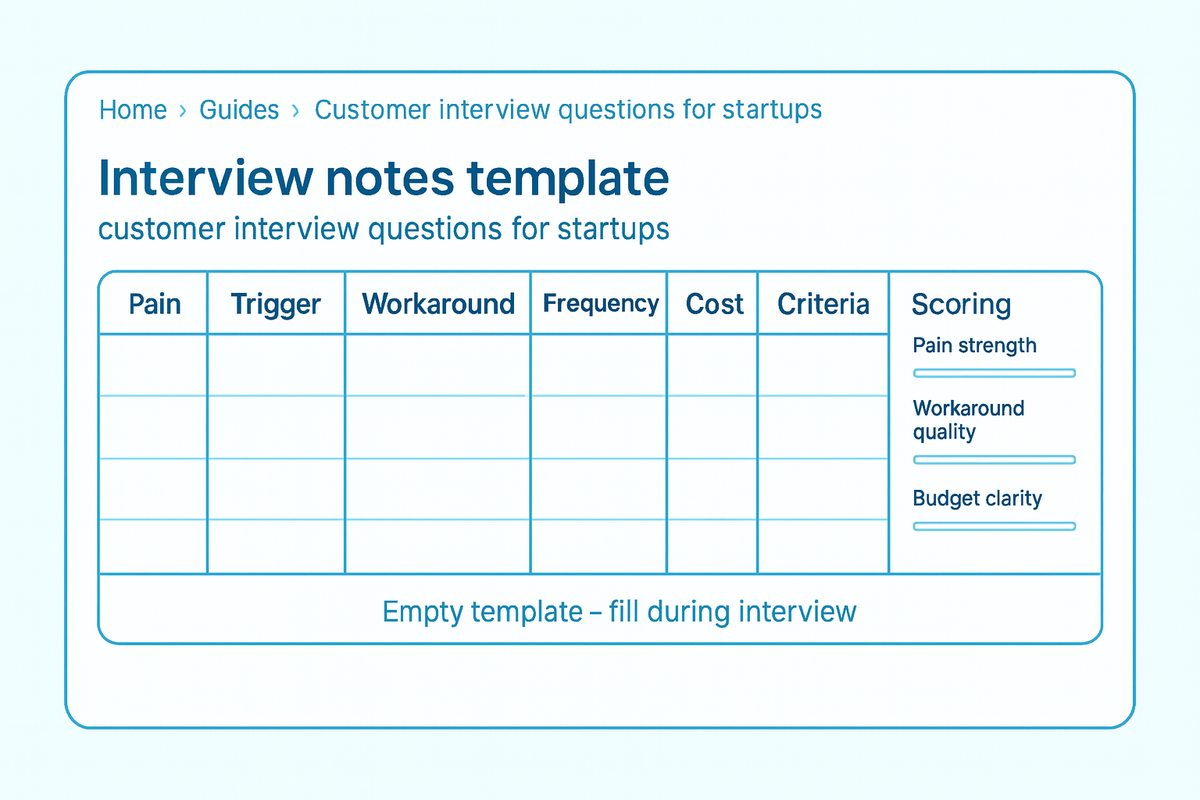
What decision follows this report? If the research revealed a hidden segment, the next step might be drafting a market research questionnaire sample doc to validate that segment's exact pain points.
What Not to Include
A strong report cuts the filler. Do not include:
Generic industry history: Skip the background if it does not change the product strategy.
Hypothetical feature requests: Do not report what customers say they might want. Report what they actually do.
Unvalidated TAM graphics: A large Total Addressable Market means nothing if you do not have a specific entry segment.
More than 10 pages: If the core argument takes more than 10 pages, the thinking is probably not clear yet.
Structuring the PDF for Decisions
Use this table to ensure every section earns its place.
Section | What it proves | What to include | What stakeholders decide |
|---|---|---|---|
Executive Summary | Clarity of direction | The core opportunity and recommended action | Are we aligned on the big picture? |
Methodology | Quality of evidence | Mix of desk research, expert interviews, and behavioral customer data | Can we trust these findings? |
Key Findings | Market reality | Growth trends, regulatory changes, structural shifts | Is this a market worth entering? |
Segmentation | Focus | The specific ICP with the most acute pain | Who do we build for first? |
Competitive Landscape | Positioning | Direct competitors, substitutes, and custom matrix axes | How do we differentiate? |
Risks & Gaps | Intellectual honesty | Unknowns, competitive threats, execution risks | What could kill this business? |
FAQ
What sections should a market research PDF include?
A standard startup market research PDF should include an executive summary, methodology, key findings, segmentation, competitive landscape, risks, and next steps.Why should a founder spend time on a market research PDF at all?
Because poor market research is much worse than no market research. A polished report built on weak assumptions creates false confidence. Structuring a factual PDF forces you to decide on the market and ICP before expensive product work starts.Can I just use AI to generate the report?
AI can summarize public data and create a broad overview, but it cannot replace primary research. Meaningful market research requires understanding future market risks and advanced competition. You must interview experts and study past customer behavior. Public sources alone cannot do this.What is the biggest mistake in competitor analysis?
Ignoring substitutes. Founders often fixate on direct software competitors. They ignore that their biggest threat is the customer continuing to use Excel, pen and paper, or an internal workaround.