A founder can do “market research” and still learn almost nothing.
They ask five friendly buyers whether the idea sounds useful. Everyone nods. They avoid money because pricing feels too early. They say there are no competitors because no other SaaS product does the exact same thing.
Then they build for three months and launch into silence.
That is not research. That is corporate theater for startups.
Good market research questions for new business interviews do something less comfortable. They show whether the problem already costs time, money, headcount, risk, or political attention. They reveal who owns the problem. They expose the workaround. They make it harder for polite feedback to masquerade as demand.
TL:DR:
Past behavior beats future intent.
Do not ask, “Would you use this?” Ask, “What did you do the last time this happened?”
A workaround is a competitor. It may be a spreadsheet, consultant, internal team, agency, or doing nothing.
Budget questions are valid early. Ask what they already spend, who owns the budget, and what failure costs.
Strong signal sounds like: “We spend six hours every Monday cleaning exports before the exec meeting.”
Weak signal sounds like: “This seems interesting.”
If they have no workaround, no owner, and no cost, the pain may be real but not urgent.
For a deeper interview flow, use a full customer discovery questions script after you pick the questions below.
Market research questions for new business: direct answer
Good market research questions for a new B2B business should reveal five things:
What you need to learn | Best type of question |
|---|---|
Whether the pain is real | Ask about the last time it happened |
Whether it is urgent | Ask what changed and what happens if they wait |
Whether it has budget | Ask what they already spend to solve or avoid it |
Whether substitutes exist | Ask what tools, people, vendors, or manual steps they use today |
Whether the segment is worth targeting | Ask who feels the pain most often and why now |
If your questions do not uncover pain, workarounds, budget, urgency, and a buying path, you may leave the call with encouragement instead of evidence.
The rule: ask them to replay reality
Most bad market research questions ask the customer to predict the future.
“Would you use this?”
“Would this save you time?”
“How much would you pay?”
“Do you think this is a big problem?”
“Which features would you want?”
These questions feel useful because people answer them. The problem is that buyers are bad at predicting future behavior, and they often soften their answers to be polite.
The better version is simple: ask about what already happened.
Rob Fitzpatrick’s The Mom Test is useful here because its core lesson is blunt: do not ask people whether your business is a good idea. Ask about their life, their work, their past behavior, and their existing commitments.
For B2B, you are trying to reconstruct the last painful workflow:
What happened?
Who was involved?
What broke?
What did they do instead?
How long did it take?
What did it cost?
Who cared?
Who paid?
What changed after?
That is where funded pain shows up.
Bad question, better question, signal
Use this list before you run interviews. It will keep you from asking questions that produce compliments instead of evidence.
Instead of: "Would you use this?" Ask: "What did you do the last time this happened?" (Reveals past behavior and real workflow)
Instead of: "Is this a problem?" Ask: "When did this last cause a delay, mistake, or escalation?" (Reveals frequency and consequence)
Instead of: "Would this save time?" Ask: "How much time does the current process take each week or month?" (Reveals time cost)
Instead of: "How much would you pay?" Ask: "What do you already spend to solve or avoid this?" (Reveals existing budget and substitute)
Instead of: "Do you like the idea?" Ask: "What would need to happen for this to become a priority?" (Reveals urgency trigger)
Instead of: "Who is your buyer?" Ask: "Who owns the budget for this today?" (Reveals economic buyer)
Instead of: "Are there competitors?" Ask: "What tools, people, or manual steps do you use instead?" (Reveals substitutes)
Instead of: "Is the market growing?" Ask: "What changed recently that made this more urgent?" (Reveals market force)
Instead of: "What features do you want?" Ask: "What part of the current workaround fails most often?" (Reveals product wedge)
Instead of: "Would you take a demo?" Ask: "If this worked, who else would need to be involved before buying?" (Reveals buying path)
Strong answers are specific, recent, and costly. Weak answers are vague, future-tense, and polite.
Copy/paste market research questions for new business interviews
Do not ask every question in one call. Pick the 8 to 12 that match your riskiest assumptions.
If you are still unclear on the category, start with pain, workflow, workarounds, and budget. If you already understand the workflow, go deeper on urgency, buying process, and segment fit.
For survey-style research after interviews, use these B2B market research survey questions to test patterns at a larger scale.
1. Context and ICP fit
These questions help you avoid interviewing the wrong person. In B2B, the user, buyer, approver, and budget owner may be different people.
What is your role in this process? (Reveals whether they feel the pain directly)
Who else is involved when this problem happens? (Reveals stakeholders and hidden users)
How is your team measured on this work? (Reveals business importance)
What company stage, team size, or volume makes this problem appear? (Reveals segment boundary)
Which teams feel this problem most often? (Reveals better ICP)
Is this problem different for smaller teams, mid-market teams, and enterprises? (Reveals segment-specific demand)
What changed in the business that made this harder? (Reveals growth or market trigger)
If you had to find five more people with this same problem, who would they be? (Reveals repeatability)
2. Current workflow
This is where the interview should slow down. Do not rush to your product. Make the buyer replay the work.
Walk me through the last time this happened. (Reveals real sequence)
What happened first? (Reveals trigger)
What tools, spreadsheets, documents, or systems were open? (Reveals current stack)
Where does the process usually get stuck? (Reveals failure point)
What gets copied, cleaned, checked, approved, or reworked? (Reveals manual labor)
Who waits on this work? (Reveals internal customer)
What happens after the work is done? (Reveals business consequence)
What part of the workflow would be hardest to change? (Reveals adoption friction)
3. Pain and frequency
Pain is not enough. A problem can be real, annoying, and still not worth a business.
Frequency tells you whether the pain is part of daily work or an annual irritation. That matters for pricing, retention, and product shape.
How often does this happen? (Reveals frequency)
When was the last time it happened? (Reveals recency)
How long does it usually take to deal with? (Reveals time cost)
How many people are pulled into it? (Reveals headcount cost)
What gets delayed when this happens? (Reveals business impact)
What mistakes happen because of it? (Reveals risk)
What is the most painful recent example? (Reveals emotional and political heat)
Who complains when this goes wrong? (Reveals internal pressure)
4. Cost of the problem
Founders often hear “this is painful” and stop there. Keep going.
You need to know what the pain costs. Cost can be money, time, lost revenue, delayed decisions, compliance risk, churn risk, employee burnout, or executive attention.
What does this cost the business when it goes wrong? (Reveals business value)
Has this ever caused a missed deadline, lost customer, audit issue, or executive escalation? (Reveals severity)
How much time does your team spend on this per month? (Reveals labor cost)
What other work does this prevent your team from doing? (Reveals opportunity cost)
If this problem disappeared, what would change in the business? (Reveals value of solving)
How do you explain this problem internally? (Reveals political framing)
Has leadership noticed this problem? (Reveals priority)
What happens if it is not solved in the next six months? (Reveals urgency)
5. Workarounds and substitutes
If a founder says, “We have no competitors,” be careful. No direct SaaS competitor does not mean no alternative.
A workaround is a competitor. So is a consultant. So is a spreadsheet. People will not switch tools unless the new way is much better than the old way.
Y Combinator’s guidance on startup interviews pushes founders to understand the existing products in their market and what is wrong with them. That applies beyond fundraising. If you cannot explain what customers use today, you probably do not understand the customer yet.
How do you solve this today? (Reveals current substitute)
What breaks in that workaround? (Reveals substitute weakness)
Did you build something internally for this? (Reveals internal build cost)
Are you using a tool that wasn’t meant for this? (Reveals repurposed substitute)
Do you hire people to handle this manually? (Reveals labor substitute)
Have you tried to buy a solution before? (Reveals past purchase attempt)
Why didn't that solution work out? (Reveals buying objection)
What is the most annoying part of the current way? (Reveals wedge opportunity)
6. Existing budget
Never ask, “How much would you pay?” People will guess, flatter you, or negotiate against an imaginary thing.
Ask about existing spend, budget ownership, approval path, and cost of failure. Budget is evidence of priority.
Do you spend money on this problem today? (Reveals existing budget)
Which budget does this come from? (Reveals budget owner)
Who approves spend for this type of problem? (Reveals economic buyer)
What have you paid for in the past to solve this? (Reveals buying history)
Are you paying for a tool that partly solves this? (Reveals competitive category)
Are you paying people or consultants to work around it? (Reveals service substitute)
What size of problem gets budget attention here? (Reveals spend threshold)
When budgets are tight, does this get cut or protected? (Reveals must-have vs nice-to-have)
7. Buying process and approval path
B2B demand can be real and still die in procurement, security review, legal review, budget timing, or stakeholder confusion.
These questions help you separate user pain from a buyable deal.
If your team wanted to buy something for this, what would happen next? (Reveals buying path)
Who would need to approve it? (Reveals approval chain)
Who would block it? (Reveals internal friction)
What information would you need to make a case internally? (Reveals sales proof needed)
What tools would it need to integrate with? (Reveals technical adoption)
What would make this too risky to adopt? (Reveals adoption blocker)
When do you usually review or renew tools in this category? (Reveals timing)
Have you bought something similar before? (Reveals purchase familiarity)
8. Urgency and timing
Urgency often comes from a trigger.
Growth breaks a manual process. A regulation changes reporting. A customer demands proof. A board meeting exposes bad data. A competitor raises the bar.
Without a trigger, the problem may sit forever.
Why solve this now? (Reveals urgency)
What changed recently? (Reveals trigger)
Is this getting worse, better, or staying the same? (Reveals trend)
What happens if you wait another quarter? (Reveals cost of delay)
Is there a deadline attached to this? (Reveals buying pressure)
Who is pushing for this internally? (Reveals champion)
What would make this jump above other priorities? (Reveals priority trigger)
What makes this hard to ignore? (Reveals severity)
9. Competitors, category, and positioning
People price and evaluate your product based on what they compare it to.
If they compare you to a $20/month tool, you are in one category. If they compare you to a $3,000/month consultant, you are in another. If they compare you to hiring another ops person, you are in a third.
When you think about solving this, what category comes to mind? (Reveals mental category)
What would you compare this to internally? (Reveals pricing anchor)
Which vendors would be considered first? (Reveals competition)
What is wrong with those options? (Reveals differentiation)
What would make switching worth it? (Reveals value threshold)
Who would feel threatened by changing the current process? (Reveals political risk)
What would your team call this problem? (Reveals buyer language)
If you searched for a solution, what would you type? (Reveals search intent and category language)
10. Segment and market-change signals
Some B2B opportunities appear because the market changes. Regulation changes. A platform shifts. A new reporting requirement appears. Customers demand something new from vendors. A manual workflow breaks at a new volume.
This is not mandatory for every startup, but it is powerful when it exists.
Steve Blank’s Customer Development Manifesto is old, but the core idea still holds: startups are searching for a repeatable business model, not just building a product in isolation.
What is changing in your market that makes this more important? (Reveals market force)
Which segment feels the change first? (Reveals beachhead ICP)
Who is forced to act, and who is choosing to act voluntarily? (Reveals demand type)
Are current vendors serving this segment well? (Reveals competitive gap)
What do experts, consultants, or operators keep hearing from this market? (Reveals repeated pain)
Is the market consolidating, fragmenting, or staying messy? (Reveals go-to-market difficulty)
What risks make buyers nervous right now? (Reveals risk-led urgency)
Where is budget moving because of this change? (Reveals funding direction)
How to run the interview without making it feel like homework
A good interview is not a survey read aloud. It is a guided reconstruction of a real event.
Use this flow:
Start with context.
Ask about their role, team, and where the problem shows up.Pick one recent event.
Ask: “Can you walk me through the last time this happened?”Stay in the past.
Ask what they did, who was involved, what tools they used, and what broke.Follow the money.
Ask what they already spend, who owns the budget, and what failure costs.Look for substitutes.
Ask about spreadsheets, consultants, internal teams, agencies, tools, and doing nothing.Find the trigger.
Ask why this matters now, not someday.End with the buying path.
Ask who else would need to care before the company could buy.
The best customer interviews feel like careful listening, not interrogation. YC’s practical design notes on user observation make a similar point: your role is to listen, keep momentum, and dig into the “why” behind behavior.
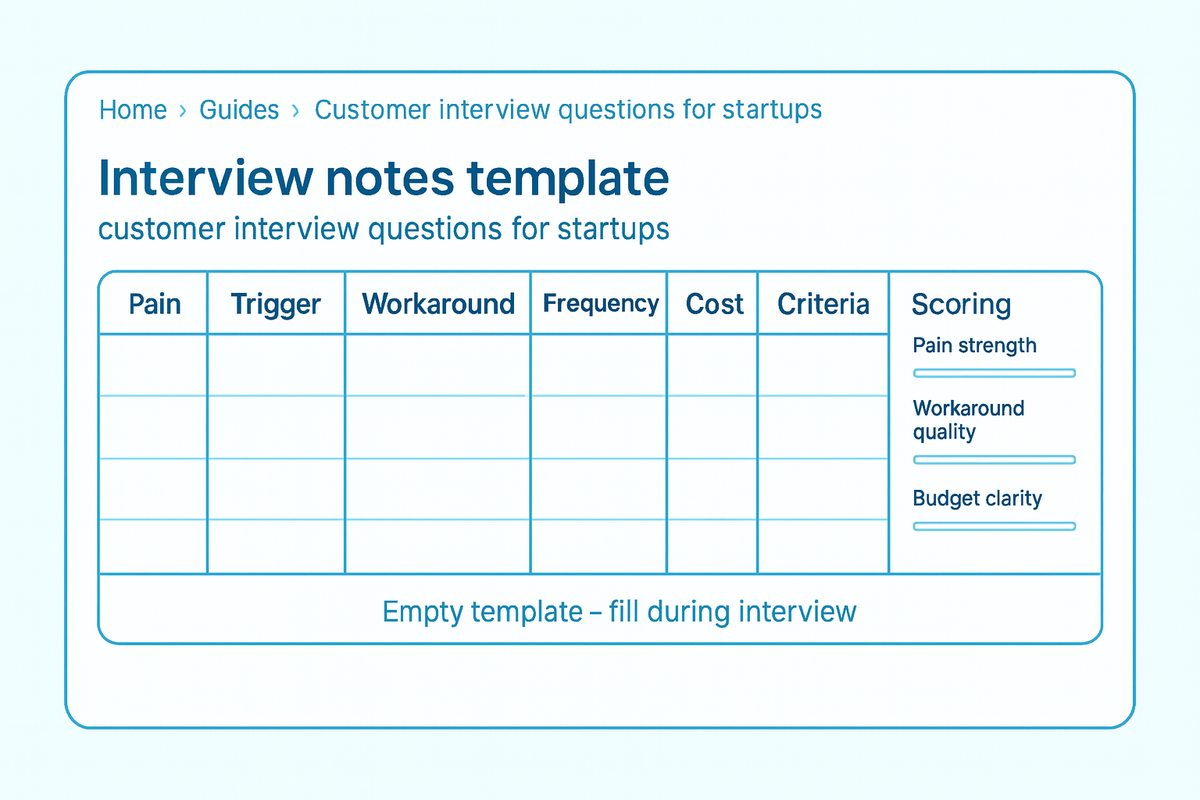
How to score answers: is this funded pain?
Use this after each interview. Do not average everything into a vague “good call.” Score the evidence.
Signal | 0 points | 1 point | 2 points |
|---|---|---|---|
Frequency | Rare or hypothetical | Occasional | Weekly, daily, or tied to a recurring business cycle |
Cost | Annoying but low impact | Some time or rework | Clear money, risk, revenue, deadline, or headcount cost |
Existing spend | No spend | Some unpaid workaround | Current tool, consultant, agency, internal labor, or budget |
Owner | No clear owner | User feels pain but cannot buy | Named owner or budget holder exists |
Urgency | No timeline | Interest this quarter or half | Deadline, renewal, audit, customer demand, or executive pressure |
Substitute strength | No current solution | Weak manual process | Active workaround they want to replace or improve |
Interpretation:
0 to 4 points: likely weak demand. Keep learning before building.
5 to 8 points: real pain may exist, but the buying path or urgency is unclear.
9 to 12 points: strong candidate for funded pain. Run more interviews in the same segment.
Do not treat the score as math you can hide behind. It is a forcing function. It makes you say what you actually learned.
For a broader guide to interpreting interview answers, use this companion on market research questions and answers.
What strong answers sound like
Weak signal:
“They liked the idea.”
Strong signal:
“They spend six hours every Monday cleaning exports before the exec meeting.”
Weak signal:
“They said they might pay if it saved time.”
Strong signal:
“They currently pay a consultant $3,000/month to prepare the same reports.”
Weak signal:
“They hate Salesforce.”
Better, but incomplete. Ask what specifically breaks, how often it happens, what it costs, and what they do instead.
Weak signal:
“Compliance is becoming important.”
Better, but too broad. Ask who is legally required to act, who is voluntarily acting, who has budget, and who lacks good vendors.
This is why early interviews still matter in a world full of AI summaries and market reports. Public research can help you understand the category, but it cannot tell you how a specific buyer fought with a spreadsheet last Thursday.
A compact B2B example: the less obvious segment can be better
Imagine a B2B sustainability SaaS company in Europe.
The obvious buyer looks like enterprise compliance. Large companies face regulation, have budget, and need reporting. It sounds clean on a slide.
But market research can point somewhere else.
In one sustainability SaaS case, the useful move was to study the market change first, then talk to experts. Regulation was pushing the market to restructure. Experts kept describing similar pains. The less obvious opportunity was not only large corporate buyers. Consultants and green mid-market businesses had immediate needs, fewer entrenched vendors, and clearer reasons to act.
The lesson is not “always target SMBs” or “always study regulation.” The lesson is narrower and more useful: do not assume the obvious ICP has the sharpest pain.
Ask which segment feels the change first, who already spends effort on workarounds, and where competition is weakest.
That is market research doing its job. It changes the founder’s target before months of product work harden around the wrong buyer.
Common mistakes to avoid
Do not ask people to design your product.
They are usually bad at that. Ask them to replay the last time the problem happened. Your job is to infer the product from the pain, workflow, constraint, and budget.
Do not confuse compliments with validation.
People may like you, like the idea, or want to be encouraging. None of that means they will fight for budget.
Do not treat surveys as the first step.
Surveys are useful once you know the language, categories, and answer options. Early on, interviews are better for learning how the workflow actually works.
Do not ignore substitutes.
If the buyer uses a spreadsheet, that spreadsheet is part of your competitive environment. If they use a consultant, the consultant is too. If they do nothing, “do nothing” is the competitor you must beat.
Do not avoid money.
You do not need perfect pricing yet. You do need to know whether the problem already has budget gravity. Willingness to pay matters more than abstract interest.
Do not interview only the senior buyer.
The budget owner may approve the purchase, but the operator often knows the pain. Interview both when you can.
FAQ
What are the best market research questions for a new business?
The best questions ask about past behavior, current workarounds, cost, budget, urgency, and buying process. Start with: “Walk me through the last time this happened,” “What did you do instead,” “How much time or money did it cost,” “Who owns the budget,” and “What happens if this is not solved?”Should I ask about budget early?
Yes. Ask what they already spend, which budget it comes from, who approves that spend, and what the current workaround costs. Existing spend is stronger evidence than hypothetical willingness.How many questions should I ask in one interview?
Usually 8 to 12. A good interview goes deep on one recent event instead of rushing through a long questionnaire.Should I use surveys or interviews for early market research?
Use interviews first when you do not yet understand the workflow, language, buyer, or budget. Use surveys later to test patterns across more people. Steve Blank’s Harvard Business Review article on lean startup is a useful reminder that startups search and test before they scale execution.What questions should I ask my target market?
Ask your target market about recent painful events, current tools, manual steps, people involved, cost of failure, existing budget, approval process, substitutes, and urgency triggers.What are good market research questions to ask clients?
Good market research questions to ask clients include: “What changed that made this more urgent,” “What have you tried before,” “Who is affected when this breaks,” “What does the workaround cost,” “Who would approve a better solution,” and “What would make switching worth it?”What should I avoid asking?
Avoid “Would you use this?”, “Do you like it?”, and “How much would you pay?” as standalone questions. They invite guesses and polite answers. Ask about what the buyer already did.Why waste time on market research at all?
Because poor market research can be worse than none. It gives you confidence without evidence. The right questions test whether the market, ICP, pain, budget, and buying path are real before product work becomes expensive.