TL;DR: Stop asking customers what they think about your idea. It usually produces polite lies. Instead, use a script that forces them to explain the last time they faced the problem, what they did, who was involved, and what it cost. Validation comes from studying their past behavior, not their reaction to your pitch.
Most bad discovery calls are soft pitches in disguise.
Founders love spending five minutes explaining their idea, then asking, "So, what do you think?" or "How do you like it?" The prospect usually says it sounds interesting. The founder writes down that the idea is validated.
Little useful evidence is gathered. When you ask for feedback on your idea, you are studying your pitch. You create an awkward situation where the prospect tries to be nice, giving you polite lies instead of real evidence.
A customer discovery questions script is a structured list of questions that forces prospects to talk about their past behavior, not their future intent.
The better discovery call starts differently: "Tell me about the last time you dealt with this."
Proper customer discovery happens when you learn before trying to validate demand. When you ask about the last time the problem happened, you are studying the customer.
Write your hypotheses before the call
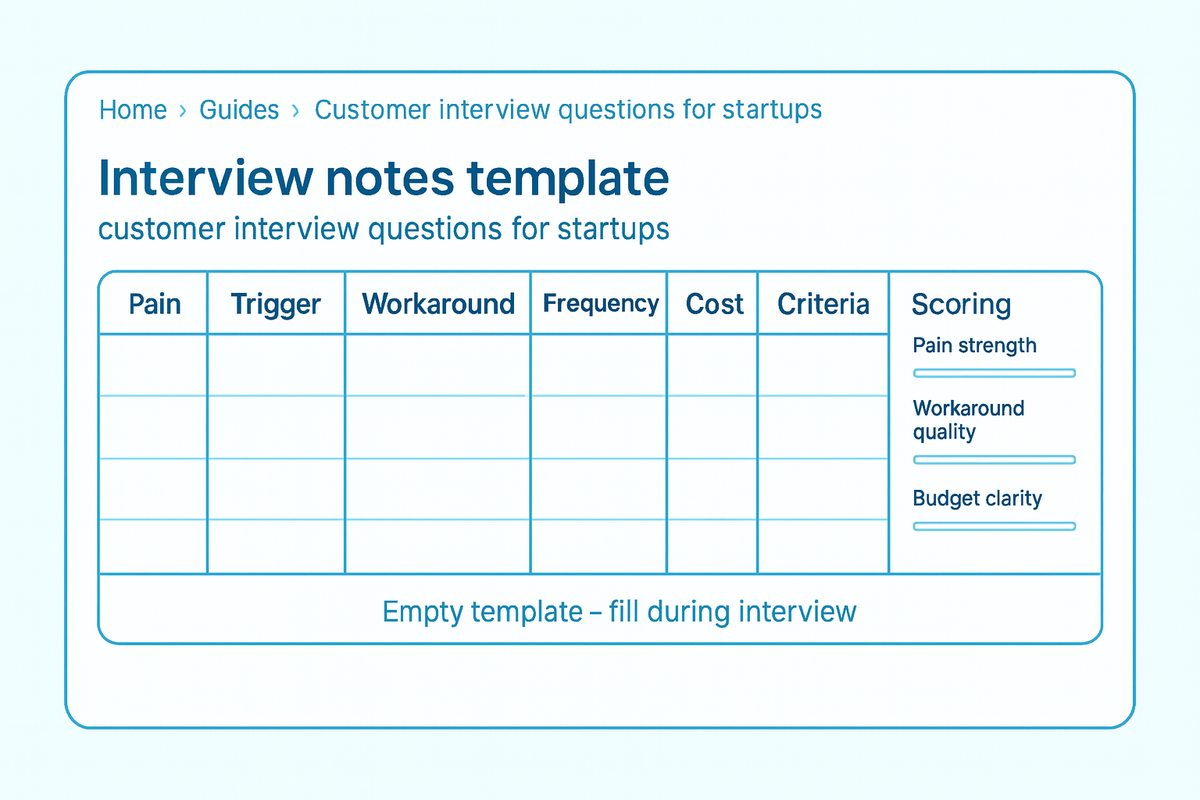
If you jump into interviews without prep, your notes will become a disconnected pile of anecdotes. Prospect A spends three hours in Excel. Prospect B hates a competitor's interface. Prospect C wants an export button. Without a target, every quote feels equally important.
You need to write your hypotheses before the call. For example, your hypothesis might be: Teams waste time because data is siloed. You then listen for past behavior that supports this. If a prospect manually bridges Competitor A and Excel every week, that is a strong signal. The pain is strong enough that they maintain a manual workaround.
Replace opinion questions with past-behavior discovery interview questions
A workaround is evidence. A compliment is not.
If a prospect claims they have no competitors or workarounds, it usually means you have not found the actual workaround yet, or they do not care enough to solve the problem. The goal is to understand the customer's actual context, not get feedback on your idea. You need to know their team, process, constraints, decision path, and current workaround.
This shift changes how you ask discovery interview questions.
Question Framework
Goal | Bad Question | Better Question |
|---|---|---|
Finding real pain | "Would you use this?" | "Tell me about the last time you solved this without us." |
Understanding the problem | "What do you think of this idea?" | "What did you do next? Why that way?" |
Gauging value | "Would you pay $50/mo?" | "What did your current workaround cost in time or risk?" |
Decision process | "Who would buy this?" | "Who else was involved in solving this problem?" |
Copy-paste customer discovery questions script
Here is a copy-paste script built around past behavior, not opinions. Use these placeholders to force past-tense evidence during your interviews.
Opener and permission: "We're researching how teams handle [problem area]. We aren't selling anything today, just trying to understand the workflow. Is it alright if I ask a few questions?"
Context setup: "Tell me about your role and what your typical week looks like regarding [process]."
Past-behavior questions: "Tell me about the last time you handled [problem]."
Workaround questions: "What did you do next? Why that way? Who else was involved?"
Cost and urgency questions: "What did it cost you in time, money, or risk to handle it that way? What broke?"
Close: "Who else should I talk to about this?"
Delete these questions from your script
Before your next call, remove any question that forces a hypothetical or asks for a perception of you. If a question starts with any of these phrases, rewrite it:
"Would you..."
"Do you like..."
"What do you think..."
"Would you pay..."
Recruit from problem signals, not generic personas
The best early discovery targets are people already describing the problem or struggling with competitors. Generic demographic personas are often too broad. Find your first users manually based on the pain they express. This approach aligns with Steve Blank's customer development methodology, which emphasizes leaving the building to find active problems rather than theoretical ones.
Consider a hypothetical B2B startup assuming their ideal buyers are large corporate teams. By researching who is actually trying to solve the problem right now, they might find independent consultants struggling with a manual workaround. This segment could offer a simpler path to early learning, which they wouldn't have found if they hadn't looked for active problem signals. NNGroup's user interviews best practices reinforce that observing actual behavior yields far better insights than asking hypothetical questions.
The core principle remains the same: get the truth by studying the past. As taught in The Mom Test, keeping an open mind and relying on past evidence prevents customers from telling you polite lies about their future intent.
FAQ
What is a good customer discovery questions script for B2B founders?
A good script forces past-tense evidence. It avoids hypotheticals and perception-of-you questions. Instead of asking "Would you use this?", it asks "Tell me about the last time you handled this problem."
Can't I just show them the idea and ask if they'd use it?
No. Asking "what do you think?" or "how do you like it?" produces polite lies. Ask what they already did, why they did it, and what workflow shaped it.
How do I know if they will pay?
Instead of asking "Would you pay for this?", ask what their current solution or workaround cost them. Willingness to pay is proven by past spending or intense manual effort, not by hypothetical future promises.
How do I know if the problem is big enough?
If they cannot remember the last time they faced the problem or cannot name the workaround they used to fix it, the problem is not a priority for them.