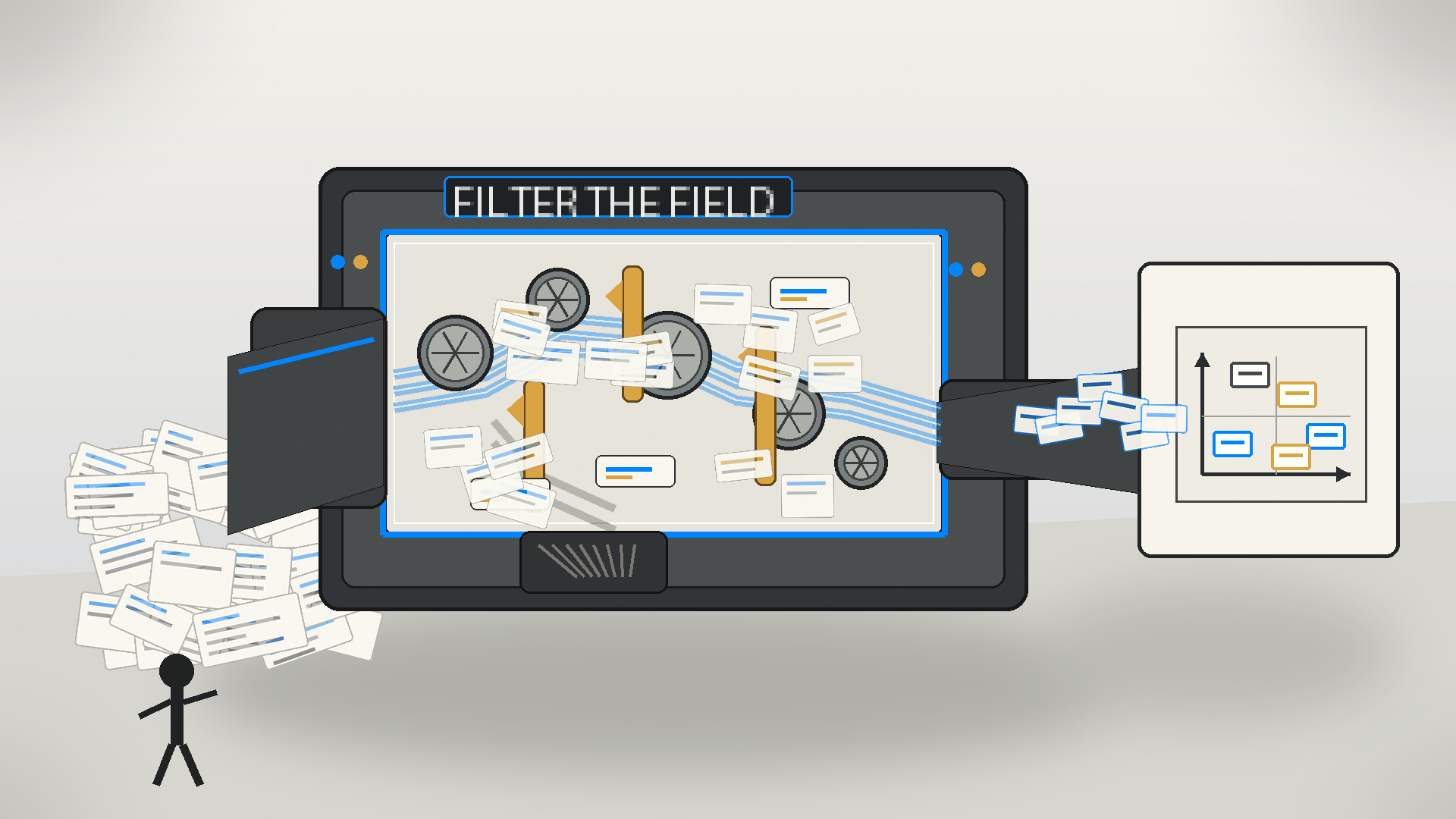
TL;DR: A positioning map is not a list of rival logos. It shows how buyers sort their options. Research the market first, find what separates alternatives in the buyer's mind, and plot your product. Finding the right axes can shift your pricing ceiling and dictate which acquisition channels will work.
A product positioning map is a visual framework that plots your product against alternatives along two buyer-relevant axes. It helps founders see the market through the buyer's eyes, discover white space, and escape commodity pricing by identifying the specific criteria buyers use to compare solutions.
When founders say, "We don't have competitors," it is usually a red flag. They think it proves their product is unique. In reality, it shows they do not know the market.
If you do not know your competitors, you do not know your customer. Buyers always compare you to something. That alternative might be a direct software rival, a spreadsheet, an internal hire, an agency, or simply doing nothing. If you do not know what that comparison is, you are building for your own beliefs, not real evidence.
A positioning map forces you to see the market through the buyer's eyes. It stops you from plotting the market based on internal opinions. Finding the right comparison frame changes how people value your work, which is the core of effective B2B positioning. Choose the wrong axes, and you might accidentally push your product into a $100 frame instead of a $1000 frame.
The Problem with Default Axes
A common mistake is drawing a two-axis grid and labeling the axes "Price" and "Quality." These are universal, default axes. They do not help you make business decisions.
Bad axes come from templates. Useful axes come from the market.
Before you draw any lines, you must do the work of finding the real dividers. Research your direct competitors and indirect alternatives. Look at how buyers actually make decisions. You want to uncover the specific parameters that separate the winners from the losers in your specific space. Proper competitor analysis gives you the raw material for this step.
Product Positioning Examples in Practice
Consider a social media management SaaS tool. A founder might want to map how their tool is cheaper and has better analytics than established tools. But after talking to buyers, they might discover the real dividing lines are different. The right axes for their map might be "one platform vs. many platforms" on the X-axis and "growth-first vs. full management" on the Y-axis. These are specific, discovered parameters.
Here is how that map looks:
                          Growth-First
                                |
                                |      [Your Product]
                                |
One Platform  ------------------+------------------  Many Platforms
                                |
                                |      [Competitor B]
                [Competitor A]  |
                                |
                         Full Management
Practical Framework: The Axis Selection Worksheet
Use this worksheet to find your axes before you try to place your product on a map.
Option A (Software tool)
Main Promise: Time savings at $50/mo
Tradeoff: Fast setup, but basic features.
Possible Axis: Speed vs. DepthOption B (Agency service)
Main Promise: Done-for-you at $2,000/mo
Tradeoff: High quality, but expensive and slow.
Possible Axis: DIY vs. ServiceOption C (Spreadsheet)
Main Promise: Free control at $0
Tradeoff: Flexible, but manual effort.
Possible Axis: Automated vs. Manual
Fill this out for three to five alternatives. The patterns will show you the right axes for your map.
How to Build Your Map
Research alternatives: Ask buyers what they used before and what else they evaluated.
Choose buyer-relevant axes: Pick the two most important variables from your worksheet.
Plot competitors: Place the alternatives on the grid.
Plot yourself: Be honest about where your product sits today.
Identify white space: Look for valuable, empty quadrants.
Choose channels: Match your go-to-market strategy to your quadrant.
Reframing the Category Changes the Price
The category defines the competition. If you misidentify the category, you anchor buyers to the wrong price point. Good B2B product positioning helps you escape bad anchors.
Imagine a team building a new fitness application. If they automatically plot themselves against other fitness apps, they cap their pricing ceiling. Buyers expect an app to cost $20 a month.
But if the team repackages the offer to focus on high-touch guidance, they change the comparison set. Now, buyers compare the product to a $140 session with a human coach. Selling the app for $45 a month suddenly looks like a bargain, compared to struggling to sell it at $15 in the app category.
You control the frame of reference. The map helps you see if your current frame serves your business.
Turning the Map into Action
A visual map is useless if it does not change your strategy. Where you sit on the map should dictate your positioning statement and your acquisition channels.
If your map shows you in a commodity quadrant, you will likely need to rely on search and comparison pages to capture existing demand. If you sit in an expert-led quadrant, your channels should reflect that authority. You will need founder-led sales, webinars, and detailed case studies to build trust. If you occupy a niche workflow quadrant, outbound outreach and partner channels often work best.
Your map should make channel choice obvious. It shows you where the white space is, and it tells you how to reach the people looking for that exact solution.
FAQ
What are the best axes for a product positioning map?
There are no universal axes. Do not use price and quality. Choose your axes only after you research competitors and talk to buyers. The best axes are the specific factors your buyers use to make a decision.Can my product be the only one in its quadrant?
Yes, finding an empty, valuable quadrant is the goal of positioning. But if the quadrant is empty, you must verify that buyers actually want a product with those characteristics. You can read more about evaluating market demand and product-market fit to ensure your chosen space is viable.How often should we update our positioning map?
Update it when your market changes, when a major new competitor arrives, or when your win rates drop. It is a living document, not a one-time exercise. Experts like April Dunford emphasize that positioning requires regular reassessment.Should we share our positioning map with customers?
Usually, no. The map is an internal diagnostic tool to help you make decisions. You translate the map into messaging and copy that you present to the customer. For more on creating effective visual strategy tools, see the Harvard Business Review's guide to competitive mapping.