TL;DR: Most customer interviews fail before the call starts because the founder goes in without a hypothesis. A customer discovery canvas is a working tool to force you to capture actual customer behavior — what they use today and how much it hurts — rather than polite reactions to your idea. This guide covers how to set up your canvas, track past behavior, and score pain based on action.
You ran eight customer interviews. Your notes are full. The calls felt good. But looking at the document afterward, you cannot answer basic questions. Who has the actual problem? What are they doing about it right now? Is the pain severe enough to matter?
The issue was not note-taking. The issue was walking into those calls without a clear hypothesis, then trying to pull evidence from a mess of polite feedback.
A customer discovery canvas fixes this. It is a simple layout you fill out during or immediately after a call. It forces you to capture the person's background, the solutions they already use, and a pain score tied to their behavior. If you need a broader strategy for planning your research, review the full customer discovery template first. The canvas is where you organize the raw data.
Why Normal Interview Notes Break
Founders often turn their notes into analytical reports. They write down long quotes about what a customer thinks of their idea.
When you ask people what they think or if they would use a product, you force polite lies. People do not want to be mean to your face. They will say your idea is interesting. They will claim a problem is annoying.
But if someone says a problem bothers them and they have taken zero action to fix it, the pain is low. Startups die trying to solve problems people do not care enough to fix. You need to know what they did in the past. To get those answers, ask customer discovery questions focused on history, not hypotheticals.
What the Canvas Is Actually For
A customer discovery canvas is a structured worksheet that standardizes your interview notes so you can spot patterns and validate demand faster. Instead of a blank page, it provides specific fields to capture a person's context, their current workarounds, the exact words they use, and a behavioral pain score.
It is a working cue for your own mental model. It acts as a demand filter.
When you do early discovery, stay manual. Go find alpha customers by hand. When you talk to them, you want to know their context, their workflow, and their team. This deep understanding makes a generic product hard to copy.
Use the canvas to turn vague conversations into comparable data. If you see an unexpected segment showing strong traction, do not discard it as off-ICP noise. Track it. That might be your real market.
Practical Framework: The Customer Discovery Canvas
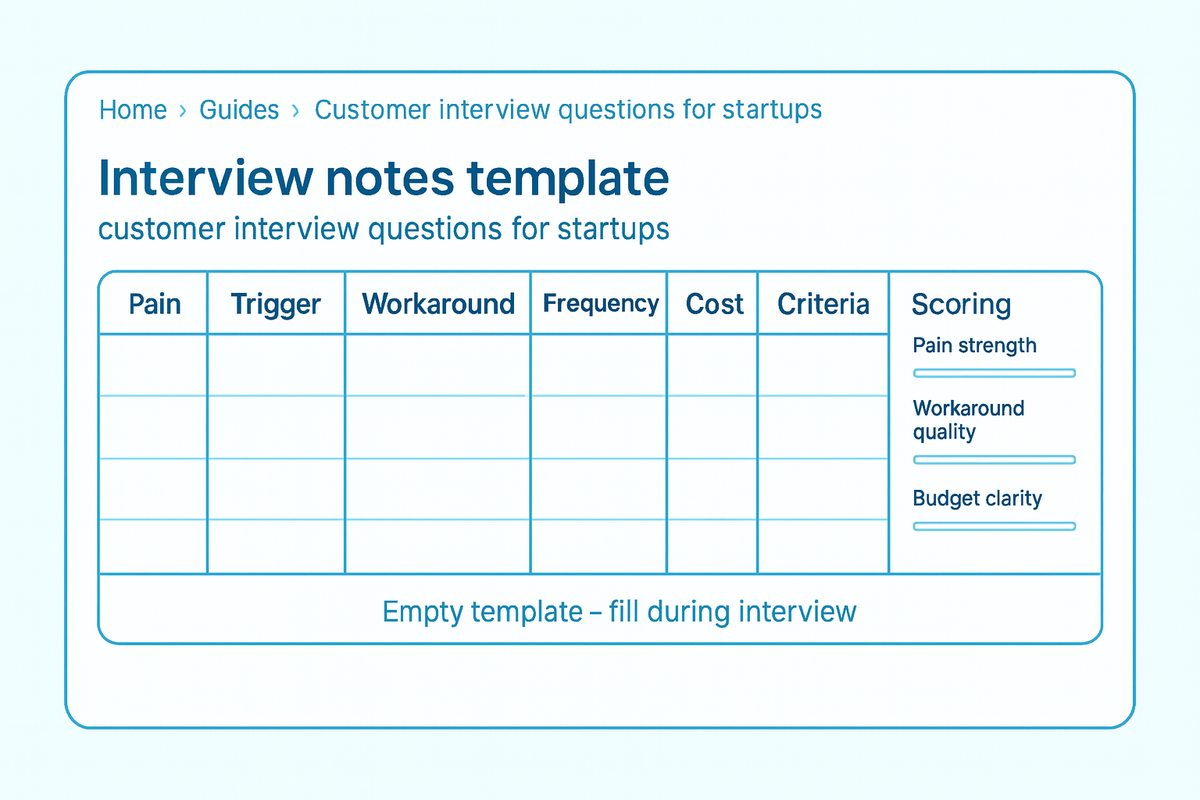
Keep the layout simple. You can copy this customer discovery worksheet directly into your notes app or a spreadsheet.
Field | Description |
|---|---|
Hypothesis Being Tested | Write this before the call to anchor your focus. |
Context & Workflow | Who they are, their team size, their daily reality. |
Current Solution | What competitor, tool, or manual workaround they use today. |
Problem Language | The exact words they used to describe the pain. |
Behavioral Pain Score | 1 to 5, based on their actions, not their complaints. |
Next Action | Follow up, ignore, or adapt the product. |
Filled B2B Example Row
Field | Example Entry |
|---|---|
Hypothesis Being Tested | Ops managers lose 5+ hours a week manually syncing data between the CRM and billing. |
Context & Workflow | Sarah, RevOps lead at a 100-person B2B company. |
Current Solution | CSV exports every Friday afternoon, uploaded into a shared Google Sheet. |
Problem Language | "I spend my entire Friday afternoon fighting with duplicate records." |
Behavioral Pain Score | 4 (They built a recurring manual process around it). |
Next Action | Show her a demo next week using her sample CSV data. |
How to Score Pain Using Behavior
Do not score pain based on how loudly someone complains. Anchor your severity score to what they actually do. Here is a practical scoring system tied to behavior:
Behavioral Pain Rubric:
1. Annoyed but inactive: They say it is annoying, but they have taken zero steps to fix it.
2. Occasional workaround: They sometimes do a manual task to bypass the issue.
3. Recurring cost: They spend regular team time on a recurring workaround.
4. Serious investment: They pay for a tool, hired a contractor, or built a custom internal process.
5. Active buying: They are actively searching for a solution, have budget ready, or signed a letter of intent.
Spotting Patterns
After 5 to 10 interviews, look down your canvas columns. If everyone has a pain score of 1 or 2, your hypothesis is wrong. If you see multiple 4s and 5s in an unexpected segment, you found a real opportunity.
Remember that talking to users is about finding the truth, not confirming your hopes. Treat customer complaints about missing features as a positive signal — it shows they care enough to complain.
Some founders think they need a massive, scalable onboarding process right away. You do not. Companies like Superhuman proved that high-touch onboarding can be a core feature. Early on, focus on getting a few people to experience real value.
The canvas helps you figure out who those people are, what they need, and whether they are ready to buy. To dig deeper into the theory behind this, review the customer development framework from Steve Blank.
FAQ
What should a customer discovery canvas include?
It should include the hypothesis you are testing, the customer's context and workflow, the solutions they already use, their exact problem language, a pain score based on past behavior, and clear next steps.
How is a customer discovery canvas different from interview notes?
Standard interview notes are often unstructured transcripts or summaries of opinions. A canvas standardizes the data you collect, forcing you to focus on concrete evidence — like workarounds and competitor usage — rather than polite feedback or hypotheticals.
How do I avoid turning the canvas into organized polite lies?
Make every field about past behavior, not reactions to your idea. Put their background and current solutions first. If they claim a problem hurts but have not tried to fix it, score the severity low. Avoid fields that ask what they think because they only study perception.
What do founders overcomplicate about this?
They treat it like a formal research report. Keep it as functional, working cues. You do not need an exhaustive spreadsheet. You just need to know who they are, what they use today, and why they act the way they do.