TL;DR: A customer discovery template is a framework to capture and score real evidence from user interviews. It is not a place to store interview transcripts. It is a forcing function to test your hypotheses. Before the call, name your hypothesis. During the call, capture what the prospect has actually done. After the call, synthesize whether the evidence changed your view of the buyer.
Founders often fall into a common trap. They run 15 customer discovery calls. They record everything and end up with 40 pages of notes. They feel productive.
But when they sit down to decide what to build, the notes are useless. They cannot answer the only questions that matter. Who has the pain? What have they tried? Why did those options fail? Is the pain strong enough to pay for? Building products without a real market need is a top reason startups fail.
A good customer discovery template does not help you write more notes. It helps you leave the call with better evidence. This template focuses on early customer discovery, helping you understand the buyer before you need a product discovery template to make feature decisions. You can learn more about this sequence in our guide to customer discovery and validation phases.
The Transcript Trap
Most discovery notes fail because they are not tied to a hypothesis.
Founders often treat discovery like a generic survey. They ask prospects what they think about an idea. They log polite answers as validation. This leads founders to build from their own beliefs, just validated by polite lies.
You need a clear mental model of the buyer when you walk away from the interview. To get that, you must start with a hypothesis.
Before you begin, you must understand exactly what you are trying to prove or disprove. Your notes should capture evidence that tests your assumptions about the ideal customer profile, the pain, the solution, and the distribution channel.
The Evidence Rules: Past Behavior Over Stated Desires
Do not study a customer's perception of you. Do not study hypotheticals.
When you ask what they think, you force people to lie to you politely. Instead, you need to ask customer discovery questions that reveal past behavior.
If a prospect says a problem bothers them, but they have done nothing to fix it, log that as weak pain. Score pain higher only when the customer has already taken action. Have they spent money? Have they burned time? Have they hacked together a workaround? Have they repeatedly failed with alternatives?
Weak note: "They said data entry is annoying and liked our AI sync idea."
Strong signal: "They spend 5 hours a week copying data between Sheets and the CRM, tried Zapier, gave up because of field errors, and now pay an intern $300 a month to handle it."
For more on asking the right questions, Rob Fitzpatrick's The Mom Test is a standard guide for avoiding polite lies.
The Customer Discovery Template
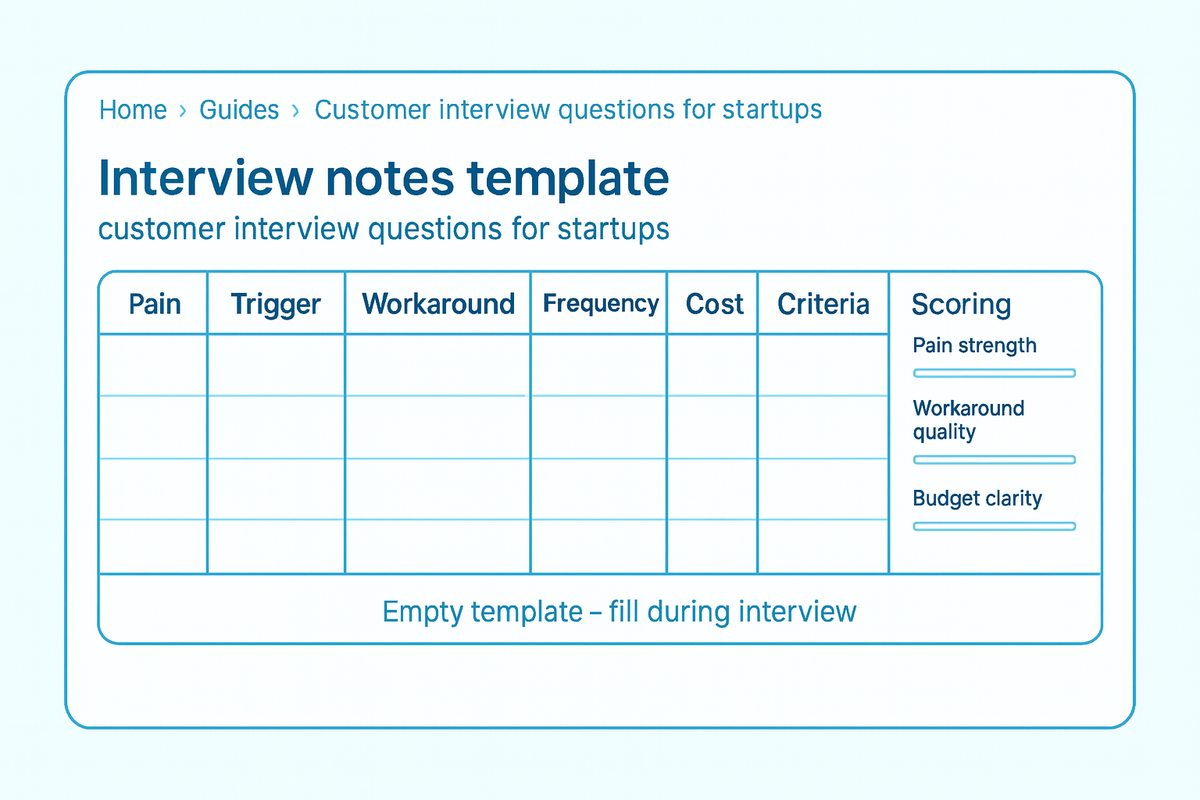
Your template should work like a lightweight cue sheet, not a polished analytical report. You do not need a giant customer discovery canvas. This template is a simpler alternative that focuses entirely on capturing past behavior and pain intensity.
The Copy-Paste Cue Sheet
Use this format to log real-time call notes and identify recurring patterns. Copy this checklist directly into your notes app to keep your interviews structured.
Context & Core Problem
Interviewee: Name and role (e.g., Jane Doe, VP Sales)
ICP Segment: Which profile does this person fit? (e.g., Mid-market sales leader)
Hypothesis Tested: What assumption are you checking? (e.g., Sales teams lose deals because of slow CRM updates.)
Exact Pain: The specific problem they described (e.g., Reps spend 2 hours a day fixing bad CRM data.)
Behavior & Action Taken
Trigger: What caused them to act? (e.g., Missed a $50k deal because contact data was wrong.)
Current Workaround: How they solve it today (e.g., Weekly manual audit by the sales ops manager.)
Alternatives Tried: What else have they attempted? (e.g., Bought a data enrichment tool.)
Why Alternatives Failed: The exact reason they stopped using other options (e.g., The tool required too much manual mapping.)
Impact & Synthesis
Money or Time Spent: Concrete proof of pain intensity (e.g., $10k/year on the failed tool, plus ops manager time.)
Stakeholders: Who else is involved in the problem? (e.g., Sales Ops, Account Executives)
Quote: One specific, grounded thing they said (e.g., "If the CRM isn't right, the forecast is a guess.")
Pain Signal: Score based on action taken (e.g., 4)
Next Steps
Confidence: How reliable is this evidence? (e.g., High-buyer shared screen to show the manual audit.)
Pattern Tag: Keyword to group similar calls (e.g.,
crm-data-quality)Next Action: Follow up, invalidate hypothesis, proceed (e.g., Invalidate hypothesis: they lose deals to bad data.)
This structure forces you to separate what people say they want from what they actually do. A similar behavior-first approach is recommended in User Interviews 101 by NN/G.
Pain Signal Rubric
Use this as a practical sorting tool to score pain intensity rapidly.
0 = No action. (They just deal with it.)
1 = Complaint only. (They say it is annoying, but do nothing.)
2 = Workaround. (They use a spreadsheet or manual process.)
3 = Repeated workaround or team impact. (Multiple people lose time.)
4 = Budget or time already spent. (They bought a tool or hired someone.)
5 = Active search or buying motion. (They are actively evaluating vendors right now.)
The Synthesis Step
One intense quote can point you somewhere. But recurring behavior across similar buyers is what should change your product decisions.
After a batch of calls, review your pattern tags. Look for the "most painful pain." You want to find a problem that forces customers to spend time or money. Steve Blank, the creator of the customer development method, notes that the goal is to find a reproducible business model. You cannot do that without finding a recurring pattern of intense pain.
If you find that your hypotheses are consistently invalidated, that is a successful discovery process. It means you learned the truth before writing any code.
FAQ
How do I use a customer discovery template without turning interviews into polite, useless survey answers?
Start with explicit hypotheses before your calls. During the interview, log evidence of past behavior, not opinions. Separate what they actually did from what they say they want. Focus on prior workarounds, money spent, and why they chose that path.
Is a customer discovery template the same as a customer discovery canvas?
No. A customer discovery canvas is a broader visual mapping tool used to chart out entire customer segments, value propositions, and market assumptions. A customer discovery template is a tactical, call-by-call logging tool used to capture evidence during the actual interviews.
Who should I interview for customer discovery?
Good inputs do not only come from current buyers. You should also speak to people who describe the underlying problem, use competitors, or have built manual workarounds. Find these alpha customers manually on forums or communities.
How should I score pain in the template?
Score pain higher only when the customer has already taken action to solve it. If they say a problem bothers them but have done nothing, treat that as weak pain. The problem is probably not painful enough to support a startup.