TL;DR
Passive interest and polite encouragement are not validation. Proof of demand beats stated interest.
Pick the validation method that attacks your riskiest assumption right now.
Use a fake door when you need to know if people want the promise.
Run a concierge MVP when you need to know if the manual workflow creates value.
Sell a paid pilot when you need to know if a buyer will pay, adopt, and deal with implementation.
Customer validation methods are ways to test whether customers will take meaningful action before you build the full product.
Founders often validate their ideas by asking around. They pitch an idea, and people say they like it. Nobody objects. A few people ask to be kept posted. The founder takes that polite interest as evidence and starts building.
The mistake is not a lack of effort. The mistake is treating stated interest as evidence while avoiding hard tests. Customer validation is not asking people if your idea sounds useful. It is finding out what they will do when the idea costs them something.
Encouragement is not validation unless the prospect takes a meaningful action. Founders confuse encouragement with evidence because a hard test creates the risk of a clear no. If you avoid asking for money, you risk building for yourself.
Evidence machines, not rituals
Validation methods are evidence machines. You define what would invalidate your assumption, and then you force proof.
Look at the evidence ladder, from weakest to strongest:
Compliments
Survey answers
Clicks
Waitlists
Demos booked
Signed LOIs
Cash collected
Clicks are weak evidence. Waitlists are better. Money and signed letters of intent are the strongest evidence you can get.
Which customer validation method should you use?
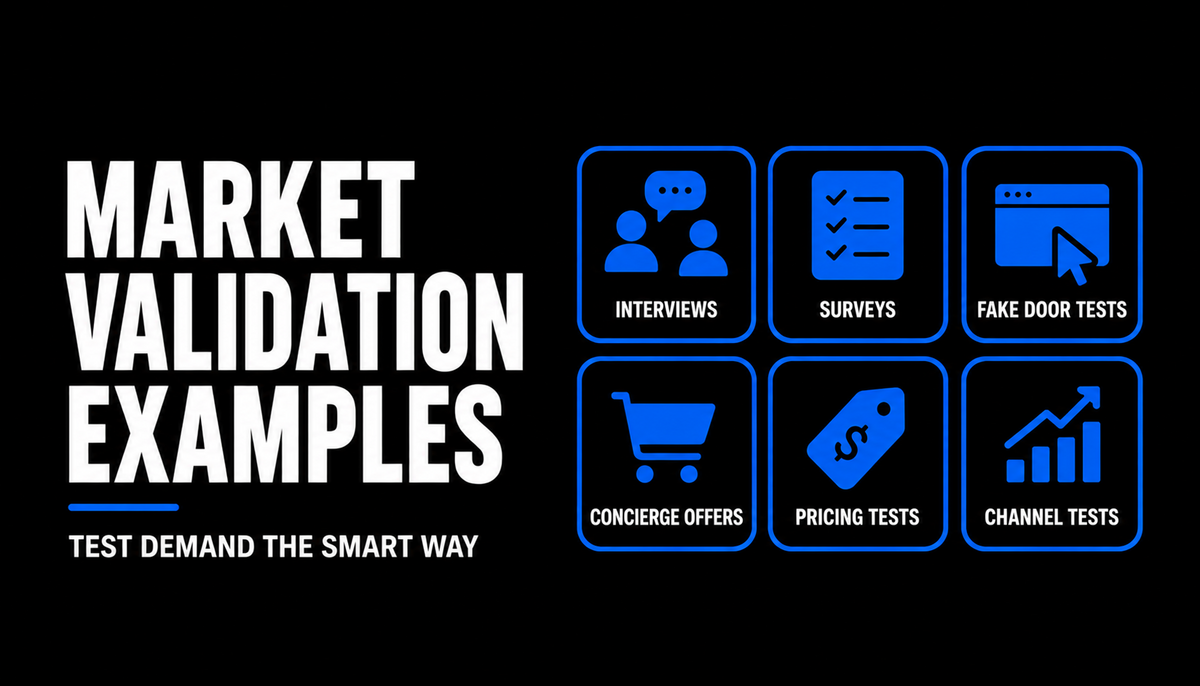
Fake door for demand risk
Concierge MVP for workflow risk
Paid pilot for payment and adoption risk
You do not choose a method based on personal preference. You choose it based on your riskiest assumption. Fake doors are the cheapest to run. Concierge MVPs cost founder time. Paid pilots require more sales effort and customer support.
Validation method tradeoffs
Fake door: Best when unsure anyone wants the promise. Proves demand intent via purchase attempts. The biggest risk is deceiving customers. Cost is low. Speed is fast.
Concierge MVP: Best when unsure the solution works. Proves workflow value via retained usage. The biggest risk is scaling prematurely. Cost is medium. Speed is slow.
Paid pilot: Best when unsure buyers will pay. Proves willingness to pay via cash collected. The biggest risk is pilot purgatory. Cost is high. Speed is slow.
Fake doors: testing intent
A fake door tests if users will attempt to buy a promised capability before you build it. Use fake doors when demand for a feature or promise is uncertain and building it would be expensive.
A fake door validates demand for the promise. It does not validate product quality. It separates the people who say they want a solution from the people who will actually try to acquire it.
Consider a standard waitlist. Before: 150 people joined the waitlist. After: 2 of those 150 clicked a payment link. The second number is the one that matters.
You can push this further to test whether users will put real money down. An extreme example is setting up a checkout flow for a product that does not exist yet. When the customer pays, the bank transaction is immediately reverted. The user gets an email saying capacity just ended, their money was refunded, and they are on the waitlist. This proves demand with real money definitively.
If you test payment intent before a product exists, you must use clear guardrails. Refund immediately and do not pretend the product is ready. For help designing these tests safely, use a fake door testing framework. You can also read The Mom Test for more context on asking the right questions and testing demand early.
Concierge MVPs: testing the workflow
A concierge MVP answers a different question: can you create the outcome manually before you automate it?
You do not build software. You deliver the service by hand behind a simple interface. A concierge MVP is often the right validation method when you can deliver the outcome manually before automating. It forces you to learn exactly what steps create value for the customer.
This approach works exceptionally well in enterprise software. See B2B minimum viable product examples to understand how to replace complex software with human effort. Doing things manually also forces you to strip away features that do not matter, aligning with the concept of perfection by subtraction.
Paid pilots: testing willingness to pay
Use a paid pilot when B2B value, urgency, the buying process, and willingness to pay are your main risks.
Founders often think customers will raise objections on their own. They will not. You have to extract objections directly. If a customer has no objections, it often means you have not asked for a real commitment yet.
A good paid pilot forces the issue. Asking for money surfaces hidden objections about budget, stakeholders, urgency, and implementation reality. If they will not pay for a pilot, they probably will not pay for the finished software.
FAQ
What are the main customer validation methods?
Fake doors, concierge MVPs, and paid pilots. Each method tests a different type of risk: demand, workflow, or willingness to pay.
When should I use a fake door test?
When you are unsure if anyone actually wants the promise, and building the solution would be expensive.
When is a paid pilot better than a concierge MVP?
When your main risk is whether buyers will actually pay and adopt the software, rather than whether the workflow creates value.
What counts as proof of demand?
Meaningful action. Clicks and waitlists are weak evidence. Signed letters of intent and collected cash are strong evidence.
Is it okay to ask for payment when you have nothing yet?
It is a strong way to prove real demand. Think of this as an outsourced engineering team. You are providing custom development for a fraction of the cost to solve a problem they do not have the resources to tackle on their own.
How do I know when validation turns into product-market fit?
Validation proves you have something worth building. Product-market fit means the market is pulling the finished product out of your hands. For deeper reading on measurement, refer to Lenny's Newsletter on product-market fit.