Testing a new business idea organically means running unpaid experiments to validate that people will pay for your solution. Instead of spending money on ads, you find target customers manually, deliver the outcome through a concierge service or early prototype, and ask for payment to prove business viability.
TL;DR:
A product can be a useful tool and still fail as a business.
An organic validation test without a payment ask is not a real test.
Run tests that force direct customer conversations, like community interviews and manual concierge tests.
Avoid asking what a customer thinks. Study their past behavior instead.
Test one hypothesis at a time until you reach a conclusion or move on.
I mentor dozens of founders for free every month, and many of them still ask how to position themselves for a raise before they have traction. My response never changes: you don't. You get the traction first. Investors rarely fund an untested idea today, especially when anyone can build a minimum viable product in two weeks. The product itself is not your asset. Your traction is the asset.
Testing a new business idea organically preserves your early capital. It forces you to have direct conversations with the people who will actually use the product for free, without spending money on paid channels.
How do you know if an idea is a business, not just a tool?
A pain point can be entirely real and still not support a business. Enthusiastic responses validate usefulness, not business viability.
Before you talk to a single customer, you need to understand that market selection drives most of your success. As a rule of thumb, 80% of a startup's success traces directly to the chosen market and ideal customer profile. Look at market growth, regulatory exposure, and substitutes. If you think you have no competitors, that is often a red flag. It usually means you do not understand the market well enough to start a real business.
Run your idea through the pain kill-list. In past research on founder operational pains, 11 specific pains examined were killed as SaaS opportunities. It turned out they failed for four typical reasons.
Pain Killer | Why it fails as a business |
|---|---|
Episodic pain | If it only happens once a year, people are less likely to renew a subscription. |
Already bundled free | The customer often already owns a tool that solves the problem poorly but for free. |
Software costume | You cannot fix a management or relationship problem with software. |
No budget control | If the person feeling the pain cannot spend company money, you have no buyer. |
Viability comes down to frequency and cost. I once reviewed a document-processing tool that handled rare formats. I was skeptical because I rarely use anything but easily readable files. Viability depended entirely on the statistics: how often people hit the non-standard formats, and how costly those failures were.
Practical Framework: 3 Free Organic Validation Experiments
You need discipline to test a new business idea. You should test hypotheses one by one. For a broader look at the testing discipline, see our guide on structuring your idea testing methodology.
Every experiment needs structure. Use this experiment card for every test you run.
Experiment Element | Description |
|---|---|
Hypothesis | What specific belief are you testing? |
Invalidation condition | What exact result proves this belief wrong? |
The payment ask | How and when will you ask the user to pay? |
The conclusion | What did the test actually show? |
Experiment 1: Community Interviews
Find where your target market already talks and ask for a conversation.
Avoid asking customers what they think about your idea, a core principle in The Mom Test. Do not study hypotheticals. Study their past behavior. Dig into why they acted a certain way.
Locate the community: Find active forums or groups for your ideal customer.
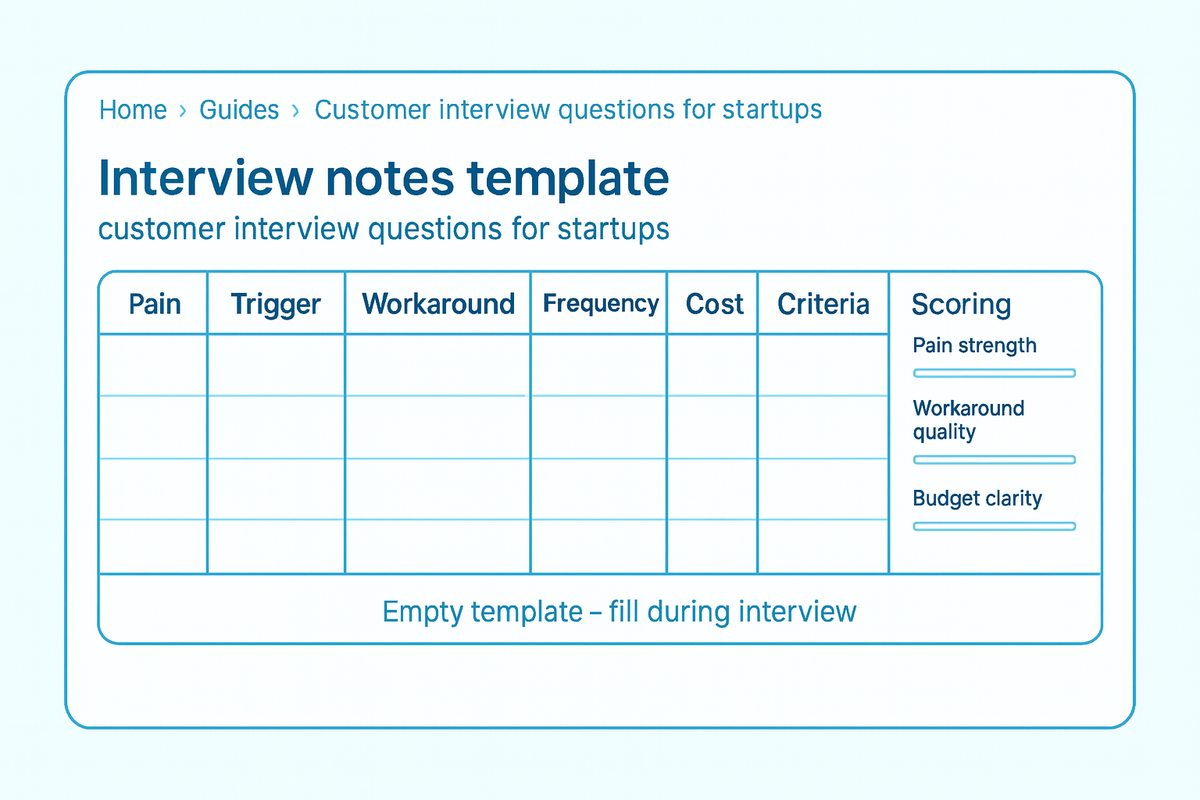
Request the interview: Ask for 15 minutes to discuss how they currently solve the specific problem.
Run the interview swap: Use the questions below to avoid polite lies.
Synthesize the mental model: Leave the interview with a clear map of why the customer makes decisions.
The Interview Question Swap
Stop asking this | Ask this instead |
|---|---|
What do you think about a tool that does X? | Walk me through the last time you dealt with X. What did you do? |
How much would you pay for this? | What did that failure cost you last time it happened? |
Would you use a feature that does Y? | Show me the workaround you currently use for Y. |
Do you like this idea? | What tool did you buy to try and fix this? |
Experiment 2: Organic Concierge Delivery
Do not build scalable onboarding at the start. You do not need software to prove that a customer will pay for a result. You just need to deliver the result manually and ask for payment. This approach to deep customer context is well documented in First Round Review's guide to product-market fit.
Find a handful of users: Source early adopters from your community interviews.
Set them up personally: Sit inside their workflow and do the hard work by hand.
Map the context: Use this unscalable friction to understand their team and daily workflow. That deep understanding becomes the moat that makes a generic product hard for a copycat to beat.
Ask for money: Charge them for the manual outcome.
Experiment 3: The Manual Alpha Pilot
Once you have an early product, test their actual willingness to pay in a live environment.
Invite users manually: Go to where the customers are and invite them directly.
Onboard them one by one: No framework can solve the learning curve for you. You need a personal approach to each early client.
Monitor the value: Watch them use the product and ensure it actually solves the problem.
Secure the commitment: When the problem is solved, ask for payment.
What counts as a passed test?
When you finish an experiment, look at what the customer actually did. Ignore what they said.
Customer Action | What it Means |
|---|---|
Praised the idea but refused to pay | You have a useful tool, not a viable business. |
Tried to pay but lacked budget approval | You are selling to the wrong person, or the pain is not expensive enough. |
Paid the requested amount | You have the traction you need to keep going. |
FAQ
How long should I keep testing an idea before I know it works?
There is no objective time. You test until you give up or hit your own limit. It is a founder-determined constraint, not a calculable one. The only thing you control is whether each test produces a real conclusion. Test hypotheses one by one, study past behavior instead of opinions, and recruit users by hand.
When should I use organic validation instead of running ads?
Organic validation preserves capital and builds early relationships, while paid experiments can offer quantitative data. If you have budget and want to test paid channels, read our guide on how to test a business idea with ad spend.
Can I test a business idea without building anything?
Yes. The organic concierge delivery experiment requires no software. You manually perform the service the software would eventually do.
What do organic tests actually cost in time?
Organic tests are free in dollars but expensive in time. You should expect to spend hours recruiting users manually and onboarding them one by one. The trade-off is a much deeper understanding of your customer.
How many people do I need to talk to?
There is no exact number. You talk to people until you stop hearing new problems and start seeing predictable patterns in their past behavior.
What if nobody in my network is my customer?
You have to leave your network. Find the forums, conferences, and digital spaces where your ideal customers actually spend time, and engage with them there. You can read more about evaluating market size and finding customers in Y Combinator's guide on how to talk to users.