TL;DR: Building a product is not testing an idea. An MVP proves you can write code, but it does not prove anyone will pay. Real idea testing forces a prospect to commit time, reputation, or money before you build anything. This guide covers how to stop farming polite compliments and start testing your core hypotheses using fake doors, manual pilots, and cold outreach.
What is Idea Testing?
Idea testing is the process of forcing prospects to commit time, reputation, or money before you write any code. It replaces assumptions and polite feedback with hard behavioral data. By running rapid, focused experiments, you measure actual market demand and find out if a problem is painful enough that people will pay to solve it.
You can build a functional MVP rapidly using modern tools. Many founders do exactly this. They get encouraging feedback from friends, polish their pitch decks, and start talking to investors.
Then they hit a wall. Nobody has paid. Nobody has signed a Letter of Intent (LOI). Nobody has even booked an implementation call.
Most founders are not actually testing their ideas. They are delaying rejection. They spend weeks on corporate design, legal setup, and theoretical market sizing. It feels like progress. In reality, they are avoiding the uncomfortable ask for money.
An MVP proves you can build something. It does not prove anyone wants the business to exist. Real validation means getting a specific buyer to take a specific step that costs them something.
Why MVPs and Compliments Fool Founders
Founders love asking prospects, "What do you think of this?"
These questions force polite lies. People do not want to crush your dreams, so they say your idea looks great. You leave the interview thinking you have validation, but you only have a compliment.
Stop asking what people think. Ask what they paid for last month. Study their past behavior. If they are not actively spending money or time to solve the problem today, your software will not change their habits tomorrow.
Customer validation requires forcing a real commitment, not measuring smiles during a demo.
Testing startup ideas by hypothesis, not opinion
Do not run broad experiments to see what sticks. B2B idea testing should isolate one of three core hypotheses:
Ideal Customer Profile (ICP): Who has the pain so badly they will act on it?
Pain-Solution Fit: If we offer this specific fix, does the ICP care enough to pay?
Distribution: Can we predictably reach this ICP and acquire them at a sustainable cost?
Test the riskiest assumption first. If you know how to reach dentists but you do not know if they care about scheduling automation, test pain-solution fit. If you know scheduling is a problem but you cannot acquire dentists profitably, test distribution.
The Signal Ladder
Not all evidence is equal. When evaluating your tests, rank your signals from weak to strong.
Signal | Commitment Cost | What It Proves |
|---|---|---|
Survey praise | Nothing | Polite interest |
Waitlist signup | Email address | Weak curiosity |
Cold reply | Time and attention | Problem awareness |
Demo booked | Schedule space | Active interest |
Signed LOI | Reputation | Strong intent |
Real revenue | Budget | Definitive proof |
A waitlist is a hint. A paid pilot is evidence.
Practical Framework: Choosing the Right Test
You need to match the experiment to the unknown you are trying to resolve.
Note: If you use attempted payments to gauge demand, you must ensure trust. Always reverse charges immediately and explain that capacity is full.
Method | Hypothesis Tested | Strongest Signal | When to Use It |
|---|---|---|---|
Fake-Door / Smoke Test | Pain-solution fit, ICP | Attempted payment | You need to know if people will buy before you write code. |
Concierge / Manual Pilot | Solution delivery, Pain | Paid pilot, usage | You know they want the result, but you must prove you can deliver it manually. |
Cold Outreach | ICP, Distribution, Messaging | Booked meetings, replies | You need to know if you can get their attention and sell the offer cold. |
The Extreme Fake-Door Test
When you need to test pain-solution fit fast, use a fake-door testing framework.
Write your offer as a hypothesis. Build a landing page with a clear pricing tier. Drive traffic to it, often by using ad spend to test acquisition, and ask them to buy.
When a prospect clicks "Buy" and submits their credit card, your system immediately reverses the charge. You show a message: "Capacity reached. We have refunded your card and added you to the waitlist."
This is the sharpest B2B idea test. It proves definitive demand with real money without harming customer trust. You must refund immediately, and you must follow up clearly.
If someone emails you angrily to complain that your fake-door page is missing a specific integration, do not panic. Celebrate. People do not complain about missing features in products they do not want.
The Pre-Product Paid Design Partner
If you are selling enterprise B2B, a fake door might not fit. Instead, pitch the core problem to a target ICP with zero code written.
The pitch: "Pay us a fraction of the cost upfront. We will act as your outsourced engineering team to solve this bottleneck manually."
Securing that payment equals validation. Building the software later is just execution. According to Y Combinator's essential startup advice, doing things that do not scale early on is how you find what actually works.
Cold Outreach Experiments
Sometimes the product is obviously useful, but acquisition and retention are the real risks. Testing with your friends or network is useless here. You must start with cold traffic.
Send targeted cold emails. Your goal is not to sell a nonexistent product, but to extract objections. If nobody replies, you have learned what will kill your distribution. The Mom Test principles highlight that early customer conversations should focus on finding hard truths you cannot see from the inside.
Set Idea Testing Success Metrics Before You Launch
Before you launch any test, write down your explicit proceed, change, or kill metrics.
If you decide you need a 3% conversion rate to validate a fake door, and you get 0.5%, the hypothesis is invalid. Do not convince yourself the page design was bad. Accept the data.
Force evidence on your core hypotheses, demand early commitment, and stop building software just to delay rejection. With no market need consistently ranking as a top reason startups fail, securing intent early is the best way to focus your efforts.
FAQ
What are the best B2B idea testing methods?
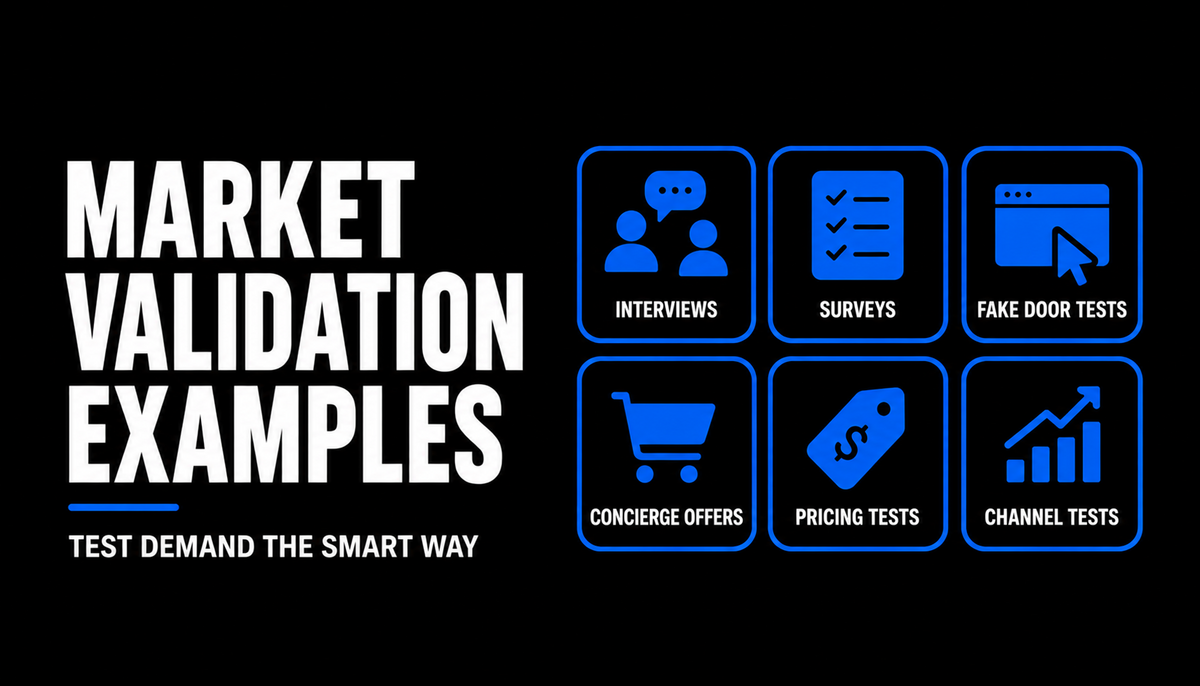
The most reliable methods are fake-door tests to prove willingness to pay, manual pilots to verify you can solve the problem, cold outreach to validate distribution, and paid design-partner agreements to secure upfront commitment.
How do I know a test proves demand, not polite interest?
Stop asking hypothetical questions. Put the offer in front of the ICP consistently and force early commitment. If they have to spend real money, schedule time, or sign a document, it is demand. If they only have to say "nice idea," it is polite interest.
What if I ask for payment before I have a product and they get angry?
If you handle it transparently, you build trust. Immediately refund a fake-door purchase and explain you are currently at capacity. A pre-product paid design-partner ask is also valid. You are offering them a custom, manual solution at a discount.
What if founders misunderstand the feedback?
Founders often think a lack of objections means the market wants the product. It does not. In most cases, you have to actively extract objections from people. No objections usually means no interest.
Should I always start with cold traffic?
Cold traffic is necessary when acquisition quality, retention, or message-market fit is the primary risk. If your biggest unknown is simply whether the technical solution works for a known buyer, a warm manual pilot is fine.