TL;DR: Lean validation helps founders prove commercial demand before scaling operations. Instead of relying on waitlists or polite feedback, you run a zero-code loop: state your hypothesis, run a manual test with live prospects, and measure hard signals like upfront payments or signed LOIs.
What is lean validation?
Lean validation is the process of testing a business hypothesis with the smallest possible investment of time and money. It replaces founder assumptions with undeniable customer behavior — like paying for a pilot or signing a letter of intent — before any software is actually built.
You get off a dozen customer interviews. The prospects agree the pain is real. You launch a polished no-code waitlist. A few people sign up and tell you to keep them posted.
This feels like you managed to validate your startup idea. You did not.
Founders hide behind surveys and waitlists because asking for money before a product exists feels uncomfortable. Polite interest does not pay bills. A waitlist tells you someone was curious. It does not tell you their boss will approve a budget, or that the pain is recurring and not already solved by an existing tool. As noted in Y Combinator's guide to product-market fit, early feedback misleads founders who do not ask for a real commitment.
If the prospect likes the idea but will not book the next call, introduce the buyer, sign a letter of intent, or pay for a pilot, you have feedback. You do not yet have demand.
Practical Framework: The Lean Validation Loop
Lean validation is a controlled attempt to make reality push back. You need a system of prioritized hypotheses and focused sprints.
The loop involves four steps:
Hypothesis: Define the ideal customer profile, the pain, the solution, and the channel. (Output: written assumption)
Minimum Test: Run a manual, zero-code test with live prospects. (Output: manual offer)
Hard Signal: Measure undeniable behavior, not opinions. (Output: payment, LOI, or scheduled demo)
Decision: Review the signal and decide what to do next. (Output: proceed, pivot, or kill the idea)
This loop helps you prove commercial demand before you scale operations. You can structure this as a timeboxed validation sprint once your hypotheses are clear.
The Zero-Code Test
Start by mapping the market with a two-axis competitor matrix. These two axes must be specific to your category. If you cannot map the alternatives, you do not understand the customer yet.
Next, run the smallest manual test. Treat your product like outsourced engineering for the first customers. Sell the outcome and do the work manually.
Find your first alpha customers by going to where they already are. Invite them, onboard them manually, and watch where the friction appears. Do not rely on automated emails or video tutorials. You must personally support the first customer team. Early onboarding friction can kill conversion before you test the idea fairly.
Signal vs. Noise: The Evidence Ladder
You must separate real demand from polite noise. Use this signal scorecard to measure evidence.
Signal Level | Example | Why It Matters |
|---|---|---|
Weak (Noise) | Compliments, survey interest, generic waitlist signups | Cheap to give. Shows curiosity, not budget or urgency. |
Better (Feedback) | Qualified waitlist answers, booked demo with a buyer, intro to budget owner | Shows the pain is recognized and worth their time to discuss. |
Strong (Proof) | Signed LOI, paid pilot, upfront revenue | Shows real demand. The problem is painful enough to spend money on now. |
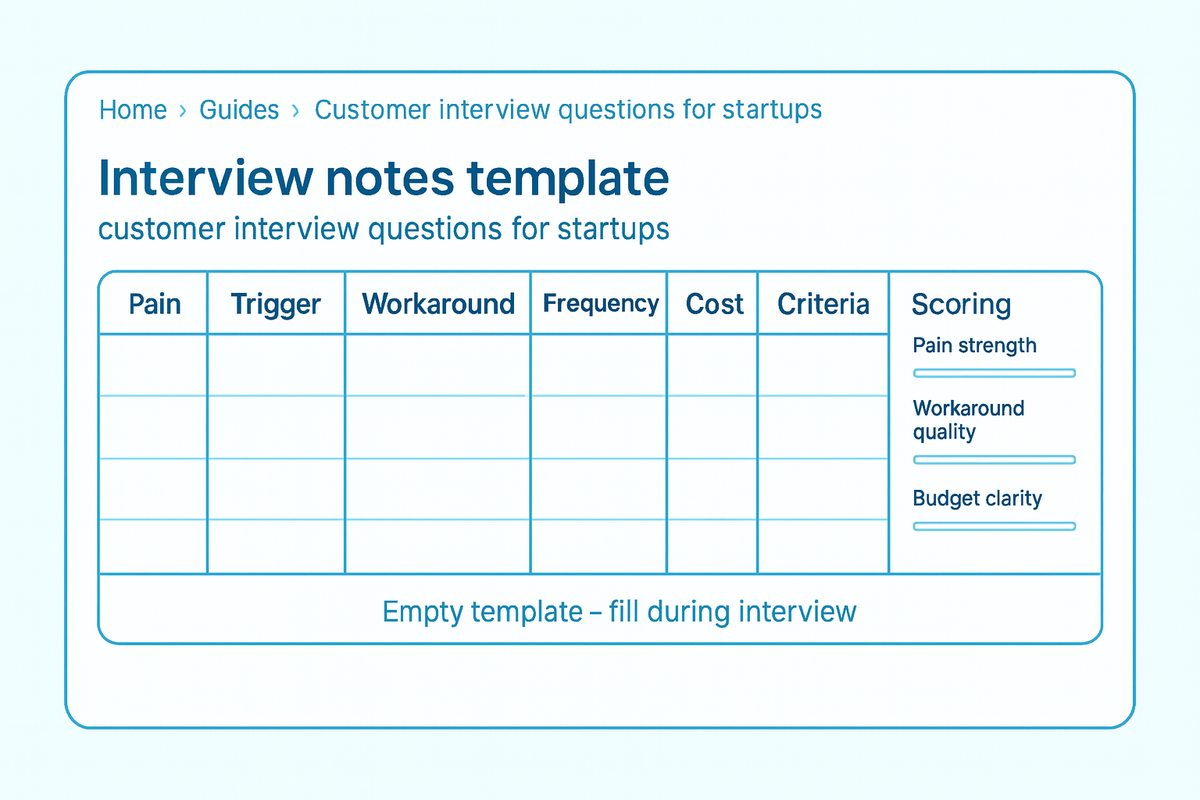
As The Mom Test teaches, do not run product idea validation with hypothetical questions like \"would you use this?\" Ask about past behavior. Ask what they did the last time this problem happened. Past behavior is harder to fake than future enthusiasm. Effective B2B product discovery supplies the inputs. Lean validation tests whether the market actually behaves that way.
False Negatives and Edge Cases
A failed test does not always mean a bad idea. Founders often misread false negatives.
The Channel Mismatch: A founder’s strategic bottleneck is often channel expertise. If you test a B2B hypothesis using paid ads, but you do not know how to run paid ads, the test will fail. A failed test in a channel you do not understand only proves you do not know the channel. Use a channel where you already have expertise.
The Feature-Breadth Trap: Founders often assume a broad feature capability is their main selling point. They think supporting every obscure file format will win the market. Instead of building it, measure how often users actually hit the nonstandard cases. You should validate the frequency and cost of the edge case before you write code to solve it.
The Absence of Objections: Founders tend to believe objections will flow naturally. They usually do not. You should actively extract objections from people. An absence of objections is not validation. It often means the prospect is just being polite. You can read more about extracting real objections in this Harvard Business Review piece on B2B sales.
FAQ
Can we validate B2B demand before we build anything, including asking for money or exposing a missing feature?
Yes. It is often the best way to prove real demand. Frame the offer as a paid pilot or design partnership. You provide custom development for a fraction of the cost. That is a massive favor for a company facing a real business problem they lack resources to solve.
What should I do when a prospect complains about a missing feature?
Celebrate. Customer complaints about a missing feature indicate real interest. In most cases, customers do not care enough to complain. A complaint means they want to use your solution.
Is a lack of objections a good sign?
No. If they do not show any objections, it does not mean they do not have them. You have to do the hard work of extracting those objections. Try asking for a deposit. If they have hidden objections, a request for money will often reveal them.