TL;DR: Unstructured research leads to analysis paralysis. A clear process drives actionable insights. Pick the right market and Ideal Customer Profile (ICP) first. Validate pain points through past behavior, not hypothetical questions. Run expert interviews to uncover non-obvious segments.
Founders often treat market research as a corporate exercise. They skip it. They build a product based on their own beliefs. Then they walk into investor meetings claiming, "We have no competitors."
This is not a competitor-analysis problem. It proves the founder does not understand the market, the customer, or the substitutes. Claiming you have no competitors often signals you are unprepared for real business.
Contrast that with a B2B sustainability startup in Europe. New ESG reporting regulations were forcing large enterprises to comply. That seemed like the obvious target. But research revealed a different segment: medium SMBs. These companies did not have to report. They wanted to adopt voluntary ESG reporting for branding and mission reasons. This segment was easier to target because competitors were not focused there. It produced much clearer signals for sales.
Finding these non-obvious angles requires a clear market research process. You have to go beyond asking an AI for an overview.
What is market research for startups?
Market research for startups is the structured process of validating a market, defining an ideal customer profile, and proving demand before building. A startup market research process has distinct steps. You must define hypotheses and segment the market. Then you validate pain points through past behavior. Finally, you map competitors and test distribution.
The B2B Market Research Framework
Founders overcomplicate how to do market research. They reduce it to public desk research or run massive surveys. They forget basic principles on how to talk to users.
Your goal is to get an overview and then look into the future of the market. Public sources are rarely enough. You need expert interviews to find the real edge.
1. Define the ICP Hypothesis
Start by identifying who you think will buy the product. Look at market dynamics, growth rates, and regulation pressure. Pick a market and ICP to test first.
2. Segment the Market and Identify Structural Changes
Break the market down into distinct groups. Look for structural market shifts, like incoming regulations. These changes force market restructuring and create immediate pain points. This dictates why your strategy needs to adapt based on real shifts.
3. Size and Prioritize Segments
Evaluate which segment offers the clearest path to traction. Consider the size of the segment, willingness to pay, and the strength of the competition.
4. Validate Pain with Expert Interviews
Do not rely solely on public data. Talk to industry experts. See if market participants actually share the pain points you identified. If multiple experts highlight the same friction, you have a foundation for a solution.
5. Source the Right Customer Voices
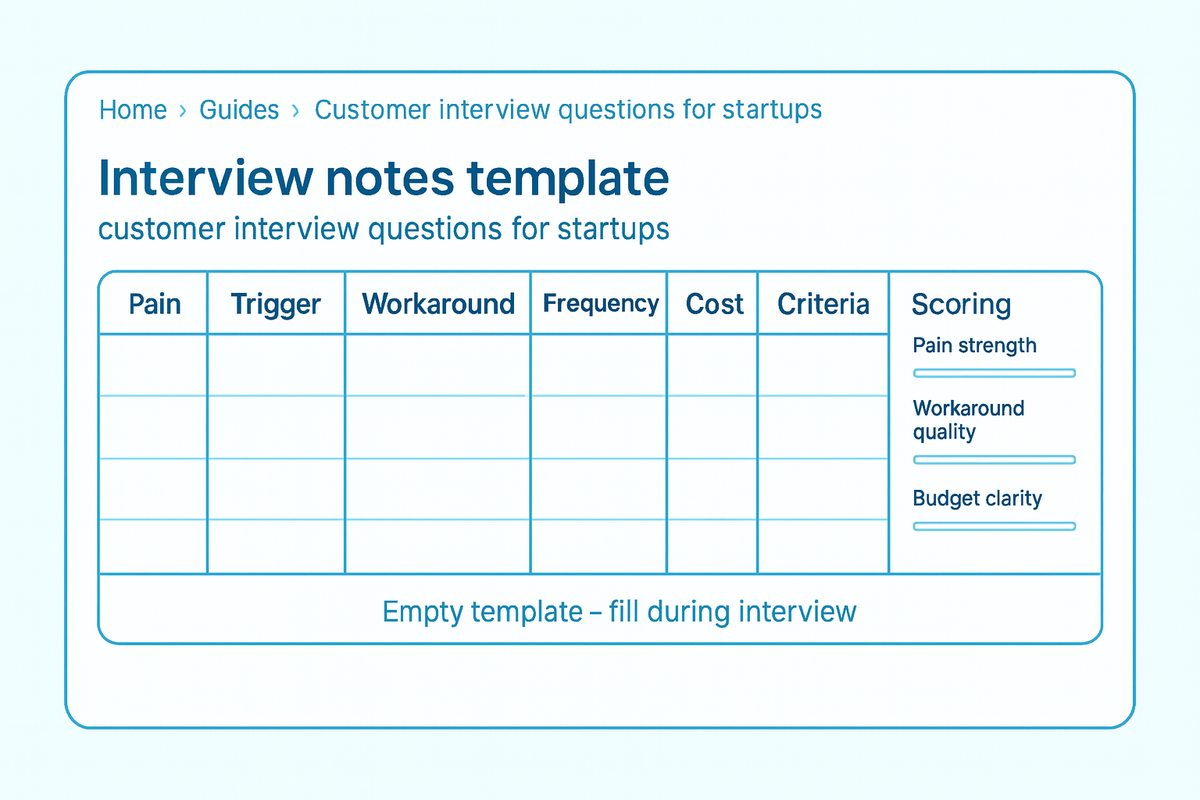
When testing market research methods, do not only look for current buyers. Find people who describe the underlying problem. Find people who use competitor products and still face the issue. Focus on asking questions that get past polite lies, a technique detailed in The Mom Test.
6. Map Competitors and Substitutes
Only build a competitor matrix after you research the broader market. Do not use generic templates. Choose two parameters that actually separate competitors in your specific space.
For example, evaluating tools for social media management might use:
One-platform vs. many-platform
Growth-first vs. full management
7. Decide the Next Test
Turn your research into manual action. Go where your ICP is. Invite the first customers and onboard them. See if they get real value.
Startup Market Research Checklist
Use this checklist to track your validation progress.
1. ICP Hypothesis: Define who needs this most based on market growth data and regulation trends.
2. Segmentation: List potential segments by analyzing structural shifts and industry changes.
3. Prioritization: Select the best segment based on willingness to pay and competition level.
4. Validate Pain: Confirm the problem is real through expert interviews highlighting shared friction.
5. Customer Voices: Capture how they solve it now by analyzing past behavior and competitor usage.
6. Competitor Map: Identify the gap using a 2x2 competitor matrix of product parameters and substitutes.
7. Next Test: Prove the solution works through alpha customer onboarding and initial usage.
How Founders Misunderstand Validation
Many founders rely entirely on LLMs for desk research. This provides a decent overview. But it cannot predict the future of the market or uncover proprietary risks. Expert interviews remain the cheapest way to find information that is not yet public.
Your first priority is to pick the right market and ICP. Only then should you test growth, competition strength, and future risks. Building without this validation is one of the top startup failure reasons.
FAQ
Why waste time on market research if it often misleads founders?
Because the wrong research is worse than no research. Founders mislead themselves by asking prospects, "What do you think about this?" These questions force polite lies. Do not study hypotheticals. Research past behavior. Find out what they actually did and why they did it. Look for repeated signals across complaints, reviews, and competitor weaknesses.
What should a startup market research checklist include?
It must cover defining your ICP, segmenting the market, validating the pain through expert interviews, finding the right customer voices, and mapping competitors based on specific market parameters.
How much market research should a startup do before building?
Enough to confidently select a target market and ICP, understand the regulatory pressure, and validate the pain with real past behavior. Over-researching leads to analysis paralysis; under-researching leads to building for yourself.
What is the difference between market research and customer discovery?
Market research evaluates the broader landscape, including growth trends, competitors, and structural shifts. Customer discovery focuses on talking directly to individuals to understand their specific problems and past behaviors.
How do we find early customers to research?
At the alpha stage, you do this manually. It is not a scalable process. Go to where your ICP is. Invite the first customers and onboard them. Ensure they get actual value out of the product before you overbuild.