Problem discovery questions help founders uncover the workflow reality, hidden costs, and operational frustrations of their target buyers. Unlike general product discovery interview questions, they focus strictly on the problem space. They test whether a pain point is expensive and urgent enough to solve, before you ever test a solution.
TL;DR: Do not ask customers if they like your idea. Ask them to reconstruct past behavior. True problem discovery separates a real operational pain attached to a budget from a passing complaint. Use these 7 targeted questions to extract workflow reality, cost, and urgency, rather than collecting polite lies.
A founder hears a prospect complain about a workflow. The founder assumes this is validation, goes heads-down, and starts building. Months later, they launch to silence.
The mistake was treating a complaint as a business opportunity. Operational pain can be real and still fail as a recurring software business. The pain might be episodic, meaning nobody renews. It might already be bundled for free into a platform they own. It might be a judgment or relationship problem wearing a software costume. Or, the person feeling the pain might not hold the budget.
If you build on your own beliefs or superficial reactions, you build for yourself. To validate real demand, you have to stop asking for opinions and start reconstructing past behavior.
Practical Framework: Qualify Before You Ask
Before you ask any questions, you have to talk to the right people. Interviewing people who match a theoretical buyer persona is a weak start. You want to find people who actively describe the problem or who already use competitors and feel the pain.
When conducting market research for a European B2B sustainability SaaS, the obvious move was to target large corporate buyers. Instead, discovery focused on consultants and green SMBs. This segment was actively dealing with the problem and offered a simpler, less competitive path to growth in a market that was heavily regulated and not yet consolidated.
Find the people actively struggling. If you interview current happy buyers of an alternative, or people who have never experienced the frustration, your data will skew.
The Problem With Opinions
Founders often overcomplicate discovery by making it opinion-heavy. They ask, "What do you think of this concept?" or "Would you use this feature?"
This forces polite lies. People want to be helpful, so they nod and say it looks great.
Good discovery is about understanding customer needs by uncovering real workflows, constraints, and tradeoffs before you ever propose a solution. You are not collecting reactions. You are turning hypotheses into evidence with clear invalidation metrics.
If a prospect says, "I hate how long this takes," your job is to find out what they actually did about it last time, not what they might do in a hypothetical future. You can learn the right interview methods to avoid these traps in The Mom Test.
When to Ask Problem Discovery Questions
You should use these questions early in the validation process: before demoing a product, before pitching your idea, and before writing requirements. They work best when you need to confirm that a costly problem exists and that your target buyer is actively trying to solve it.
Practical Asset: 7 Targeted Problem Discovery Questions
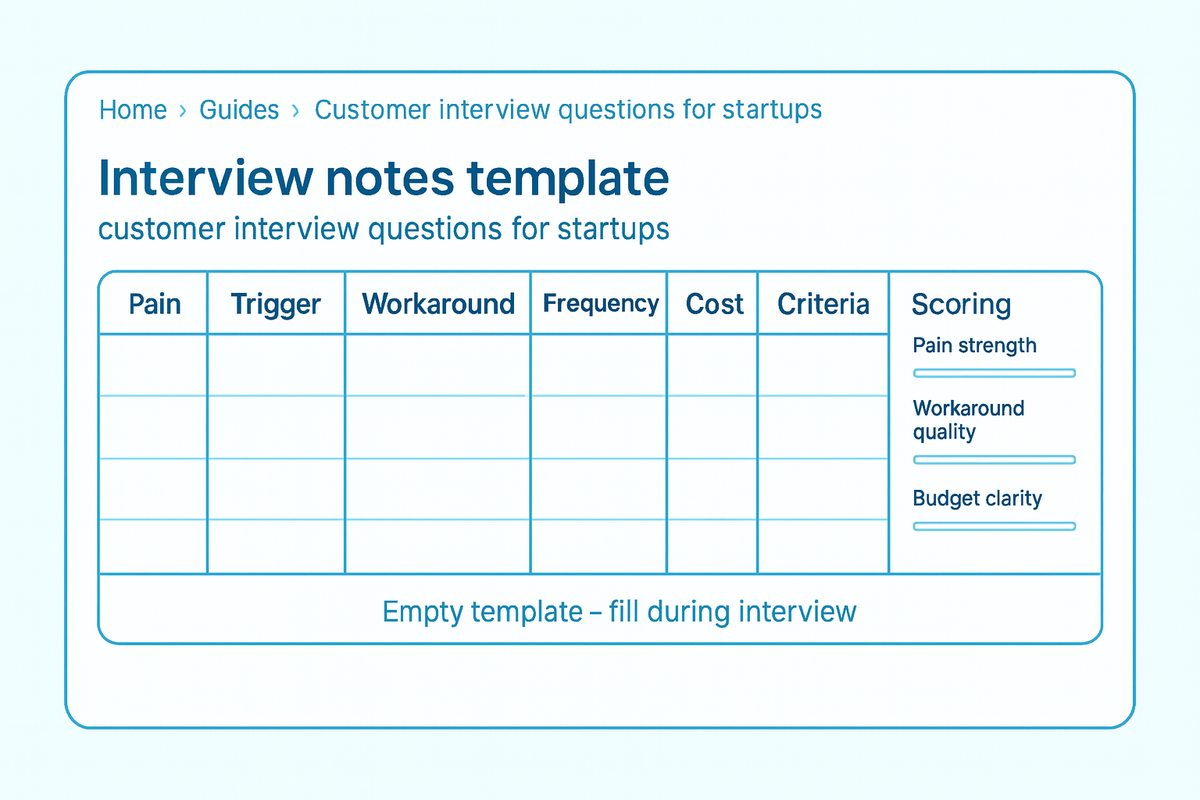
Use this checklist to explore the workflow, cost, and frustration attached to the user's current problem.
1. "Walk me through the last time this happened." Reveals exact steps and triggers of the workflow. Red Flag: They cannot remember a specific instance.
2. "Why did you handle it that way?" Reveals constraints, habits, and internal rules. Red Flag: They are satisfied with their current workaround.
3. "What did you try before?" Reveals the history of failed attempts. Red Flag: They have never tried to fix it.
4. "How often does this happen?" Reveals recurrence and frequency. Red Flag: It happens once a year (episodic pain).
5. "What does it cost in money, time, or missed revenue?" Reveals the actual business impact. Red Flag: No measurable cost; it is just an annoyance.
6. "Do you compare solving this to software, hiring a person, or doing nothing?" Reveals their mental category and budget source. Red Flag: They compare it to doing nothing.
7. "Would you pay for a solution before it is fully built?" Reveals genuine urgency and willingness to pay. Red Flag: They have no clear path to budget approval or show no urgency to buy.
If you need a broader structure that goes beyond strict problem-finding, you can adapt these into a full customer discovery questions script.
The Edge Case: Tool Problems vs. Business Problems
Not every painful issue deserves software.
Founders frequently confuse operational problems with existential business uncertainty. Operational problems — like messy spreadsheets, slow approvals, or broken formatting — are excellent candidates for tooling.
Fear, reluctance to start, or not knowing where customers come from are much deeper founder and business problems. If a customer's strongest pains are psychological or strategic, and you are pitching an instrument or a tool, you are aimed at an unimportant pain for that audience. Do not build tools for existential fear unless selling a methodology is truly your business model.
When a user hits an edge case, validate whether a supposedly broad technical capability is actually broad enough by measuring how often they hit the nonstandard case and how costly those failures are. Evidence matters.
FAQ
What should I ask if I am not pitching the idea or asking whether they like it?
Stop asking for opinions and hypotheticals. Reconstruct past behavior. Ask what happened before and after the workflow, how often it repeats, and what it costs. The point is to extract evidence of behavior, value, and urgency, not compliments.
What is the difference between problem discovery questions and product discovery interview questions?
Problem discovery questions are a specific subset of product discovery interview questions. They focus entirely on understanding the user's pain, workflow, and costs before a solution is ever introduced, rather than testing usability, features, or positioning.
How do I know if the pain is strong enough to build a product around?
Look at what they have already paid for or attempted. If they have hired freelancers, bought competing tools, or cobbled together expensive internal workarounds, the pain is real. If they just complain but have taken zero action, the pain is not strong enough to force a purchase.
Where can I learn more about interviewing effectively?
NNGroup offers excellent baseline advice on user interviews, and Steve Blank covers customer development that helps locate product-market fit through rigorous qualification.