TL;DR: Having "no competitors" is not a competitive advantage. It usually means you haven't found the customer's current workaround. True problem validation requires moving past polite compliments. You need hard evidence of pain severity, frequency, and budget. Prove the problem is real by extracting objections and analyzing past behavior. Secure paid commitments before you build an MVP.
When a founder pitches and says, "We have no competitors," they usually think it sounds visionary. In reality, it's a warning sign recognized in essential startup advice.
If you don't know your competitors, you don't know the market. If you don't know the market, you don't know the customer.
Customers always have a current workaround for their pain. They might use a messy spreadsheet, hire a consultant, or do nothing. If you cannot name what they do instead of using your product, you are building from your own beliefs. You need real evidence.
Founders often avoid the topic of money because the concept feels unproven. But willingness to pay is the cleanest signal you can get. If there is no money changing hands, there is no real value produced. A commitment to pay is essential. Problem validation must test evidence of pain and budget, not just founder conviction.
What is problem validation?
Problem validation proves a specific target audience experiences a painful, recurring issue they actively try to solve. It isolates the customer's pain from your proposed solution. You rely on past behavior, current workarounds, and willingness to pay as evidence. You do not rely on opinions or hypothetical interest.
The trap of interview theater
Founders often confuse building a product with validating a business. Modern AI tools make it fast to build things people do not need. You can design dark modes and features all day. But none of it matters if you aren't solving the most painful pain.
Many founders fall into "interview theater" during idea validation interviews. They ask hypotheticals like, "Would you use this?" or "What do you think of this idea?" These questions force polite lies. No one wants to tell you your idea is bad to your face. You leave the meeting thinking you have validation, but you only have a compliment.
A compliment is not validation. A repeated workaround is better. A signed letter of intent (LOI) or a paid pilot is best.
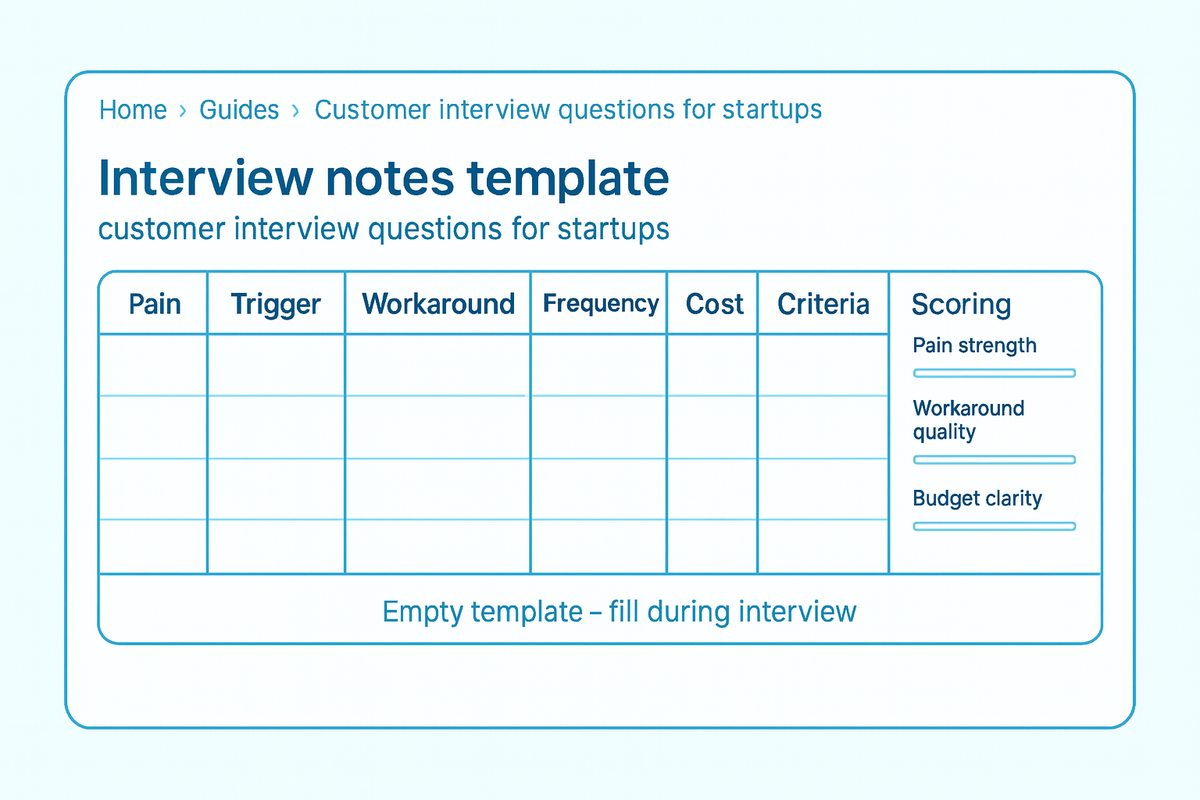
Instead of asking what someone thinks of your future product, study their past behavior. In successful customer development, you should ask:
When did this last happen?
What did it cost you in time or money?
What did you do instead?
Silence from a customer is not agreement. It usually means you didn't work hard enough to extract their objections. You must ask super-specific questions to pull objections out of people. They will not offer them freely.
Practical framework: The problem validation scorecard
Founders overcomplicate problem validation. They treat it like a framework exercise instead of an evidence threshold. To avoid lying to yourself, score your problem across three dimensions: Severity, Frequency, and Budget. This isolates the specific job of proving the pain exists before you move into the subsequent phases of customer discovery and validation.
Dimension | Weak Evidence | Strong Evidence |
|---|---|---|
Severity | The customer calls it an inconvenience. They have no current workaround (the pain isn't active enough to fix). | It is a costly pain or urgent blocker. They string together expensive software or human labor to fix it. |
Frequency | They experience the problem once a year. | They experience it daily or weekly as part of a core workflow. |
Budget | They have no existing spend. They see your tool as a cheap "app." | They have a named budget owner. They compare your solution to hiring a $100/hour human. |
Proof layer: Don't upgrade your validation score based on discovery call confirmations alone. Upgrade the score only when you have hard proof of demand:
They sign an LOI.
They pay for a custom pilot.
They put down a deposit before the product exists.
Mapping these dimensions directly impacts your business model. If a customer only feels a pain once a year, you cannot force a monthly subscription model. If the problem has no clear monetary value, you will struggle to frame your pricing. Keep demos secondary until you have clear evidence of the problem and channel.
Think of early validation as offering outsourced engineering. You provide them a custom fix for a fraction of the cost. If they won't pay for that, the pain is not severe enough.
Bridging to solution validation
Once you prove the customer has a painful, recurring, budget-connected problem, you earn the right to design a solution.
For B2B problem validation, verifying the pain first prevents you from building a solution that searches for a market. A strong B2B product discovery framework separates these steps intentionally. First, you prove the pain and define metrics to either invalidate the hypothesis or proceed. Then, you figure out the exact product mechanics.
If the problem is already obvious in a known category, you might not need to re-prove the need. For example, people clearly want emotional support or an AI companion. In those cases, the real test shifts toward customer acquisition and retention with cold traffic. But for most new products, skipping problem validation guarantees you will build the wrong thing.
FAQ
How do I know this is a real problem and not interview theater?
Stop asking "do you like it?" and stop validating opinions. A real problem leaves a trail of past behavior. Validate why the customer acted a certain way in the past. Look for willingness to pay. Real validation requires financial or behavioral proof, not just head nods on a call.
What is the difference between problem validation and solution validation?
Problem validation proves that a specific audience experiences a severe, frequent pain they will pay to fix. Solution validation proves that your specific product effectively solves that pain and that customers will choose it over their current workarounds.
Is it okay to ask for payment when I have nothing built yet?
It is the only way to go. This is how you prove real demand. Frame it as a design partner agreement or custom development. If the problem is painful enough, they will pay to solve it before the final software exists.
What if the customer does not have any objections during the interview?
If they do not have objections, it does not mean the product is perfect. It means you failed to extract the real reasons they will not buy. You must actively dig for objections using an interview validation framework designed to find the truth.