TL;DR:
Do not ask what people think of your idea. They will tell polite lies.
The best early discovery questions reconstruct past behavior and reveal what alternatives they already pay for.
Good market research proves whether a segment is worth entering at all. It does not validate your solution.
Founders often treat early discovery like validation. They enter interviews believing they already know the customer. They claim they have no real competitors. Then they build from their own assumptions rather than market evidence.
The core mistake is skipping the difficult work. You must prove who the ideal customer profile actually is, what alternatives they use, and whether the market is worth entering.
If you do not know the competitors, you do not know the market. If you do not know the market, you are building for yourself. To gather real evidence, you need open-ended questions that uncover pain points without pitching a solution.
The best questions to ask your target market are questions about past behavior, current workarounds, cost, frequency, decision-makers, and switching triggers.
The Danger of Opinion Polling
Founders overcomplicate target-market questions by turning discovery into soft pitching. Asking "What do you think about this feature?" or "Would you pay for this?" forces polite lies. People do not want to crush your dreams. So they say yes to hypotheticals.
Do not study their perception of you. Study their past behavior. You get actionable insights when you understand what they actually did and why they did it. Good B2B customer interview questions sharpen your understanding of the customer. They do not validate your preferred solution. NNGroup's advice on user interviews confirms that discussing your idea usually leads to false positives.
Practical Framework: Segment Discovery Rules
Market research helps you find the right people who feel the pain in a way you can build a business around. For a deeper look at new markets, see our guide on market research questions for a new business.
Take a B2B sustainability software company in Europe. The obvious target market seemed to be large corporations facing new regulations. But early research surfaced a completely different opportunity: consultants and green SMBs. These smaller companies did not legally have to comply with the new reporting frameworks. They wanted to comply for branding and marketing benefits. Targeting them allowed for much simpler growth compared to the heavily regulated corporate space.
You find hidden segments by using the answers from your interviews to run a segment fit decision rule:
Rule 1: Does the segment currently spend money or time solving the problem? If no, discard the segment.
Rule 2: Are they comparing their current solution to an expensive alternative or a cheap internal workaround? Target segments anchored to higher prices.
Rule 3: Is their growth context heavily regulated and crowded, or voluntary and open? Prioritize the simpler path to entry.
Frame your interview questions around learning the buyer's current workflow, category comparisons, and regulatory pressure. Then use those answers to decide which segment is simpler to reach and less crowded.
How to Fix Leading Questions
Bad question | Better question | Why it works |
|---|---|---|
Would you use a tool that does X? | How do you currently solve X? | Uncovers actual behavior instead of hypotheticals. |
Is this a big problem for you? | What happens if you do not complete this task? | Forces the buyer to explain the real consequence. |
How much would you pay for this? | What did it cost you to fix this the last time it broke? | Anchors value to past spending, not future promises. |
10 Questions to Ask Your Target Market
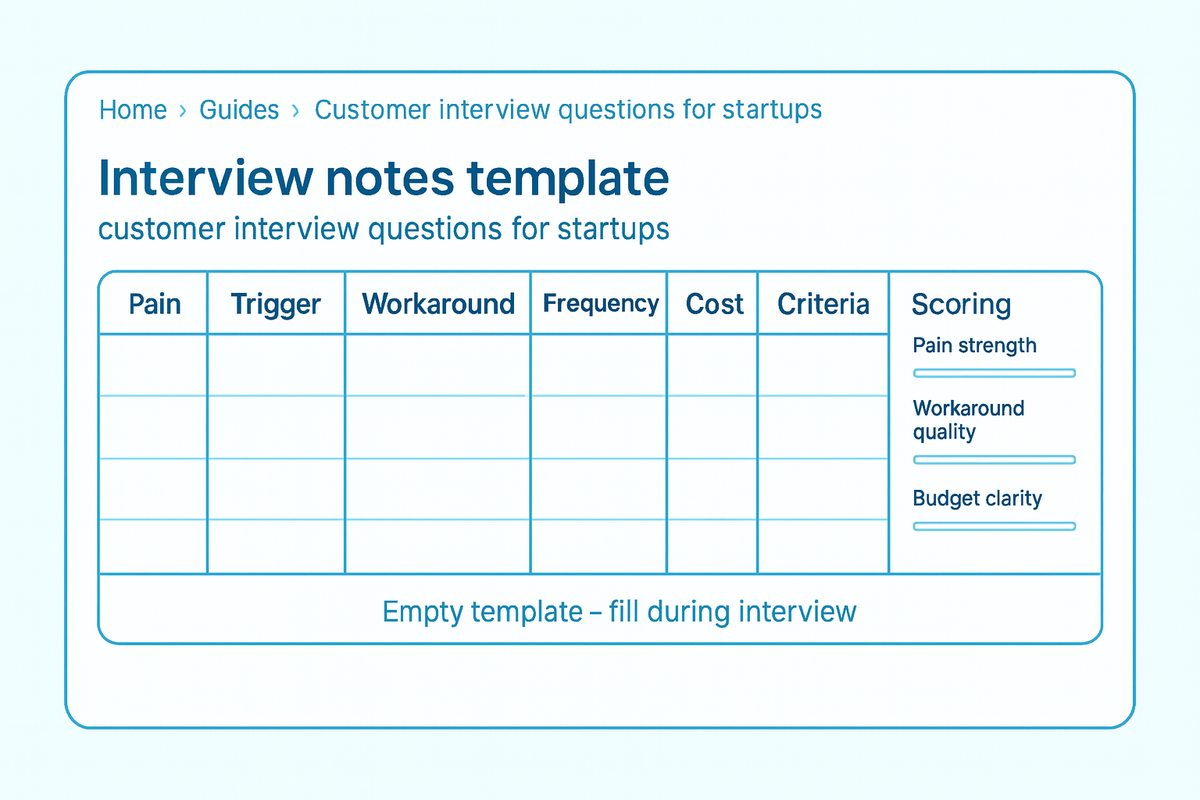
1. Walk me through the last time you handled [specific task or workflow].
Have them reconstruct the sequence of events. Listen for where they hesitate or complain.
2. What tools, spreadsheets, or manual processes do you currently use to get this done?
This reveals their actual competitors. Competitors are often internal workarounds or substitutes, not other startups.
3. What happens if you do not complete this task?
Understand the real consequence. Is it a minor annoyance, or does it cost them money, time, or regulatory fines?
4. How much time and money did it cost you to fix the problem the last time it broke?
Quantify the pain. The problem may not be worth solving if they cannot attach a number or significant time loss to it.
5. How often does this specific painful case happen?
Do not assume an edge-case capability has a big market. Measure frequency and pain to see if the capability is actually broad enough.
6. What prompted you to start looking for a better way to handle this?
Find the trigger event. Understanding why they decided to change behavior helps you align your marketing and sales motion. Steve Blank's customer development framework relies heavily on identifying this exact catalyst.
7. Who else in your organization is involved in making decisions about this process?
Map the buying committee early. The user and the buyer are rarely the same person in B2B sales.
8. What external pressures are changing how you do this?
This helps uncover broader market dynamics. It can reveal unexpected segments, like the green SMBs in the sustainability example.
9. What is the hardest part about dealing with the tools you currently use?
Let them complain about their current setup. This gives you exact language to use in your customer discovery questions script.
10. If you could instantly change one thing about this workflow, what would it be?
Use this to identify their ultimate desired outcome. Do not treat their answer as a literal feature request.
FAQ
If I’m talking to my target market, why shouldn’t I just ask what they think of the idea?
Asking "what do you think about it?" invites polite lies. You want the blunt truth. People are conditioned to be nice when presented with hypotheticals. As noted in The Mom Test, early discovery should not study the customer’s perception of you. Ask open-ended questions about what they actually did before. Ask about the last time the problem happened, what they tried, why they chose that path, what broke, and what it cost them. The goal is to build a clear mental model of the customer’s past behavior, not engage in validation theater.
What should you avoid asking your target market?
Avoid asking about the future. Do not ask if they would buy something, how much they would pay, or if they like a specific feature. Future promises cost the buyer nothing and provide you with false confidence.
How many target-market interviews should you run?
Run interviews until you can accurately predict what the next person in that specific segment will say. If answers are still wildly different after 10 calls, your target market definition is probably too broad.
How do you know if an answer is useful?
An answer is useful if it describes a specific past action, a concrete dollar amount, or a measurable amount of lost time. If the answer starts with "I usually" or "I think I would," it is hypothetical and less useful.