TL;DR: Founders often copy standard SaaS pricing tiers before testing what buyers will actually pay. Benchmarks are useful as a sanity check, but only after you define your retention pattern and your perceived competition. Figure out if buyers use the product daily or yearly, and whether they compare it to cheap software or an expensive human service. Set your model and prices based on usage and framing, then use benchmark tables as guardrails.
SaaS pricing model benchmarks are industry data points, like median tier prices, standard feature limits, and common value metrics, used to compare your pricing structure against similar companies.
Benchmarks are guardrails, not answers.
The biggest pricing mistake founders make (often a top reason startups fail) is treating standard pricing tiers as a decision rather than a sanity check. If you copy a competitor's pricing without knowing their retention pattern or willingness to pay, you are building for an average that does not exist. Use benchmarks to spot extremes, but build your tiers around your own evidence.
Practical Framework
Before looking at standard ranges, build your context. Follow these steps:
Check your retention pattern: Is the product used daily or once a year?
Define the perceived competition: Does the buyer compare you to an app or a human service?
Pick the value metric: Are you charging per seat, per outcome, or by usage?
Build a competitor matrix: Plot the market on two category-specific axes (e.g., one-platform vs. many-platform).
Run a benchmark sanity check: Compare your planned tiers against industry standards to see if you are leaving money on the table.
Standard B2B SaaS Pricing Benchmarks
Search intent for benchmarks usually focuses on tier ranges. Once you know your category frame, you can use standard tier data to see where you sit.
B2B Tier Ranges and Context
Tier | Target Market (ACV) | Typical Seat Count | Illustrative Range (Monthly) |
|---|---|---|---|
Starter | SMB (< $1k ACV) | 1-5 users | $10–50 |
Pro | Mid-Market ($1k-10k) | 10-50 users | $50–250 |
Enterprise | Enterprise ($25k+) | Custom/Site-wide | $500+ |
Note: The ranges above are illustrative hypotheticals for early-stage B2B structures, not validated industry benchmarks.
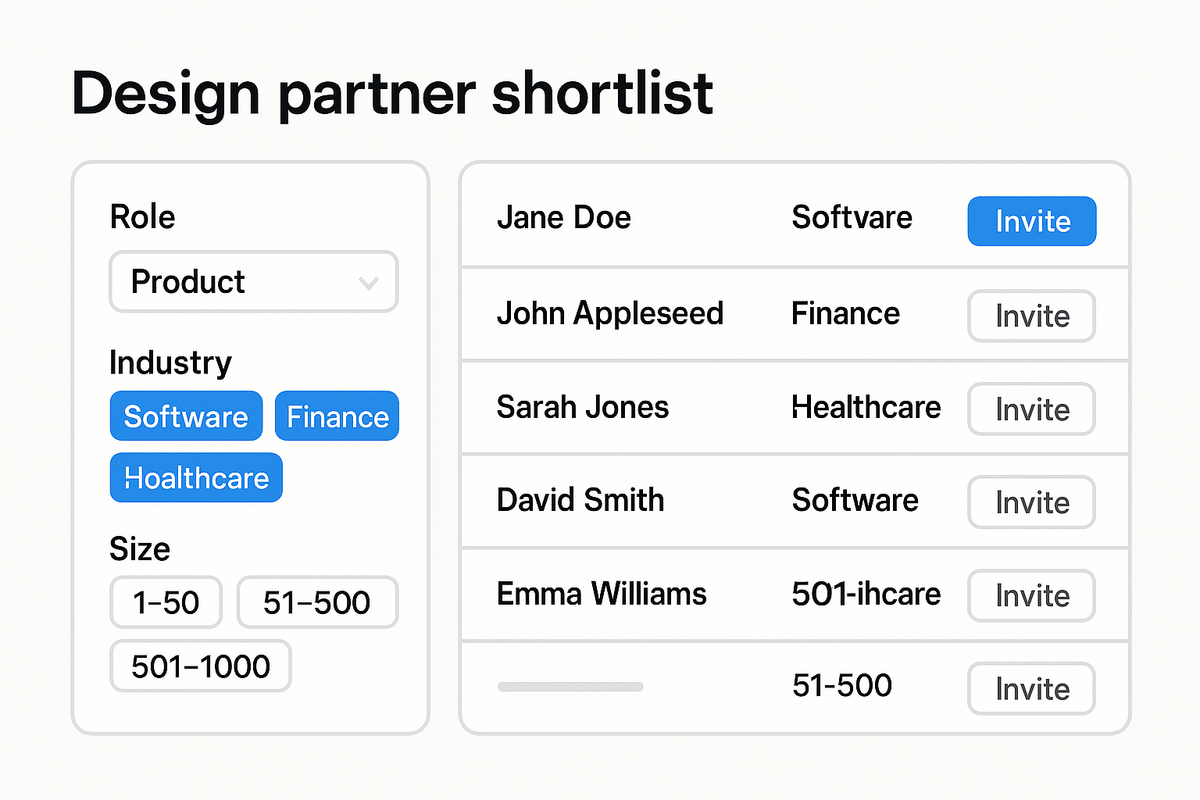
Do not just pick a number from this table. Pair these ranges with your competitor matrix. Test these assumptions in the real world. A startup pilot program is an excellent place to test tier willingness-to-pay. Once you have pilot interest, use a design partner template to structure the commercial agreement before publishing prices publicly.
The Benchmark Trap
Founders often try to find the perfect pricing model before they prove their concept. They look at industry averages and copy standard $49, $99, and $249 tiers because it feels safe.
But this skips the hard part: asking the buyer for money. If you do not ask for money, you produce no real value. The exact price matters less than finding out if they have any willingness to pay. This requires active customer development.
Standard SaaS pricing models should only frame the conversation.
Start With the Retention Pattern
Your retention pattern tells you which model to use.
Many founders force a monthly subscription on a product that buyers only need once a year. This guarantees high churn. If your product is used daily, a subscription or seat-based model makes sense. If it is used rarely, you need a different structure.
Industry data shows hybrid and usage-based pricing are growing, but you must follow how your real users engage.
Map the Perceived Competition
Your pricing ceiling depends on what the buyer compares you to.
If buyers compare your tool to a basic software utility, they expect to pay $10 a month. If you reframe the product as a replacement for a human service, the acceptable benchmark changes entirely.
Consider an illustrative fitness app example: if early customers compare the product to other apps priced at $20, that becomes the ceiling. But if the team reframes the product, positioning it against a $140 human coaching session, they might successfully sell the app for $45 a month, far above the $15 software average.
Category framing changes the baseline. This is a core part of a founder's primer on how to sell SaaS.
Outcome-Based vs. Per-Seat Models
Founders often ask if they should price per seat or per outcome.
Outcome-based pricing is easy to sell. Buyers like paying for results. But Monetizely data on SaaS pricing suggests that value alignment is hard to get right. If you price on outcomes, the outcome must be a measurable artifact. Never promise results outside your control.
Per-seat pricing is boring, but it often provides better retention and a higher lifetime value. It works well when predictability is the main goal.
FAQ
What are typical B2B SaaS pricing tiers?
Typical B2B SaaS tiers often use illustrative ranges like a Starter tier ($10-50/month) for individuals, a Pro tier ($50-250/month) for teams, and an Enterprise tier ($500+/month) with custom features and security.
What is a good SaaS starter tier price?
A good starter tier usually falls between $10 and $50 per month. It should offer enough value to solve a basic problem while keeping friction low for new users.
When should startups use usage-based pricing?
Use usage-based pricing when the value scales directly with how much the customer uses the product, such as API calls or transaction volume. It works best for products where usage varies widely between customers.
Which SaaS pricing benchmark should I copy for my tiers?
Do not copy a benchmark directly. Start with the retention pattern of your ideal customer. Decide if they use the product daily or yearly. Then price against perceived competition. Use benchmark tables only as a sanity check.
What if I do not have direct competitors?
Saying you have no competitors means you do not know the market. Buyers always compare your product to something. They might compare it to a spreadsheet, a human assistant, or doing nothing. Find that anchor and set your price against it.