TL;DR:
Startup customer development is a formal process for proving market demand before you write any code.
Understanding your ideal customer profile (ICP) and how to reach them is the real moat.
Market exploration must happen before agile development begins.
Ask for money before building anything to prove demand.
Stop asking for opinions; study past buyer behavior instead.
I mentor dozens of founders for free every month, and many still ask how to position themselves for a seed round before they have traction. The answer never changes: get traction first. Very few investors fund just an idea today. An MVP can often be built in a matter of weeks. The idea was never the scarce part.
A founder who says they have no competitors usually means they haven't looked. No competitors means no market. No market means no customer. And no customer means you're building on your own beliefs. Being right doesn't count. You can be correct about the problem and still lose because the buyer doesn't believe you.
The formal framework fixes this problem. It runs market exploration first, before the agile build loop starts. Understanding your ideal customer profile (ICP) and how to reach them is the thing competitors cannot copy in a few weeks. Deep customer understanding is your durable moat.
What Is Startup Customer Development?
Startup customer development is a formal process for proving market demand before you write code. It forces founders to leave their assumptions behind, systematically test their hypotheses about the problem, and verify that real buyers are willing to pay for a solution. By focusing on the customer's actual context, this framework ensures you validate the market need rather than just your ability to build software.
The agile development loop is excellent for iterating on features, improving UX, and delivering software quickly. But agile cannot tell you if you are building for the wrong audience, or if the problem is actually worth solving. Agile handles the how and the what, but market exploration must handle the who and the why. The handoff sits exactly where demand is proven — you only start the agile build loop once you know the market wants it.
Focus | What It Handles | What You Cannot Learn From It |
|---|---|---|
Customer Development | Who the buyer is and why they pay. | How to build the software efficiently. |
Agile Build Loop | How to iterate features and improve UX. | Whether the problem is actually worth solving. |
The traditional framework, originally introduced by Steve Blank, moves through four phases.
Phase | Purpose | Stage |
|---|---|---|
Customer Discovery | Find out who the customers are and test if the problem matters to them. | Pre-product |
Customer Validation | Prove you have a repeatable sales roadmap to reach those customers. | Pre-product |
Customer Creation | Create end-user demand and drive it into the sales channel. | Post-product |
Company Building | Transition from learning to execution and scale the organization. | Post-product |
This guide focuses purely on the pre-product process. For a closer look at phase mechanics, read this breakdown of the customer discovery and validation phases.
The Customer Development Process, Step by Step
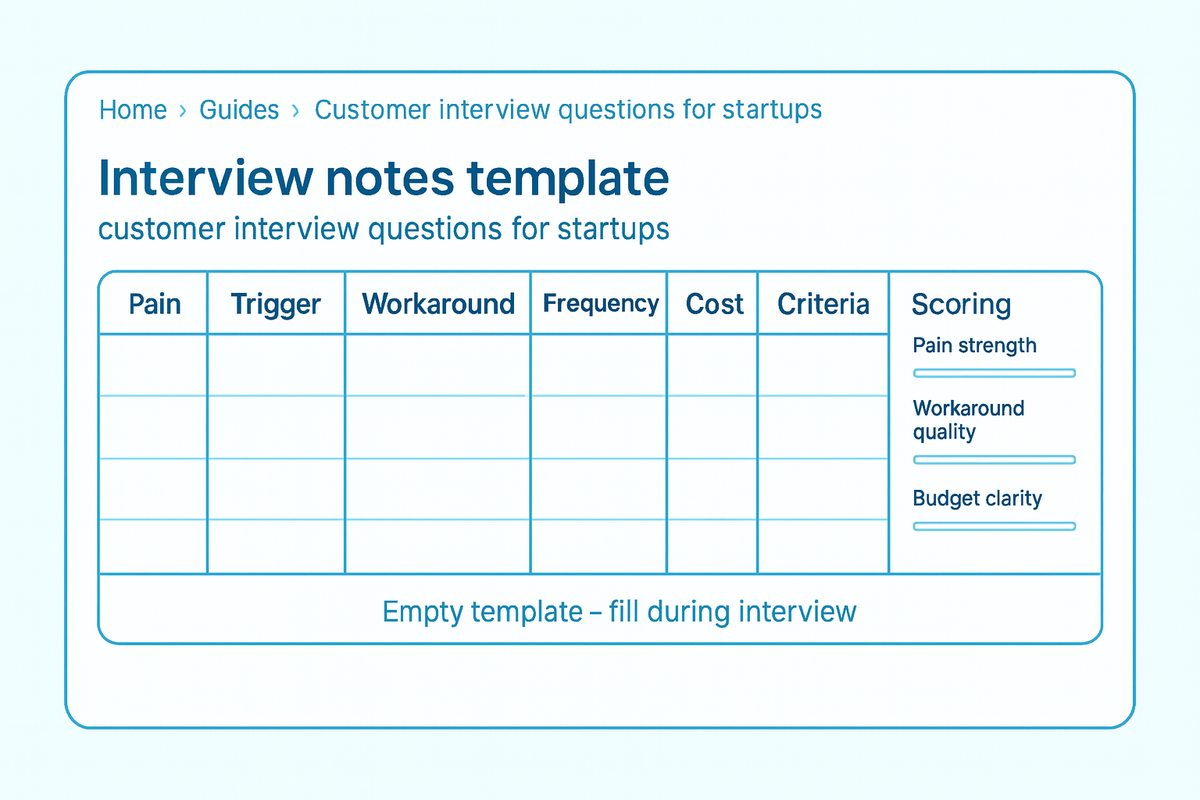
Do not start building yet. Commit to a floor of at least 10 conversations with real buyers before writing code. Use this concrete sequence to test demand before you start an agile build.
Map the market first.
Do this before testing anything. In my experience, a startup's success largely traces back to the chosen market and ICP. One team I worked with built a European B2B sustainability SaaS and assumed their buyer was the corporate sustainability office. But because they researched this heavily regulated, non-consolidated market first, the data pointed somewhere else entirely: small consultants and green-leaning SMBs. They found a near-competitorless growth segment before running a single test.Build a contextual competitor matrix.
Pick two specific axes that separate players in your niche. You can only pick them after you map the broad market, and they are never universal. For example, in the social media management space, the right axes turned out to be one-platform vs. many-platform and growth-first vs. full-management.Define your ICP and GTM.
A go-to-market strategy is not a product launch plan. It is the exact set of actions required to consistently put your company in front of your ICP. Everything else follows later.Recruit alpha customers by hand.
Find your first users manually. This manual grind isn't a phase you skip once you raise; it's the process you use to learn what to build. Go to where the customers are, invite them directly, and ensure they get actual value.Look for demand proof as a strong signal.
The best signal to move from exploration into building is proof of demand. Founder conviction is not enough. Across dozens of pitches I've reviewed, real progress beats vision. Investors read vision without traction as naive storytelling. If you need a framework to organize these findings, try using a customer discovery kit.
The Proof-of-Demand Ladder
How do you know you are ready to start the agile build loop? Check your demand proof. Real commitment is the first step on the road to product-market fit, as highlighted in The Mom Test.
Verbal interest. (Weakest signal)
Demo scheduled or Signed LOI.
Money changed hands. (Strongest signal)
If people just say they like the idea, you are not on the ladder.
FAQ
What is the difference between customer development and product development?
Customer development answers whether a market exists and if people will pay to solve a specific problem. Product development (like the agile loop) answers how to build the solution efficiently. You must run customer development first to prove demand, then use product development to deliver the solution.
How do I know demand is real before I build anything?
Stop asking what people think. Ask what they did the last time this came up, and why they chose that. NNGroup's User Interviews 101 emphasizes digging into real past actions. You need to understand customer needs by studying their past behavior. Walk out of every interview with a clear mental model of the customer.
How many customer interviews do I need?
Set a floor of at least 10 conversations with real buyers before you write any code. This is a minimum to prevent you from building on your own assumptions, not a magical threshold where validation is guaranteed.
Is it okay to ask for payment when I have nothing yet?
Asking for money before you have a product is a strong way to validate. It proves real demand. You're not selling a product that doesn't exist. You're offering to build the thing they need for a fraction of what an in-house team costs. That's a much easier conversation than founders expect.
Can I hire someone to do these interviews?
Founders cannot fully delegate growth experimentation. The founder must stay in the loop. The founder is the source of customer understanding and the highest-leverage ideas. Delegating early discovery work misses the point.