TL;DR
Stop pitching ideas: With modern tools, anyone can build an MVP in weeks. Investors want proof of demand, not a polished story about a hypothesis.
Traction is your narrative: If you don't have MRR or early traction, stop tweaking your deck and go get customers.
Cold traffic beats friendly pilots when friendly pilots are too warm to prove demand: Your market validation needs to come from cold channels, not friends who said they might use your tool.
The deck is a proof file: Structure your slides to show validated ICPs, extracted customer objections, and a real commercial pilot pipeline.
Every month, founders ask how to position their startup pitch deck for a seed round before they have any traction.
The answer is simple: you don't.
You go get the traction first. With modern tools, anyone can spin up a minimum viable product in weeks. An idea, a vision, and a well-designed slide deck are no longer enough to raise money. If you don't have MRR, or at least your first signs of real traction, tweaking your investor pitch is a waste of time.
A startup pitch deck shouldn't be an exercise in persuasion or storytelling polish. It should be a proof file. It must demonstrate that you have found a real problem, identified an Ideal Customer Profile (ICP), and generated demand.
A startup pitch deck should show concrete evidence of market validation and early traction rather than just a big vision. It needs to clearly articulate the problem, prioritize a specific ICP, present a solution that fixes the most painful issue, and back up its growth claims with a real commercial pilot pipeline and tested distribution channels.
The Proof-First Pitch Deck Outline
Investors want to see that you understand the market and that the market wants what you are building. Structure your slides to present concrete evidence instead of untested hypotheses.
Recommended Slide Order: Core Premise
Slide # | Slide Name | Investor Question | Proof to Show |
|---|---|---|---|
1 | Problem & ICP | Who has this problem and how bad is it? | Validated pain points from specific customer segments. |
2 | Solution (MVP) | How does your product fix the core pain? | A simple product focused entirely on the primary pain. |
3 | Market Validation | Have you proven people want this? | Data from cold traffic tests and extracted objections. |
4 | Traction | Are people actually using or paying for it? | Initial MRR or a real commercial pilot pipeline. |
Recommended Slide Order: Execution
Slide # | Slide Name | Investor Question | Proof to Show |
|---|---|---|---|
5 | Business Model | How will you make money? | Pricing tested with early users or design partners. |
6 | Go-To-Market | How will you reach more customers? | Distribution experiments and tested acquisition channels. |
7 | Competition | Why will you beat the alternatives? | Understanding of why customers choose you over existing options. |
8 | Team | Why are you the right people to build this? | Evidence of founder-market fit and execution speed. |
9 | The Ask | What are you raising and why? | Funding needed to scale your proven demand and hit the next milestones. |
1. Problem & ICP
Start with the problem, but be specific about who feels it. Don't present a massive, vague Total Addressable Market. Instead, show that you have firmly prioritized potential ICPs. Building a Go-To-Market strategy for the wrong ICP can kill your startup. Show the painful problem your specific ICP is experiencing.
2. The Solution (Your MVP)
Your MVP should focus on one thing: fixing the most painful problem for your ICP. With current tools, it is easy to build features people don't need. Keep your composure and avoid adding extras like dark mode or feature sprawl. Show how your product solves the core pain.
3. Market Validation
How do you know people want this? Don't rely on friendly pilots or people saying they like the idea. You need to test your category with cold, or somewhat cold, traffic when friendly pilots are too warm to prove demand.
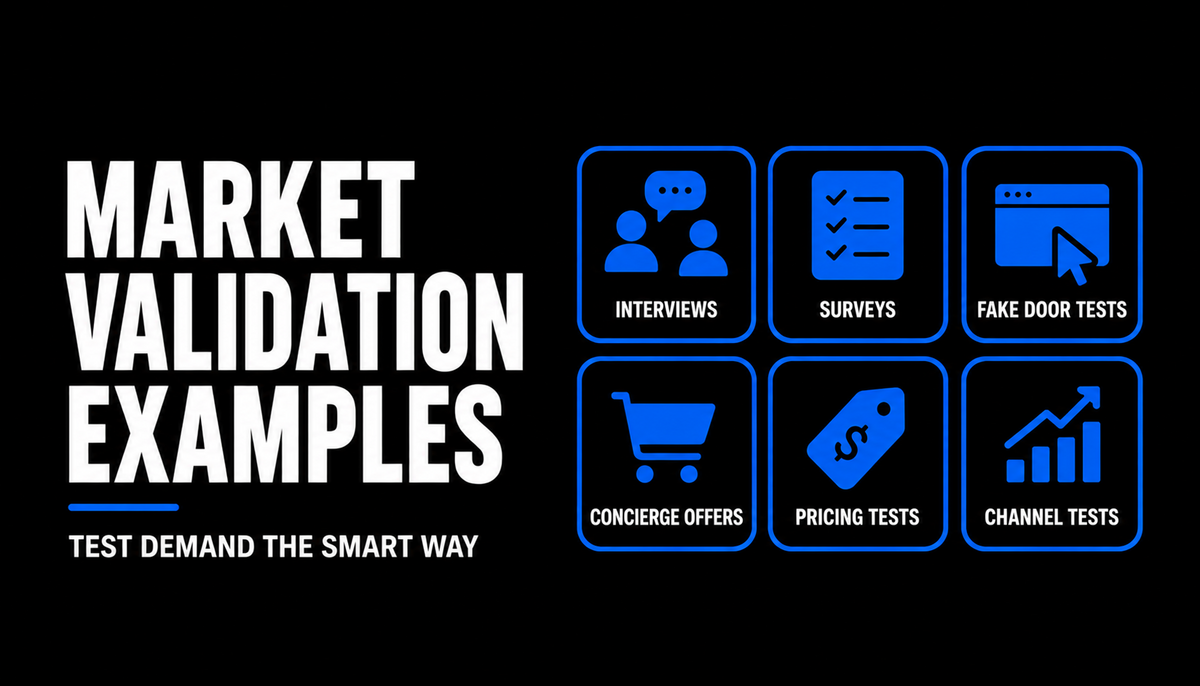
Show the assumptions you have tested for your ICP, pain-solution fit, and distribution. What metrics are you tracking to prove or invalidate these assumptions? For real-world benchmarks on proving your market, review these market validation examples. This is where a true market validation pitch deck stands out.
4. Traction and Commercial Pilot Pipeline
This is the most important slide. Hypotheses are not enough; you need evidence.
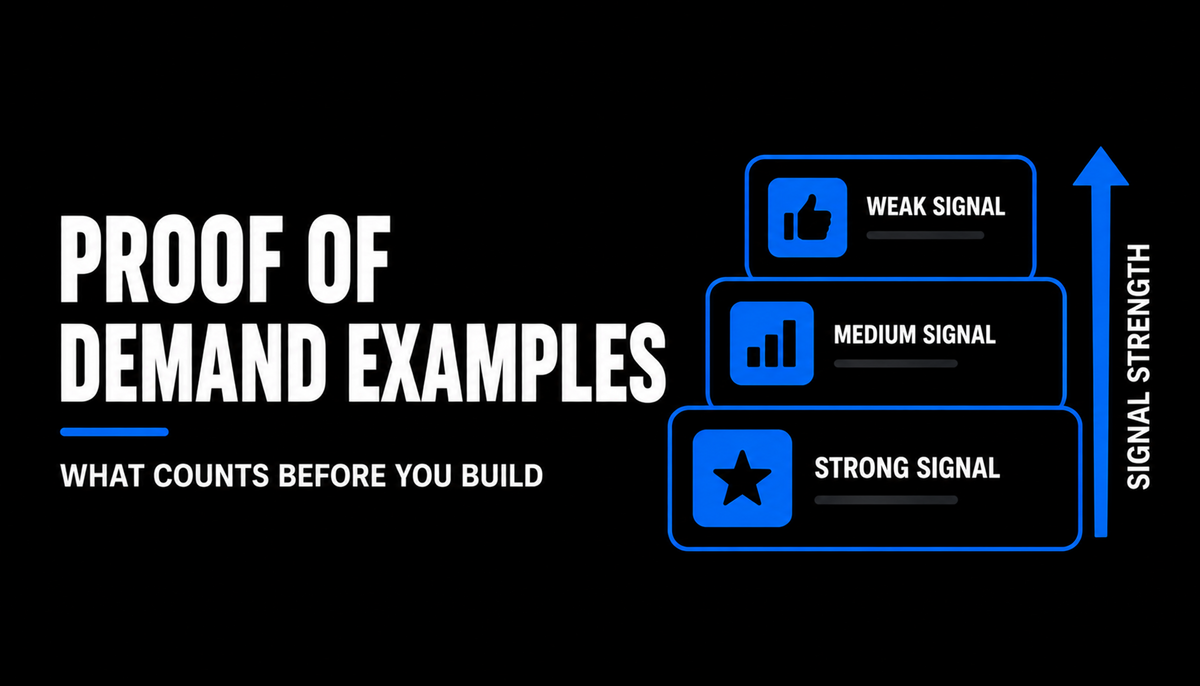
Contrast weak proof with strong proof. "Three friendly pilots are interested" is weak. "ICP selected, cold channel tested, and initial MRR secured" is strong. Show your commercial pilot pipeline to demonstrate real client demand. If you are struggling to move beyond early testers, study these proof of demand examples.
5. Business Model
Investors need to see how you will make money. Prove that your pricing hypothesis has been tested. If you have design partners or early users, show that they are willing to pay for the value you provide.
6. Go-To-Market
Your go-to-market strategy must be built on evidence, not just assumptions. Present the distribution channels you have already tested and the customer acquisition metrics you have gathered. Explain how you plan to scale the channels that are working.
7. Competition
Saying "we have no competitors" is a massive red flag — if you don't know your competitors, you don't know your market. If you don't know the market, you don't know the customer, which means you are building for yourself. Show that you understand the alternatives and why your ICP will choose you.
8. Team
Why are you the right people to build this? Focus on your execution speed and your understanding of the market. Investors want to see founder-market fit and evidence that your team can iterate quickly based on market feedback.
9. The Ask and Milestones
What are you raising, and exactly what milestones will this capital unlock? Connect the funding to scaling the demand you have already proven. Before you present your terms, make sure you understand the mechanics by reading our term sheet seed stage guide.
Practical Checklist: The Traction-Before-Deck Audit
Founders often overcomplicate their decks by trying to perfect their positioning or frameworks before they have evidence. Before you open your presentation software or search for the best pitch deck template, run this audit. If you need a structured starting point for gathering this evidence, try using a design partner template.
Question | Weak Answer (Stop & Get Traction) | Strong Answer (Ready to Pitch) |
|---|---|---|
What is our current traction? | "We have a great MVP and early interest." | "For example: We have $5K MRR and 10 active commercial pilots." |
How did we validate the market? | "We talked to our network and they loved it." | "We ran cold traffic experiments and secured letters of intent." |
What is our GTM strategy built on? | "Our hypothesis about how the market will react." | "Evidence from extracted customer objections and early sales." |
What does our pipeline look like? | "We have a list of targets." | "We have a documented commercial pilot pipeline with conversion rates." |
If your answers fall in the weak column, close the deck. Do not try to polish an unvalidated idea. Go manually test your market, extract real objections from prospects (they won't volunteer them — you have to do the hard work of extracting them), and get your first sales. As Y Combinator's seed deck guide highlights, traction makes the rest of the pitch exponentially easier.
Avoid The Vision Trap
Many founders believe they need to change a prospect's worldview to sell their product. This is a mistake. Your goal is to integrate your solution into their existing vision. Nobody wants to pay to be told they are wrong.
When you present your deck, Sequoia Capital advises showing how you fit into the customer's reality. Listen to what the market is telling you. If your initial assumptions are wrong, pivot toward the opportunity.
FAQ
How do I make a startup pitch deck work if we don't have traction yet?
You don't solve a lack of traction with better positioning or a prettier deck. If you are pitching an MVP, it must target the most painful problem possible. Show that you have extracted real objections and that you have a plan to secure commercial pilots. But realistically, the best way to fix a zero-traction deck is to pause fundraising and go get early sales. Early customer evidence is the biggest advantage you can have during fundraising, a principle commonly emphasized in reports like CB Insights' analysis of startup failure reasons.
How many slides should a startup pitch deck have?
Aim for 8 to 10 slides. Investors spend only a few minutes reading seed decks. Keep the focus on your ICP, the core problem, and the concrete evidence of traction and market demand.
What should be in a seed pitch deck?
A seed deck must include your problem, solution, market validation, traction, business model, go-to-market strategy, competitive landscape, team, and the ask. The emphasis should heavily lean toward your traction and proof of demand.
What if we have pilots but no revenue?
If you have pilots but no revenue, show how those pilots are structured to convert. Detail the milestones required to turn them into paying customers, and demonstrate that these are not just friendly favors but real commercial tests.
Is market size still important?
Yes, but proving that you can capture a small, specific segment is more critical early on. Investors want to see that you can acquire and monetize your initial ICP before expanding to a massive Total Addressable Market.