TL;DR: When you test a business idea with Facebook ads, do not use them to avoid the hard work of getting real traction. Ads should force fast evidence. Define your segment before spending, build creatives around entirely different customer pains, and measure success by willingness to pay, not by cheap clicks.
A founder sits watching a Meta Ads dashboard. The numbers are moving. Click-through rates are up. Cost per click is down. For two weeks, they have tested button colors, audience sizes, and headline synonyms. They celebrate the rising engagement graph.
But nobody has booked a call. Nobody has explained their pain. Nobody has asked about pricing.
The ad test did not fail because the campaign setup was messy. It failed because it never asked for evidence that mattered. In 2026, an MVP takes two weeks to build. You do not need ads to buy cheap traffic; you need them to force fast evidence that a real customer wants to pay for your solution.
Facebook ads validate demand only when they force a specific, high-intent action from a clearly defined audience. If the campaign only generates clicks without a willingness to pay or book a call, it has measured curiosity, not market demand.
Initial Campaign Setup
Keep the campaign setup simple so you measure the offer, not your media buying skills.
Campaign objective: Optimize for conversions (leads or purchases), not traffic or clicks. The algorithm gets you what you ask for. If you ask for clicks, you will get people who click on everything.
Audience setup: Keep the audience broad but constrained by your exact B2B segment criteria (job titles or specific interests). Do not over-constrain the age or location unless your product requires it.
Ad angles: Run three distinct pain angles. Do not test 15 minor copy variations of the same idea.
Budget split: Split your budget evenly across the three angles so each gets a fair test.
Minimum budget: Plan to spend enough to get 100 to 200 clicks per pain angle. If your average cost per click is $2, expect to spend $600 to $1,200 to get a directional signal. You are buying data, not customers.
Practical Framework: Define Your Segment Before Spending
Targeting errors ruin campaign data. If you show a great offer to a mismatched audience, the failure looks like a product problem when it is actually a distribution problem.
Consider a B2B sustainability SaaS. The obvious early market is large enterprise corporations. But market research might show that corporate buyers are highly regulated and slow to adopt. Instead of burning budget on enterprise employees who cannot buy, the founder pivots the ad targeting toward green SMBs and sustainability consultants. That path has simpler, faster growth.
Find the most painful, accessible wedge in your market before you open the ads manager.
Test Distinct Pains, Not Copy Tweaks
Founders waste early budgets running A/B tests on "Automate your workflows" versus "Save time on workflows." These are narrow variations of the same weak promise.
Treat early ad spend as a validation budget. Your goal is to find out what hurts. Build completely separate creatives around distinct customer pains. Test "Stop losing money on excess inventory" against "Tired of manually updating five spreadsheets."
Use plain, actionable wording. If the customer does not immediately grasp the pain you are solving, they will not click. The point is to discover the right angle, not to polish a bad one.
The Landing Page Is the Actual Test
A click means someone was curious. It does not mean they have the problem badly enough to act.
The ad only measures attention. The landing page is where you test intent. Without a high-intent action on the page, you bought traffic, not evidence. This is especially true for B2B. Facebook reaches business buyers as people, so post-click qualification is critical.
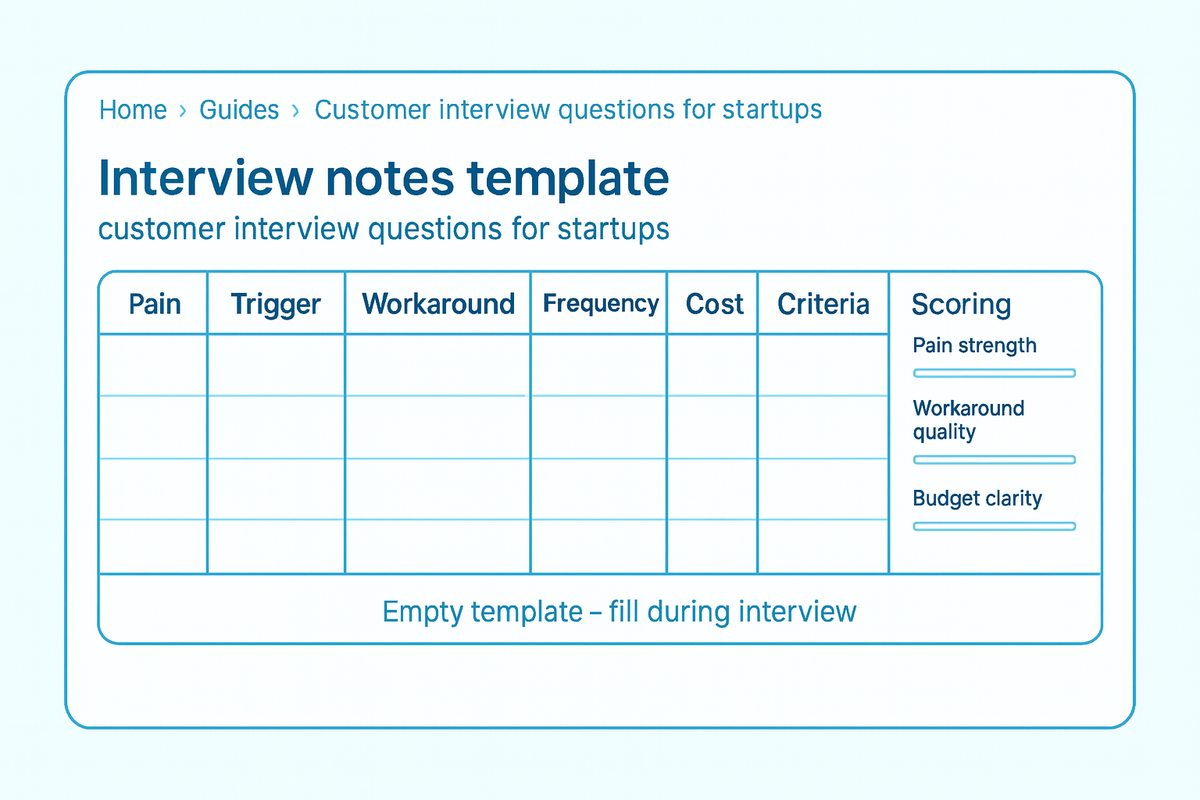
Require the user to take a hard action. Ask for their company type, role, current workaround, and budget authority. Ask them to book a sales call or join a paid pilot. If you lower the barrier to get more leads, you dilute the very signal you are trying to capture. Real demand looks like a willingness to act or pay.
Facebook Ad Validation Scorecard
Metric | What it really means | How much to trust it | What to do next |
|---|---|---|---|
Impressions | The algorithm found people to show your ad to. | Noise | Ignore it. |
Cost Per Click (CPC) | The algorithm found a pocket of cheap attention. | Noise | Ignore it. Cheap clicks do not equal revenue. |
High CTR | The ad copy or image is curious or provocative. | Weak | Investigate the landing page. If they click but do not convert, the ad over-promised. |
Generic Email Signup | Mild interest or fear of missing out. | Low | Push for a real conversation to qualify the lead. |
Qualified Form Answers | The visitor actually has the problem and fits the segment. | Strong | Continue testing this ad angle. Book a call immediately. |
Booked Call / Deposit | The pain is severe enough to justify spending time or money. | Very Strong | Scale this angle. You have found a true market signal. |
When to Stop Testing
Founders often ask for a universal rule on campaign duration or a minimum budget threshold. They want a statistical rule to tell them when to stop.
There is no objective universal timeline. You test until you get a clear signal or until you hit your own limit. Set a time box or budget that you are willing to lose, and run the distinct pain angles.
Stop testing when:
You have spent your planned budget and collected 200 clicks per angle without a single qualified lead.
People are clicking, but none of them are willing to take a high-intent action (like booking a call or paying a deposit).
Continue testing when:
You are getting qualified form fills, even if the volume is low.
You have a clear high-intent signal and need to see if the angle scales.
If the evidence improves, keep going. Do not lower your standards just to declare the test a success. Often, the best user research approach is knowing when to walk away from a dead end.
FAQ
What campaign objective should I use?
Always use a conversion objective optimized for leads or purchases. If you use a traffic objective, Meta will find the cheapest clicks from people who click on everything but never buy.
What counts as a real signal?
A real signal requires effort or money. Clicks, impressions, and cheap email signups are noise. A booked sales call, a paid deposit, or a detailed form submission with qualified answers is a true signal of demand.
Do I need a large budget to get statistically significant results?
No. You are looking for a directional signal, not academic certainty. If you spend enough to get a few hundred targeted visitors across three distinct pain angles and nobody takes a high-intent action, you have your answer. You do not need to spend thousands to confirm that a cold market is cold.
What if B2B buyers are not on Facebook?
They are on Facebook, but they are there as people. They are scrolling through family photos and news. Your ad must disrupt that pattern with a highly specific business pain. This is why B2B growth marketing on Meta requires sharp qualification after the click.
What should I do if my ads get leads, but no one wants to pay?
Those are not real leads. You likely have a mild convenience product rather than a painkiller. Change your offer to something that requires a small upfront commitment, or interview those leads to find out what problem they would actually pay to solve.