TL;DR:
Confusing vision with evidence is a fast way to fail.
True validation happens close to real money.
List the core assumptions that can kill your business.
Rank those assumptions by risk.
Run quick tests to find the truth.
Study past behavior instead of hypothetical answers.
The Danger of Untested Beliefs
Picture a founder who claims they have no competitors. They build a product based on their own view of the customer, and they avoid asking for money because the concept is "unproven." Then they try to pitch investors before they have any traction.
Founders often confuse vision or market research with actual evidence. But vision without traction just looks like naive storytelling. You cannot build a go-to-market strategy on a hypothesis alone. You need proof of demand. That means willingness to pay, signed letters of intent, revenue, or real customer conversations.
Testing startup assumptions is the practical layer of lean startup methodology. It forces you to list your assumptions and run tests. You want to get close to real money before you write any code. This approach aligns with the core principles of customer development.
List the Core Assumptions
Founders often overcomplicate this process. They treat it like selecting a rigid scoring framework or designing a pitch deck.
You do not need a complex score. You just need to identify the few core hypotheses that will kill the business if they are wrong. These usually fall into five categories:
Ideal Customer Profile: Who exactly needs this?
Pain-Solution Fit: Does the problem hurt enough for them to act?
Distribution: Can you reach them where they already are?
Market Quality: Is this segment actually viable?
Pricing Logic: Are they willing to pay?
Rank by Risk
Once you have the list, rank your assumptions by business-killing risk.
Next, figure out what evidence gets you closest to actual buyer commitment. A waitlist tells you someone was curious. A payment tells you they crossed a line.
Use this simple signal strength ladder to measure your proof:
Opinion: They say it sounds like a good idea.
Click: They visited your landing page.
Signup: They gave you an email address.
Conversation: They spent thirty minutes explaining the problem.
Demo Booked: They committed time to see the solution.
LOI: They signed a letter of intent.
Payment Intent: They attempted to give you real money.
Practical Framework: Running Tests Without Code
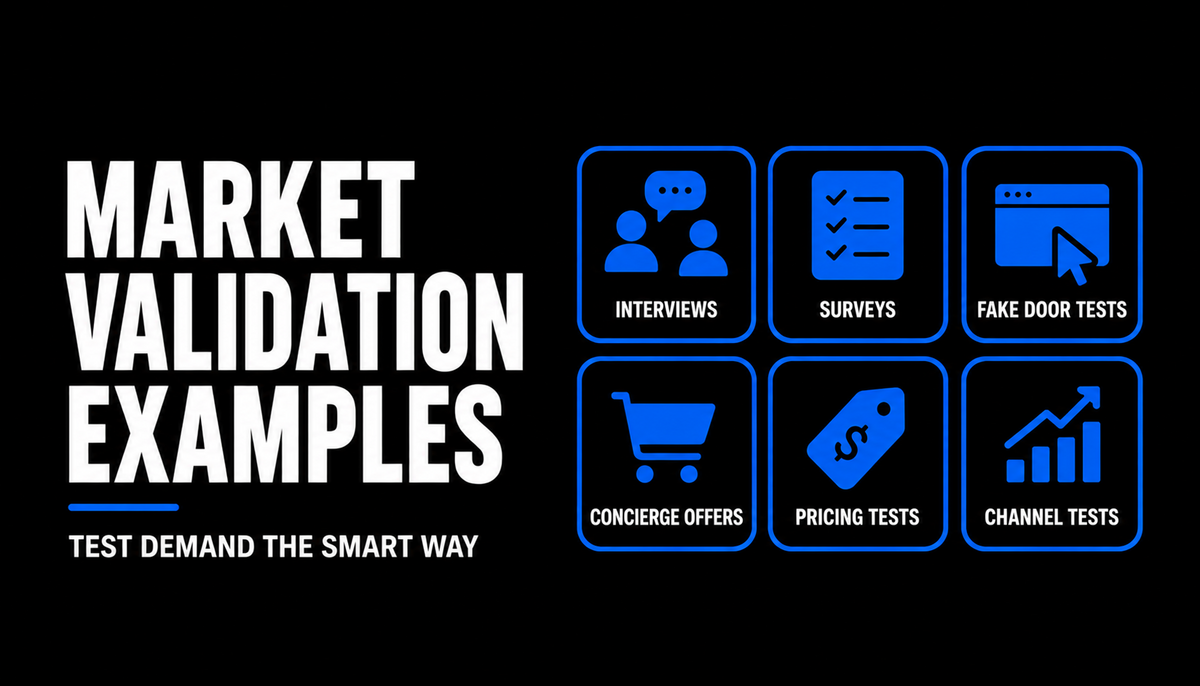
Design high-signal experiments that require no code. You can run a validation sprint to maintain a weekly testing cadence.
Research the market before you test. This stops you from defaulting to the most obvious buyer segment. For example, a B2B sustainability startup skipped the highly regulated corporate segment entirely. They researched market dynamics first, isolating consultants and green small businesses. That was a simpler segment with zero competition, so they ran their tests exclusively there.
The Ethical Fake-Door Test
The strongest test of demand is a fake-door test that measures payment intent.
You offer the product and let customers click to buy, but you do not capture their credit card funds. Charging and refunding a non-existent product violates most payment processor terms and carries severe fraud risk. Instead, when they try to pay, capture the intent signal, explain that capacity just ended, and put them on a waitlist.
This provides high-signal evidence of willingness to pay, and it builds trust because you do not take their money. Even complaints about a missing feature are a rare positive signal here — it means people actually care.
Manual Alpha Outreach
The cleanest early test is often manual. Find five people. Solve the problem for them by hand. See if the outcome is valuable enough for them to pay for it. You do not need software to deliver a concierge service, a practice highlighted in The Mom Test for early customer discovery. Classic frameworks on business strategy emphasize testing models with manual effort first.
Stop Misunderstanding Silence
Founders often mistake silence for validation. People are polite during customer interviews. If a customer says a problem hurts, look for prior action. If they have not tried to solve it before, treat their words as weak evidence.
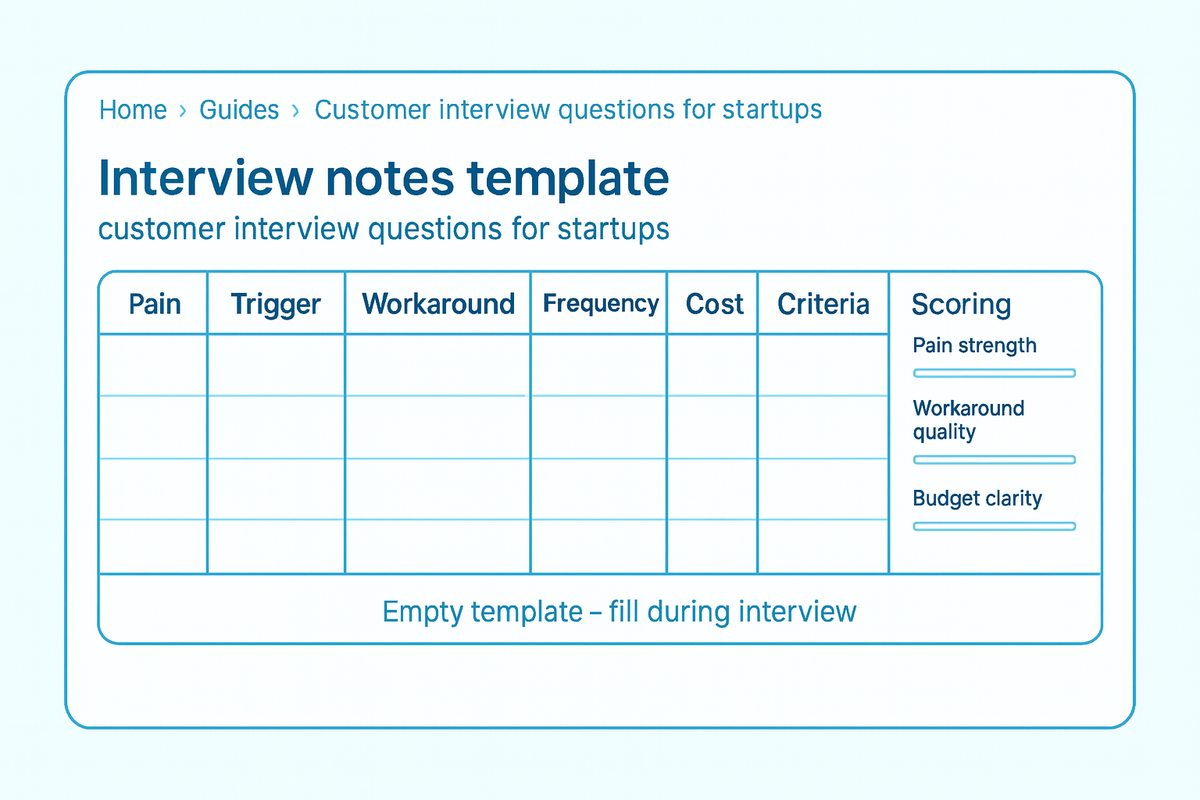
Interviews are useful mostly to disprove hypotheses. The goal is to find the objections people are too polite to volunteer. Actively extract those objections. Talk to users about their past behavior, not their hypothetical future actions.
Testing in unfamiliar channels is another trap. A founder might run paid ads in a new channel and get zero conversions, then kill the idea. That failed test may only prove you are bad at that channel. It does not prove nobody wants the product.
Assumption testing is not a one-time pre-launch checklist. It is a continuous de-risking exercise that lasts throughout the life of your startup. Keep running these tests to validate new channels, features, and market shifts. Using a structured customer discovery kit can help systematize these experiments and keep your interviews focused on evidence rather than polite fiction.
FAQ
How do I avoid fooling myself?
Study past behavior instead of hypothetical interest. Ask what the customer has already done to solve the problem. Rely on manual alpha outreach over paid acquisition for early learning. Measure actions that require effort or money.
How long should I test?
There is no objective duration. Testing continues until you give up or run out of runway. It depends entirely on your endurance and learning rate. Enter this kind of startup push only when you have enough renewable runway to run multiple failed experiments before running out of cash.
Do customer interviews count as proof?
Interviews count only if you measure past behavior. Asking if someone would buy a future product invites self-deception. Interviews should expose weak assumptions and extract objections.