TL;DR: Customer discovery explores whether a painful problem exists and how teams handle it today. Customer validation tests whether a specific buyer will commit scarce resources like cash, proprietary data, or team hours to solve it.
Founders often get stuck in endless discovery interviews because asking for budget or access risks a direct rejection. When you hear the same costly problem repeated across a tight, homogeneous audience, stop asking open-ended questions. It is time to ask for a concrete commitment.
Customer discovery vs customer validation comes down to the difference between learning and selling. In discovery, you audit past behavior to understand a real problem with low risk to the buyer. In validation, you present an offer and ask for scarce resources to prove commercial demand before you build.
The $10,000 Survey Trap
Consider an illustrative scenario: a founder surveys two hundred e-commerce operators. Sixty-eight percent check a box saying they would pay ninety-nine dollars a month for automated inventory alerts.
That response feels like validation. The founder builds the tool for eight weeks, connects Stripe, and launches a ten-thousand-dollar paid ad campaign to acquire customers.
The campaign generates clicks, but zero accounts convert to paid plans. The bank balance drops, and the founder cannot tell what went wrong. Did buyers dislike the interface? Was the price off? Or did the market never care in the first place?
This failure happens when you confuse stated preference with actual demand. A survey answer costs the respondent nothing. Checking a box takes two seconds and requires no skin in the game.
Surveys are helpful for generating hypotheses and spotting language worth exploring. But surveys do not validate commercial intent. Customer discovery focuses on finding people who actively struggle with a problem or fight with clumsy workarounds. Customer validation tests actual behavior: funnel click-through rates, trial setups, and purchases. The core mistake is treating survey answers as proof of demand, then spending capital to scale an unproven message. Direct conversations show you why buyers convert before you spend money on acquisition channels.
To separate user feedback from product readiness, review product discovery vs customer discovery so you know whether you are exploring user workflows or testing commercial demand.
The Fundamental Shift: Past Behavior vs. Scarce Resources
Understanding customer discovery vs validation protects founders from mistaking polite conversations for market traction. The line between the two phases comes down to what you ask from the prospect.
Customer Discovery: Audits past actions and current costs (Low risk beyond call time)
         │
         ▼ [Transition Heuristic: Repeated costly pain in a single audience]
         │
Customer Validation: Demands immediate, scarce resources (Direct financial or operational risk)
Customer discovery is an open-ended audit of historical behavior. You are not pitching an idea. You are not asking for opinions about a mockup. You are asking what the person did last week, what failed, and what that failure cost their team.
In The Mom Test, Rob Fitzpatrick points out that asking people what they think of your idea invites polite lies. People want to encourage you, especially when a conversation is friendly. But when you ask them to walk you through how they solved a problem yesterday, they describe what actually took place.
Customer validation flips that dynamic. You stop researching the past and start proposing a transaction. You present a specific solution and ask the prospect to put something scarce on the line.
In Steve Blank's customer development framework, validation proves whether your sales model is repeatable. If people praise your concept during discovery but refuse to commit time or money during validation, you do not have a distribution problem. You have an offer problem.
To keep discovery calls focused on historical facts rather than hypotheticals, use tested questions to ask customers about your product during initial calls.
The Discovery vs. Validation Comparison Matrix
When comparing customer discovery vs customer validation, your posture, goals, and metrics must change when you move from listening to asking for commitments.
Dimension | Customer Discovery | Customer Validation | Transition Trigger |
|---|---|---|---|
Primary Objective | Map operational workflows, uncover existing workarounds, and isolate painful problems from past actions. | Test whether a specific, defined buyer will commit scarce resources to solve that problem with your product. | Multiple buyers in the same narrow segment describe identical, costly operational pain without prompting. |
Founder Posture | Curious researcher asking neutral questions about historical behavior and actual financial costs. | Direct commercial partner asking for a binding commitment, data access, or upfront budget. | The founder can accurately describe the customer's current manual workaround and quantify its weekly cost. |
Output Artifact | Documented problem patterns, workflow maps, and verbatim customer quotes about real expenses. | Signed pilot agreements, cash deposits, production data access, or scheduled onboarding dates. | The prospect agrees to a structured next step that requires their team to spend time, reputation, or money. |
Customer Risk Required | Low. The interviewee only spends thirty minutes sharing past experiences and professional context. | High. The buyer stakes budget, internal credibility, workflow access, or proprietary company data. | The conversation moves from casual feedback to evaluating a concrete commercial offer. |
Failure Signal | Vague answers, varying pain points across calls, or a problem solved easily with free tools. | Polite verbal praise followed by excuses when asked for budget, data access, or calendar time. | Repeated praise paired with refusal to commit resources signals an offer problem; return to discovery. |
The Fear of Selling: Why Founders Linger in Discovery
Discovery feels safe. When you set up a thirty-minute interview to learn about someone's workflow, nobody rejects you. The prospect is usually pleasant, listens politely, and calls your project interesting.
Validation is uncomfortable. The moment you name a price, request access to live systems, or ask for an introductory meeting with their boss, the prospect might say no.
Many founders conduct fifty or sixty customer discovery interviews not because they need more data, but because they want to avoid that rejection. They hide behind research.
Knowing when to stop customer discovery comes down to spotting repeated signal. When three to five distinct prospects in the exact same role independently describe the same costly problem without prompting, you have enough discovery signal. Gathering ten more interviews rarely makes your product safer. It simply delays finding out whether anyone will pay for it.
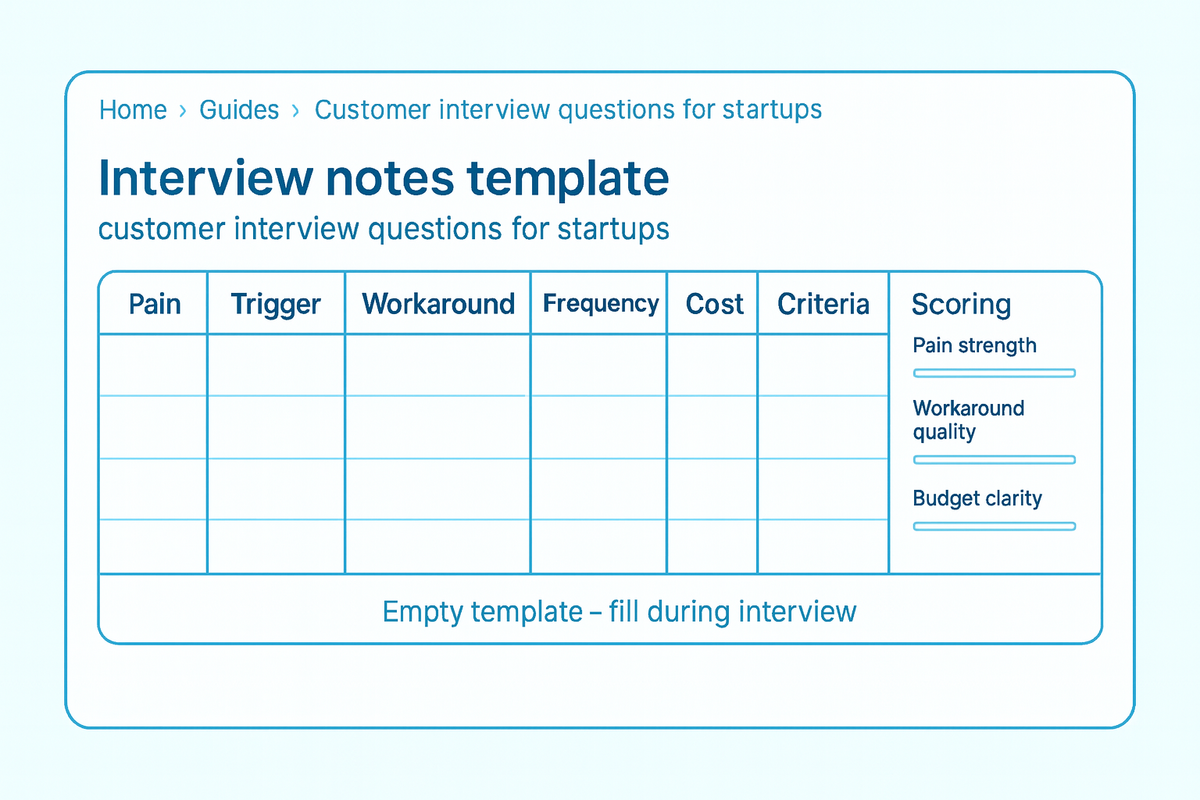
To keep your research organized before reaching this point, map your assumptions on a structured customer discovery canvas for B2B.
The Transition Gate: Knowing When to Narrow and Ask
You cannot validate demand across a scattered audience. If you interview two dental clinics, two logistics brokers, and two marketing agencies, you cannot spot a real pattern. Each business runs on different economics and priorities. A positive signal from one dental clinic tells you nothing about the marketing agency.
Validation requires cohort discipline. Narrow your target profile until accounts share similar operational constraints.
Broad Discovery: 18 e-commerce operators across dropshipping, apparel, food boxes
         │
         ▼ [Filter: Discrepancies only matter above 5,000 active subscribers]
         │
Narrowed Cohort: 10 homogeneous subscription box brands ($2M-$10M GMV)
         │
         ▼ [Hypothetical Ask: $750 audit fee + 90 days of live 3PL manifests]
         │
Validated Demand: 4 sign and upload data; 6 decline due to timing or budget
Consider a founder building an operations tool for e-commerce brands:
Broad Discovery: The founder interviews eighteen operators across apparel brands, dropshippers, and subscription food boxes. The founder asks: "Walk me through the last time a warehouse billing discrepancy happened, and what it took to fix it."
The Pattern: In this scenario, the founder observes that apparel brands and dropshippers treat warehouse errors as minor noise. But subscription box brands with more than five thousand active subscribers lose eight to fifteen hours every month manually auditing spreadsheets.
The Narrow Cohort: The founder stops general discovery. Instead of talking to all e-commerce brands, the focus narrows strictly to subscription businesses generating between two and ten million dollars in annual volume. Talking to at least ten businesses in this single group provides a dependable pattern.
The Validation Ask: The founder approaches target accounts in that niche with a concrete offer. As an illustrative validation ask, the founder requests access to ninety days of live warehouse manifests and a seven hundred and fifty dollar fee for a full reconciliation audit. This specific fee and access request serves as one example of a commitment ask, not a universal benchmark for every business.
The Result: Four brands sign the agreement and provide data access. Six decline due to competing priorities.
Those four signed agreements represent validated demand. The founder did not rely on polite compliments; the buyers committed proprietary data and company money to solve the issue.
Early B2B Commitments: What Counts as Validation?
A practical b2b customer validation framework does not require a five-figure software contract on day one. Cash is the strongest proof of demand, but other scarce resources also confirm serious intent.
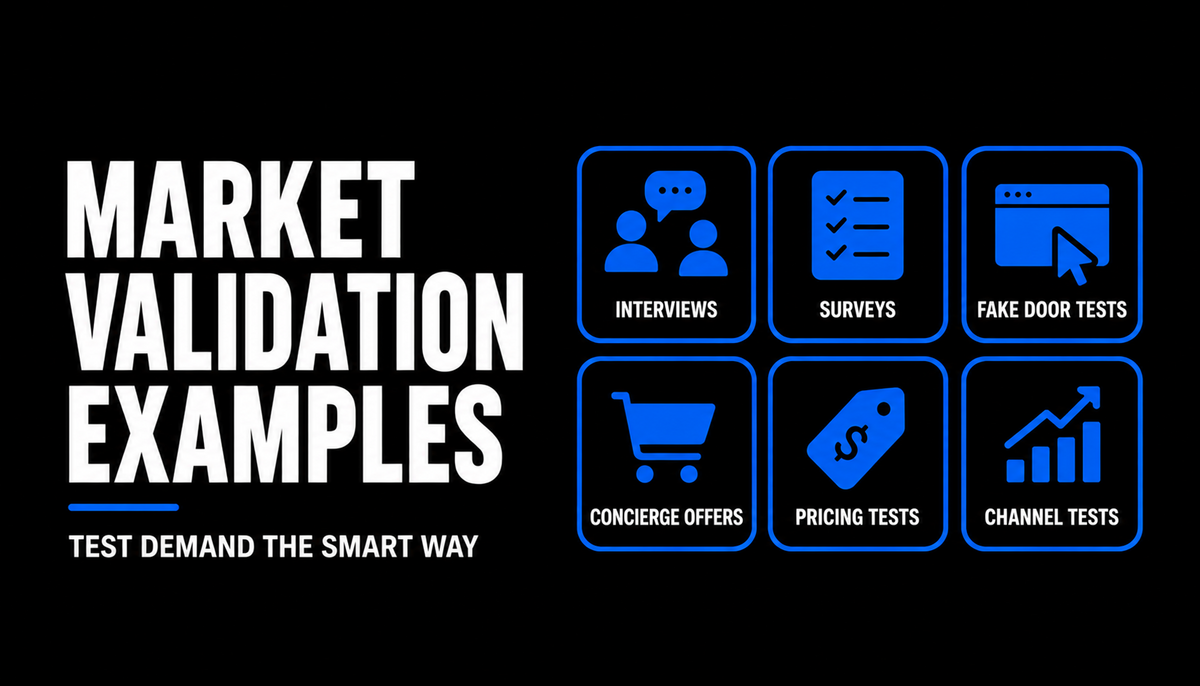
To design tests that fit your current stage, look at the full menu of startup validation methods for demand.
Here is how scarce resources rank in B2B validation:
1. Upfront Capital and Paid Pilots
A paid pilot, an upfront onboarding fee, or a deposit. Even a small fee changes the dynamic of the conversation. When money changes hands, the buyer expects a real outcome, which forces honest feedback on value.
2. Proprietary Data and System Access
Granting API access, sharing internal databases, or uploading months of sensitive financial records. A company rarely hands over operational data to an unknown vendor unless the problem hurts enough to justify the security risk.
3. Workflow Integration and Calendar Time
Committing three engineers or ops managers to a mandatory sixty-minute weekly working session. Executive time is heavily guarded. If a department head commits their team's working hours to your pilot, they care about solving the problem.
4. Reputation and Political Capital
Introducing you to their chief financial officer, procurement director, or external clients. Few managers risk their internal standing for a tool they do not need.
If an account refuses to commit any of these four resources, treat their verbal praise as unvalidated demand. If you need help structuring these agreements, review our guide on B2B startup pilot program structure to set clear expectations and boundaries.
Alpha Validation: Promise Focus, Not Delivery
Founders often hesitate to ask for a sale because the software is incomplete. They worry that selling an unfinished product makes them look dishonest.
You do not need to promise enterprise reliability, comprehensive documentation, or instant feature delivery to early alpha customers. Promising an established vendor experience when you are working from a basic prototype creates disappointment.
What you promise instead is dedicated focus and direct founder communication:
You promise that their specific problem gets your direct attention every day.
You promise a direct shared Slack channel with the people building the tool.
You promise weekly adjustments tailored to their specific operational workflow.
Early adopters do not buy early-stage software expecting an established product. They buy because existing tools are too rigid to solve their exact issue, and they want a team dedicated to fixing their problem.
Do not attempt to scale this process through automated marketing funnels early on. As Paul Graham outlines in his essay on doing things that do not scale, early validation requires manual work. Go where your target buyers work, invite them directly, onboard them by hand, and make sure they experience real value before spending money on acquisition channels.
For practical tactics on handling these direct founder-led interactions, read Y Combinator's guidance on talking to users.
FAQ
When do customer interviews stop being discovery and turn into validation?
Interviews stop being discovery when you stop asking about past habits and start asking for commercial commitments. Discovery explores historical workflows, past expenditures, and current workarounds. Validation asks the prospect to put scarce resources on the line today, such as upfront budget, production system access, or dedicated team hours.
Do customer surveys count as validation?
No. Surveys help generate hypotheses and show how prospects describe problems, but checking a box requires zero commitment. Validation requires observable behavior that carries real risk. Funnel actions, trial engagement, and especially purchases show genuine commercial intent, whereas survey responses only capture stated interest.
What should I do if a prospect gives great feedback but will not pay yet?
Treat polite verbal praise without commitment as unvalidated demand. If a prospect will not pay money, test whether they will commit other scarce assets, such as access to live workflow data or weekly implementation sessions. If they refuse those requests as well, the problem lacks sufficient urgency, and you should step back to discovery before building further.