TL;DR:
Do not ask existing clients what they think of your product; this produces polite lies.
Ask about past behavior: what structural changes forced them to buy, what they compared you to, and where their old workflow broke.
Use this feedback to find hidden segments. Sometimes the most profitable segment is the one that buys for mission or branding, not compliance.
Interviewing already-won customers is the lowest-friction path to identifying reliable product expansion and sharper positioning.
The Danger of the "Understood" Client
Founders often treat already-won B2B clients as a solved problem. You assume you understand them because they pay you. This makes you build from your own beliefs. You skip market research because it feels like a slow corporate exercise.
This is a mistake. Your current customers hold the real signal for your ideal customer profile (ICP). If you do not ask them the right questions, you miss it.
Take the Environmental, Social, and Governance (ESG) software market. Everyone assumed large corporations were the obvious buyers. Compliance laws forced them to switch. But market research revealed a different story. Medium-sized businesses were buying voluntarily. They did not face compliance mandates. They wanted ESG reporting for branding, marketing, and mission alignment. This discovery gave a much sharper segmentation and sales motion. It worked better than generic satisfaction questions ever could.
How Founders Overcomplicate Client Research
Founders often treat client interviews like opinion polling. They ask questions like, "What do you think about our new feature?" As established in resources like The Mom Test, traditional survey questions often fail to capture reality. In practice, asking for opinions forces polite lies. Customers want to be nice. They do not give you actionable insights.
Instead, ask about past behavior. Study what they actually did and why they behaved that way. Find out what they compared you to before they bought. Ask how often they hit edge cases. Find out how costly those failures were.
The most useful market research questions are concrete. They uncover the retention pattern and the perceived category. They reveal the true monetary value your tool creates. They show you the frequency of nonstandard cases and segment-level motives.
The Repeat-Pain Validation Framework
Do not use a generic customer survey. Use a practical step built around repeat-pain validation. The goal is to find structural changes in the market.
Here is how to run this framework:
Identify target: Who are the operators in this market? Look for active, already-won B2B customers. Book short interviews focused on workflow.
Ask about structural change: What forces you to change your workflow or budget? Look for repeated external pressures, like new regulations or market shifts. Map these triggers against your current features.
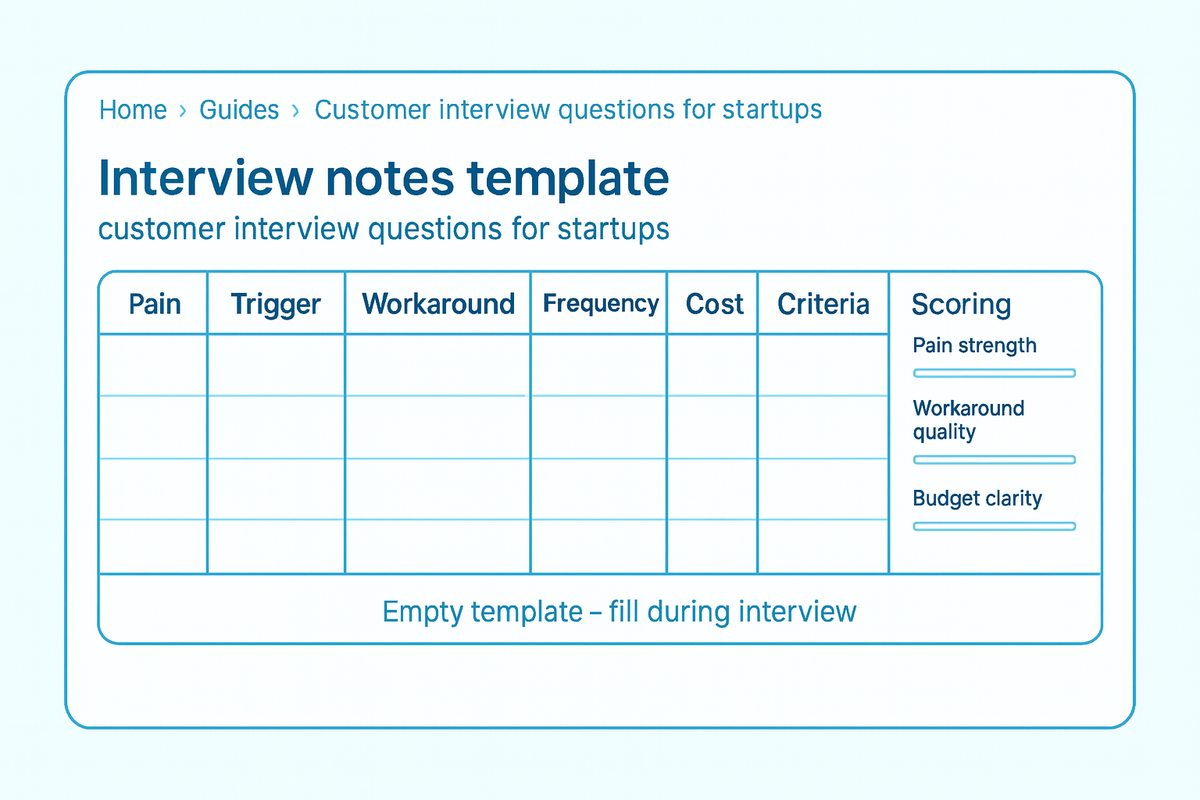
Cross-reference: How often does this specific problem happen? Look for the exact same pain appearing across multiple client interviews. Discard isolated complaints; keep the repeated ones.
Update positioning: What would happen if this went unsolved? Look for the monetary or time cost of the failure. Turn verified pain into product priorities or new messaging.
Consider the example of a European B2B sustainability SaaS startup. They needed to find a prominent growing segment before writing code. By interviewing experts and early users, they discovered a pattern: a regulated, non-consolidated market made consultants and green SMBs a strong early segment. While this specific strategy won't apply to every market, they could not have found their initial wedge without understanding the specific, repeated market pain.
Best Market Research Questions to Ask Existing Clients
Before you build your script, start with these core b2b customer interview questions:
What specific event forced you to look for a solution?
What alternatives did you compare us against?
When did your old workflow fail, and what did it cost?
How often do you hit an edge case we do not handle?
What internal change would force you to stop using this product?
The Complete Question Bank
To extract expansion or pivot insights, focus your interviews on friction. These customer interview questions and answers help you build a clear mental model of your customer.
Buying Triggers and Workflow Pain
"Before you bought our tool, what specific event forced you to look for a solution?" This identifies the trigger. It tells you what structural change creates urgency.
"Walk me through the last time the old workflow failed. What was the exact cost to the business?" This anchors your value proposition in monetary value.
Alternatives and Perceived Value
"What internal or external alternatives did you compare us against?" This reveals your perceived competition. Framing the right category is the difference between a $10 and $100 pricing model.
"If you could not use our software tomorrow, what would you do instead?" This shows you exactly how they value your core features.
Edge Cases and Expansion
"How often do you encounter an edge case that our software does not handle?" Do not assume an edge-case capability has a big market. Measure the actual frequency and the pain it causes.
"What is the most manual task you still do after using our product?" This points directly to reliable product expansion opportunities.
Retention Risk and Segmentation
"What would force you to stop using this product?" This uncovers retention risks. It helps you accurately map understanding customer needs on a deeper level.
"Who else inside your company relies on the output from our tool?" This maps the internal buying committee and reveals hidden user segments.
You can learn more about structuring these feedback loops in our guide to B2B customer feedback collection. You can also study Steve Blank's customer development methodologies to improve your technique.
Moving Beyond New Business
Existing client feedback is the highest-trust path to product expansion. New prospects give you objections. Existing clients give you operational reality.
When you research new business, you test hypotheses. For that, you need different market research questions for new business. When you talk to existing clients, you study actual usage. User research experts like those at NNGroup emphasize this approach. Look for the gap between why you built the product and why they actually use it.
By asking about past performance instead of future desires, you build a product grounded in real evidence.
FAQ
Why spend time asking existing clients market research questions if they already bought? Because bad research is worse than none at all. Founders often ask questions that create polite lies, which mislead product strategy. Do not ask clients how they like the product. Ask about past behavior. Ask what they did before buying, why they acted that way, where the workflow broke, and what forced urgency. The goal is a sharper mental model of the customer, the ICP, and market dynamics.
What should you not ask existing clients? Do not ask for feature requests, future predictions, or their opinion on your design. Questions like "Would you use this feature?" or "How do you like our product?" generate polite lies. Focus entirely on past behavior and actual workflow friction.
How many B2B clients should you interview? As a general starting heuristic, try to interview five to seven active clients. While not a precise market benchmark, in B2B markets, you will often spot pattern recognition after just a few deep interviews. If the answers are completely different every time, your ICP is too broad.
How are existing-client questions different from prospect questions? Prospect interviews test hypotheses about a problem they have not solved yet. Existing-client interviews audit the reality of the solution. You are looking for usage gaps, actual retention threats, and proof of monetary value.
Should you ask about future features? No. Instead of asking what they want you to build, ask what manual work they still do. Let their actual pain points dictate the roadmap, rather than their guesses about what software they might use.
How do you turn interview answers into positioning? Look for the specific words they use to describe their problem and their alternatives. If they compare you to a human consultant, you are in the services category. If they compare you to an intern, you are an efficiency tool. Use their exact words on your landing page.