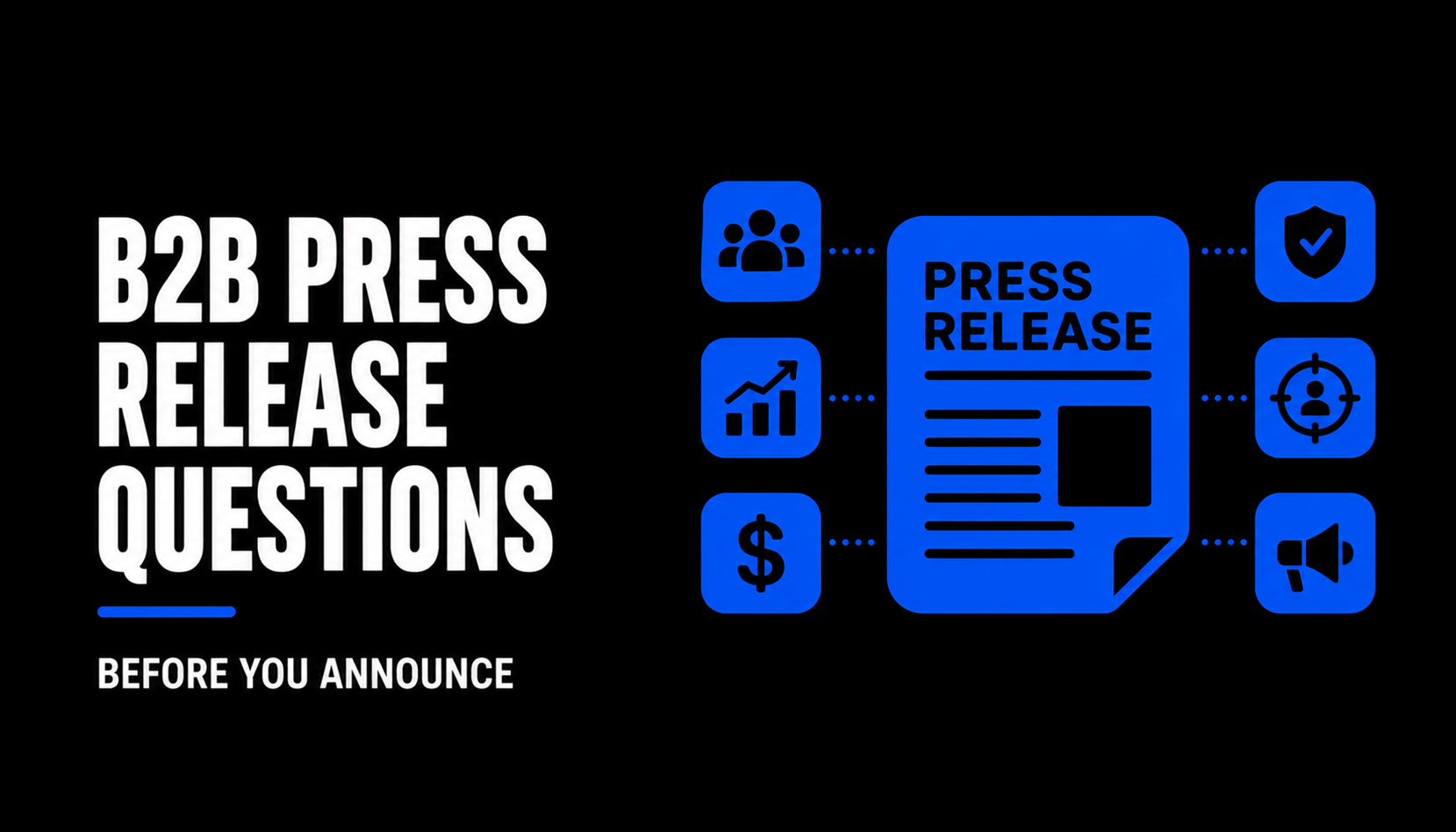
A B2B press release is not automatically a traction channel. It is useful when the announcement carries a business signal that a customer, partner, investor, journalist, analyst, or future buyer can believe. Before you write the release, use these press release B2B questions to decide whether the news has enough proof, relevance, and distribution fit to justify publishing.
TL;DR: Announce only when the proof is stronger than the noise
A B2B announcement should make a specific audience think, "This changes how I evaluate this company." If the release mainly says that you are excited, proud, or launching soon, use a private customer update, sales email, founder post, or wait until the proof is stronger.
- Use a press release when the news creates credible commercial evidence: customer adoption, a meaningful partnership, funding with a clear use of proceeds, or a product milestone tied to buyer pain.
- Avoid publishing just because the company wants momentum; weak announcements can consume attention without improving pipeline, trust, or market learning.
- Before distribution, separate the readiness decision from writing mechanics: start with founder press release questions, then use a press release guide, B2B SaaS examples, and a B2B press release template only if the signal is real.
Use this as a readiness filter before drafting, pitching, or distributing.
What readiness means in B2B
B2B announcement readiness means the news has a specific reader, credible proof, customer relevance, timely context, usable quotes, and a realistic channel path. The test is not whether the release sounds polished. The test is whether a buyer, partner, investor, journalist, analyst, customer, or recruit has a reason to update how they understand the company.
A business signal is evidence that reduces doubt about your product, market, customer pull, or ability to execute. Distribution fit is the match between that evidence and the channels that can plausibly reach people who care.
B2B press release readiness framework
Use this framework before you announce. The goal is not to make every release sound bigger. The goal is to decide whether the news deserves public attention at all.
1. Audience: who must care?
Ask:
- Who is the specific reader: buyer, partner, investor, journalist, analyst, existing customer, or recruit?
- What decision could this announcement affect?
- Would the same reader care if this news came from a company they had never heard of?
- Is this release written for a real market segment or for internal morale?
Strong answer: The audience is narrow enough that the release can name their problem, category, buying context, or operational pressure. In complex B2B buying, the audience often includes multiple stakeholders, so the announcement should help more than one reader understand why the signal matters.
Weak answer: The release targets "the market," "business leaders," or "innovative companies" without naming the buyer context.
Decision rule: If you cannot name the audience in one sentence, avoid broad distribution. Rewrite the announcement as a targeted customer or partner message first.
2. Proof: what can you substantiate?
Ask:
- What happened that is independently understandable?
- Can you state the proof without adjectives?
- Is there a customer, partner, investor, product milestone, or operational result behind the claim?
- Are all claims accurate, permissioned, and supportable?
Strong answer: The release includes a concrete event: a named customer relationship, a signed partnership, a funding round, a shipped product capability, a regulatory milestone, or a measurable operational change. If customer quotes or endorsements are used, use only approved, accurate, specific quotes that represent the relationship clearly.
Weak answer: The release relies on words like revolutionary, leading, seamless, next-generation, or game-changing because the underlying proof is thin.
Decision rule: If removing adjectives makes the announcement collapse, the proof is not ready.
3. Customer relevance: why would a buyer care now?
Ask:
- What buyer pain does this announcement make easier to understand?
- Does it reduce risk, cost, implementation friction, time, compliance exposure, or operational uncertainty?
- Does it answer a question prospects already ask in sales conversations?
- Can sales use this announcement without sounding like they are forwarding marketing copy?
Strong answer: The announcement gives buyers a reason to update their view of the company. It might show that a real customer adopted the product, a partner expanded distribution, a product now solves a painful workflow, or funding will support reliability, hiring, or market expansion.
Weak answer: The announcement says the company is excited to launch but does not explain what changed for the buyer.
Decision rule: If the release cannot support a sales conversation, it probably will not create commercial traction.
4. Timing: why now?
Ask:
- Is there a real trigger, or are you trying to fill a content calendar?
- Would waiting a short planning cycle likely produce stronger proof?
- Is the announcement tied to an event, customer deadline, market shift, funding close, launch date, or partner availability?
- Will the company be ready for inbound questions if the release works?
Strong answer: The timing aligns with a business moment: a product is available, customers can act, partners are ready to amplify, executives are available for interviews, and the company can follow up with prospects.
Weak answer: The company wants to look active but has no clear next step for interested readers.
Decision rule: If attention would arrive before your team can convert it into conversations, wait or narrow the channel.
5. Quote quality: would anyone say this aloud?
Ask:
- Does each quote add evidence, interpretation, or stakes?
- Could the quote be attributed to any company in the category?
- Does the quote explain why the announcement matters now?
- Is the customer or partner quote approved and specific enough to be useful?
Strong answer: A founder quote explains the strategic reason behind the announcement. A customer or partner quote explains the practical value in plain language. PRSA describes public relations as relationship-building strategic communication, so quotes should support that job rather than decorate the page (PRSA: All About Public Relations).
Weak answer: "We are thrilled to announce..." followed by a generic category claim.
Decision rule: If the quote does not add information, cut it or replace it with a sharper sentence from the operator closest to the proof.
6. Distribution fit: where can this realistically travel?
Ask:
- Which channels already reach the target reader?
- Is this news strong enough for trade media, or is it better for partner channels and direct sales follow-up?
- Do you have a prepared distribution list, partner coordination plan, and post-release follow-up motion?
- Are you choosing distribution because it fits the news or because it feels official?
Strong answer: The channel matches the signal. A named customer story might support sales outreach and trade media. A technical product release might fit community, analyst, or existing customer channels. A funding announcement might fit investor, recruiting, and category credibility channels.
Weak answer: The company sends the same release everywhere and measures success by publication alone.
Decision rule: Use the founder distribution checklist for the broad launch motion and the B2B distribution checklist when the audience is buyers, partners, analysts, and trade media. For wider context on when PR belongs in the startup channel mix, compare it with other routes in PR for startups.
For public pages that may be discovered through search, Google's guidance on helpful content is a useful forcing function: the announcement should provide useful, reliable information for people, not just package internal excitement as a public update (Google Search Central helpful content guidance).
Weak versus strong B2B announcement evidence
| Scenario | Weak evidence | Strong evidence |
|---|---|---|
| Launch | Product is "now available" with no buyer proof. | Product is available, solves a named workflow, and has beta users, pilots, waitlist evidence, or customer quotes. |
| Funding | Round size is treated as the whole story. | Funding is tied to hiring, product reliability, expansion, customer demand, or a credible investor thesis. |
| Partnership | Logo exchange with vague collaboration language. | Signed partner motion with distribution, integration, implementation, customer access, or a clear joint use case. |
| Customer news | Customer name appears without explaining the work. | Customer relationship shows adoption, problem solved, deployment context, or a permissioned quote about value. |
Minimum readiness check
| Readiness area | Pass condition |
|---|---|
| Audience | One specific reader group can be named. |
| Proof | The core claim survives without adjectives. |
| Relevance | A prospect would understand why it matters. |
| Timing | The company can handle follow-up now. |
| Quotes | Each quote adds evidence or interpretation. |
| Distribution | At least one channel has a real audience fit. |
Use this as an internal rule of thumb, not a scoring model. If several areas are weak, avoid publishing a public release yet. If the gaps are narrow, tighten the announcement and distribution path. If every area is defensible, move into drafting and channel planning.
Planning example: When proof is weak, announcement work tends to turn into a release, a light pitch list, and scattered posting with no clear buyer follow-up. When proof is strong, the same effort can be allocated across a tighter release, targeted journalist or analyst notes, prospect follow-ups, partner amplification, and a sales-ready summary. The point is to spend announcement time where it can create conversations.
Will press release B2B questions actually get you to first customers?
Press release B2B questions will not create traction by themselves. They help you avoid pretending that publication is the same thing as demand. The real job is to test whether your announcement carries a believable business signal before you spend founder attention on writing, approvals, pitching, and distribution.
For early-stage companies, that distinction matters. A strong release can support trust, sales follow-up, partner credibility, recruiting, and market understanding. A weak release can make the team feel visible while adding little to pipeline or learning.
Use the framework as a go or no-go filter. If the proof is thin, keep talking to customers, sharpen the offer, or turn the update into a direct message. If the proof is strong, then a press release can become one useful channel inside a broader traction system, not a substitute for one.
FAQ
Should a B2B startup issue a press release for every product launch?
No. Issue a release only when the launch gives a specific audience new information that changes their evaluation of the company or product. For minor feature updates, a customer email, changelog, founder post, or targeted sales note may be more useful.
What is the most important press release B2B question before announcing funding?
Ask what the funding proves beyond the fact that money was raised. A stronger funding release explains what the capital enables for customers, the market, the product, or company execution.
Can we publish without a customer quote?
Yes, but the release needs another credible proof source. That could be a signed partnership, product availability, funding close, technical milestone, or clear founder explanation. If you use a customer quote, make sure it is permissioned, accurate, and specific.
How do we know whether the announcement belongs in media outreach or direct distribution?
Use media outreach when the news is independently interesting to a publication's audience. Use direct distribution when the main value is informing prospects, customers, partners, investors, or recruits who already have a reason to care.