TL;DR:
Polite compliments are not market demand. Buyers validate software only when they commit scarce resources: operating data, team hours, or money.
Real operational pain can still make a bad software business if it happens once a year, comes bundled free in existing tools, requires human judgment, or belongs to a user without budget.
Test three assumptions separately: your ideal customer profile, the pain-solution match, and your distribution channel. A quiet outbound campaign often means you have not mastered the channel, not that the concept failed.
Move buyers through four progressive stages: behavioral interviews, workflow mockup audits, manual concierge delivery, and commercial pre-commitments.
Set a clear gate before ending any discovery call. A prospect who needs to think about it is a polite decline unless you secure a calendar date, sample files, or commercial terms on the spot.
Every year, technical founders fall into the false-positive trap. They hop on twenty video calls to pitch an unbuilt software concept. Prospects smile, nod, and say the idea looks promising.
Energized by the feedback, the team spends five months writing code, building authentication flows, and provisioning cloud infrastructure. When they launch, they email those same twenty prospects.
Nobody replies. Nobody uploads data. Nobody asks for an invoice.
The founder assumes the product needs two more integrations, a cleaner dashboard, or a lower price. The real problem happened months earlier: the founder treated polite encouragement as commercial validation.
Words cost nothing. In business software, real validation occurs only when a buyer trades something scarce before you build. That trade can be internal political capital, sensitive company data, team calendar hours, or money. If a prospect will not commit any of those assets while looking at mockups, they rarely pay when those mockups become production software.
What is B2B concept validation?
B2B concept validation is the process of testing whether business buyers have an urgent problem and will pay for a proposed software solution before writing code. For early-stage technical and product founders, it replaces polite encouragement with verifiable commitments: access to proprietary operating data, team workflow hours, and written commercial pre-commitments.
Even when operational pain is real, it can still make a poor recurring software business. Before writing code, run your concept through four operational filters:
Episodic pain: The problem is urgent, but it happens once a year (like an annual tax filing or an audit). Customers use the tool for two weeks, cancel their subscription, and return to spreadsheets.
Bundled functionality: An incumbent platform like Salesforce, HubSpot, or Microsoft 365 already solves 70 percent of the problem for free within an existing subscription.
Disguised human judgment: The problem looks like a software bottleneck, but it is actually a management failure, interpersonal friction, or a political standoff wearing a software costume.
The budgetless champion: The operator experiencing the friction loves the tool, but they do not control discretionary spend and their executive team does not view the problem as a strategic priority.
Deconstruct Your Concept into Three Separate Hypotheses
Founders often treat validation as a single binary question: does the market want my product?
When a test produces silence, they do not know what broke. Did the buyer reject the workflow? Did the pitch reach the wrong department? Did the email land in spam?
To build reliable evidence, isolate your concept into three distinct hypotheses. You can map these baseline assumptions systematically using our guide to testing startup assumptions.
Ideal customer profile: Who specifically owns the problem and holds the budget?
Pain-solution match: Does your proposed mechanism fix their daily workflow?
Distribution channel: Can you reliably reach this buyer through a channel you understand?
Separating these elements protects you from false negatives. A common mistake is launching a cold email campaign into an unfamiliar market, receiving zero replies, and concluding that nobody cares about your solution.
Testing an unproven concept through an unfamiliar acquisition channel mostly teaches you that you do not understand the channel. Deliverability issues, poor subject lines, or weak list targeting can ruin an outbound campaign long before a buyer evaluates your value proposition. CB Insights research on why startups fail shows that building something with no market need and mistaking early curiosity for demand are primary reasons early companies shut down.
When testing early B2B demand, focus on manual channels where you can observe customer reactions directly: warm peer introductions, targeted personal outbound, and niche community discussions.
The 4-Stage Concept Validation Framework
Validating a B2B product before building requires a gradual escalation of customer commitment. Each stage forces the buyer to trade more effort, data, or authority. If a prospect drops off at Stage 2, you save months of engineering time on an unviable concept.
Stage 1: Problem discovery: Audit past spending and active manual workarounds.
Stage 2: Workflow artifacts: Review click-through screens and request dirty files.
Stage 3: Manual concierge: Deliver the core business outcome by hand.
Stage 4: Commercial pre-commitment: Secure signed letters of intent, pilot fees, or deposits.
Stage 1: Problem Discovery (Audit Past Behavior)
Avoid asking prospects what they think about an unbuilt idea. As Rob Fitzpatrick explains in The Mom Test, asking for opinions yields polite, speculative encouragement rather than truth.
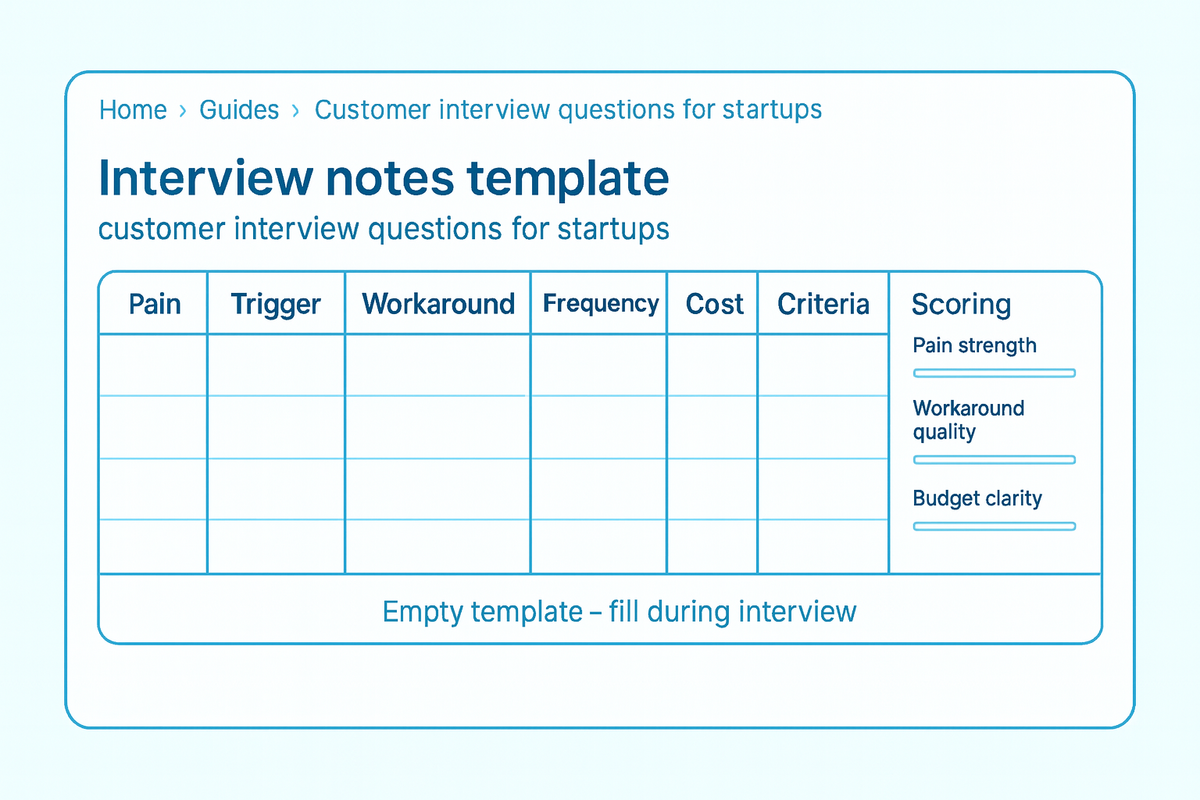
Instead, run an operational audit of their past behavior. Your goal is to uncover whether they have already spent time and capital trying to fix this problem over the last twelve months. You can organize these interviews using our B2B customer discovery canvas.
To keep interviews objective and avoid leading questions, follow user research principles like the Nielsen Norman Group guide on user interviews.
Effective questions anchor the buyer to concrete events:
“Walk me through the last time your team handled this task manually.”
“What tools or spreadsheets did you stitch together to get through it?”
“How many work hours did that take, and who got pulled away from other work?”
“Did you evaluate third-party tools to automate this last quarter? Why did you pass on them?”
“Do you have an allocated software or consulting budget to eliminate this friction this fiscal year?”
As outlined in Y Combinator's library guide on customer interviews, talking to users means digging into their actual lives rather than defending your vision. If a prospect has not actively searched for a workaround, paid an agency, or complained internally about the problem, the pain is rarely severe enough to support an early-stage B2B contract.
Test: Interview buyers about past workflow friction and current budgets without pitching your product.
Evidence to collect: Documented manual workarounds, spreadsheets in active use, hours lost per week, and existing budget lines allocated to the problem.
What it means: If the buyer has spent money or built complex workarounds, the problem is active. If they have never tried to solve it, the pain is weak evidence of commercial demand.
Next move: If active pain and budget exist, advance to Stage 2. If the problem is occasional or tolerated without effort, revise your customer profile or pause.
Stage 2: Workflow Artifacts (Clickable Mockups and Data Access)
Once you confirm the problem exists, build a visual workflow mockup using design tools like Figma. Keep the scope tight. Show only the input data, the transformation mechanic, and the finished report or operational output.
When showing mockups to buyers, avoid asking if they like the user interface.
Use the mockup to request access to their live operating environment:
“To verify that this workflow handles your edge cases, I need to test this screen against a sample of your live data. Can you share a redacted CSV export from your billing system by Thursday?”
“This screen assumes your account reps update their status notes daily. Can we spend 20 minutes observing your team's Tuesday morning pipeline review?”
A prospect who compliments your design but refuses to spend five minutes downloading a sanitized CSV is giving you polite brush-off feedback. A prospect who emails you a proprietary, messy data export has crossed the line from curiosity to operational commitment. Our framework for startup demand validation methods tracks this climb up the ladder of customer commitment.
Test: Present a click-through prototype of the core transformation and ask for operational access or live sample files.
Evidence to collect: Redacted data exports, internal process documents, or permission to observe a live team workflow.
What it means: Willingness to share confidential or messy internal data indicates serious intent. Complimenting the screens while refusing to share files is weak evidence.
Next move: If the prospect provides data or team access, proceed to Stage 3. If they withhold files after repeated requests, revise the mockups or pause the opportunity.
Stage 3: Manual Concierge Delivery
Avoid writing software to automate a workflow you have not completed manually.
In the concierge stage, you deliver the promised software outcome by hand behind the scenes. If your concept promises to reconcile disputed freight invoices, ask the buyer to email you their raw carrier bills. Run the data through Python scripts, manual spreadsheets, and database lookups on your own laptop. Deliver the audited discrepancy report to their inbox the next morning.
Delivering the value by hand teaches you critical operational details:
You discover the edge cases that would break automated code.
You see whether the client actually opens, reads, and acts on your final output.
You learn how much manual effort is required to produce the result, which establishes your baseline unit economics.
Before writing production software, check your scope against our B2B minimum viable product checklist to keep manual service operations distinct from your core software architecture.
Test: Deliver the promised software outcome manually using spreadsheets, scripts, or manual workflows behind the scenes.
Evidence to collect: Direct customer action on your deliverable, turnaround feedback, and time required to produce the result.
What it means: If the customer incorporates your manual deliverable into daily operations, the value proposition is proven. If they ignore the report, automation will not fix the lack of utility.
Next move: If the client actively relies on your manual deliverable, move to Stage 4. If they do not use the output, revise the core deliverable or pause development.
Stage 4: Commercial Pre-Commitment
The final stage is securing commercial intent before writing production code. Many founders delay asking for money because they feel uncomfortable charging for an unbuilt product.
Consider the buyer's perspective: building this solution internally would cost tens of thousands of dollars in engineering salaries and months of management overhead. Offering an early deployment partner seat provides a tailored solution at a small fraction of internal development costs.
Secure this commitment through one of three mechanisms:
A paid pilot agreement: The customer pays an upfront setup fee to participate in an invite-only alpha cohort.
A refundable deposit: The buyer places a deposit into escrow, held against defined product delivery milestones.
A structured Letter of Intent (LOI): A formal document outlining technical requirements, pricing tiers, and pilot terms. If you hit the agreed milestones, the customer agrees to execute an annual contract. Have corporate counsel review the non-binding terms before signing.
For tactical language on framing pre-build contracts, read our guide on how to presell startup software.
Test: Ask the prospect to sign a Letter of Intent, place a refundable deposit, or fund an alpha pilot before you write production code.
Evidence to collect: A signed LOI with pricing terms, a deposit transaction, or a paid pilot purchase order.
What it means: Willingness to pay or sign formal terms demonstrates genuine demand. Reluctance to commit funds or formal terms is weak evidence of commercial intent.
Next move: If you secure commercial commitments, begin building your scoped MVP. If prospects praise the tool but refuse to commit budget, revise the offer structure or pause.
The Concept Validation Decision Matrix
Use this matrix to match your validation stage with founder effort and objective evidence criteria. The decision thresholds below represent practical working benchmarks for this framework rather than rigid industry laws.
Test Method | Evidence Type | Founder Effort | Decision Threshold |
|---|---|---|---|
Problem Interview | Documented past workarounds, historic budget allocations, and named operational owners. | Low (calendar outreach, interview time, notes analysis). | Continue: Prospect demonstrates active budget spend or heavy manual hours lost. Revise: Prospect reports pain but has no budget or authority. Pause: Prospect has never actively looked for an alternative tool. |
Workflow Mockup | Exchange of confidential workflow files, live operational data, or team calendar access. | Medium (Figma wireframes, click-through prototyping). | Continue: Prospect sends sample data or introduces the operational team. Revise: Prospect likes the concept but gets confused by the workflow screens. Pause: Prospect praises design but refuses to share files or time. |
Manual Concierge | Repeated reliance on manually delivered outputs and operational workflow adoption. | High (manual spreadsheet crunching, custom scripts, white-glove delivery). | Continue: Customer acts directly on manual findings to run operations. Revise: Customer requests different formatting or modified reporting metrics. Pause: Customer ignores manual deliverables or cancels review meetings. |
Letter of Intent | Refundable deposit, paid pilot contract, or signed commercial pre-commitment. | Medium (sales contract drafting, procurement review, executive closing). | Continue: Budget owner signs terms with clear milestone gates. Revise: Prospect wants commercial pilot but needs adjusted milestone terms. Pause: Prospect demands an unlimited free trial without commercial terms. |
Worked Example: B2B Environmental Compliance Software
To see how these stages work in practice, examine how an early-stage compliance startup validated its concept in the European supply chain market. Note that the metrics and outcomes below represent a composite illustrative walkthrough rather than generalized cross-industry benchmarks.
Before testing any software, the founder researched the broader market. It was a heavily regulated, rapidly changing, and fragmented industry. The obvious initial target was enterprise procurement at multinational corporations.
Initial plan (enterprise procurement): Yielded polite praise, nine-month buying cycles, and zero access to supplier data.
Pivoted customer profile (boutique sustainability consultants and green suppliers): Uncovered immediate operational pain, unbillable manual hours, and fast access to vendor CSV files.
The enterprise calls yielded high praise. Executives agreed that carbon reporting was critical for corporate sustainability goals. However, after three months of conversations, the founder had zero commitments. Enterprise procurement teams operated on nine-month review cycles, corporate security teams refused to grant API access to internal supplier databases, and no single executive held discretionary budget for uncertified software.
The founder pivoted the target customer hypothesis. Instead of chasing enterprise corporations, the founder targeted boutique environmental compliance consultants and green mid-market suppliers. In this regulated segment, buyers had urgent operational deadlines and fewer bureaucratic layers.
Interviews revealed immediate operational friction:
In this illustrative case, compliance consultants spent fourteen unbillable hours per client manually collecting and formatting supplier CSV files.
Corporate mandates were forcing mid-market suppliers to submit audited emissions reports to keep their vendor contracts.
The founder mapped existing alternatives across two operational dimensions: scope of compliance (full compliance suite versus focused data extraction) and platform integration (single-platform versus multi-platform integration):
Incumbent enterprise ERPs: Full compliance suites with multi-platform integration, but expensive, rigid, and slow to set up.
Spreadsheets and manual scripts: Focused data extraction across disparate files, but error-prone and time-consuming.
The proposed concept: Focused data extraction designed specifically for single-workflow suppliers, delivering fast setup without enterprise software overhead.
The founder built a four-screen Figma prototype showing an automated extraction pipeline for supplier emissions invoices. When presenting the mockup to five boutique consulting firms, the founder did not ask for UI feedback. The founder asked for their dirtiest client invoice batch.
In this illustrative walkthrough, four out of five consultants sent live, redacted client vendor ledgers within 48 hours.
The founder processed these invoices manually over the weekend using local Python scripts, returning audited summaries Monday morning. Two weeks later, two consulting firms signed commercial pilot agreements at $400 per month (used here as an illustrative example of early pricing), treating the service as an outsourced analyst team.
The founder had paying customers and confirmed demand before writing a line of production application code.
Evaluating Technical Edge Cases
During validation, prospects will inevitably ask for niche capabilities: “Can you also parse scanned German PDF manifests from legacy shipping carriers?”
Founders often drop everything to build these features, fearing they will lose the deal. Before writing code for an edge case, evaluate it through two practical questions:
Occurrence frequency: How many times per week does this edge case happen in normal operations?
Cost of failure: What happens when the workflow fails? Does it trigger an operational fine, or does someone spend two minutes fixing it manually in a spreadsheet?
If a request occurs rarely and carries a low failure cost, handle it manually or exclude it from early scope. Build automated code only for frequent issues that carry immediate financial or operational penalties.
Founder Sales Discipline: Closing the Discovery Call
A validation conversation is a sales call without a shipping product. The most dangerous outcome is polite ambivalence.
When a prospect says they need to think about it internally and discuss with the team, many founders thank them and hang up.
In founder sales, hearing that a prospect needs to think about it usually means the deal has stalled. If you let the meeting end there, the prospect will often ignore your follow-up emails, and you will misinterpret their polite words as market interest.
Do not end a validation call without securing one of three concrete gates:
A scheduled calendar milestone: “Let us look at schedules right now and book a 20-minute call next Thursday at 10 AM to review your team's feedback.”
An operational asset exchange: “To see if this works for your team, send me your last quarterly vendor export by Wednesday evening. I will run the audit manually and show you the gaps.”
A clear commercial qualification: “If we hit every security requirement and automate this manual step, do you have discretionary budget authority to sign a $500 monthly pilot this quarter, or does that require board approval?”
If a prospect refuses to put a follow-up meeting on the calendar or share a sample file, the conversation has reached a dead end. Accept that signal immediately. That response is far more useful than spending three months building software for an opportunity that will never close.
FAQ
Can I ask for payment before the product exists?
Yes. You are not deceiving the buyer when you are transparent about your roadmap. You are offering custom development and direct founder support at a fraction of what an enterprise would spend building the solution in-house. Treat early buyers like an alpha cohort; willingness to pay is the clearest proof of real demand.
How many discovery interviews are enough before moving to mockups?
Focus on pattern consistency rather than an arbitrary target. In this validation framework, hearing three to five consecutive prospects describe the identical operational bottleneck, unprompted workarounds, and existing budget spend serves as a practical qualitative heuristic rather than a statistically definitive sample size. Once those behavioral patterns repeat consistently, move to testing mockups.
What if outbound fails in a channel I do not know?
Outbound failure in a new channel usually reflects a lack of channel expertise, email deliverability hurdles, or poor targeting rather than a broken concept. Before abandoning an idea, test customer demand through channels with lower technical friction, such as warm peer introductions or direct industry networking.
What should I do if a champion loves the concept but procurement blocks early payment?
Trade for alternative operational currency. Ask for a formal Letter of Intent with milestone triggers, thirty days of access to direct reports for manual concierge testing, or warm introductions to mid-market peers who operate with faster purchasing cycles.